flowchart TB
    AM["<b>Anna Maria</b><br/>Westerinen<br/>1853"]
    PK["<b>Pekka</b><br/>Karhunen<br/>1848–1882"]
    KA["<b>Kalle</b><br/>Karhunen<br/>1874"]
    AN["<b>Anna</b><br/>Karhunen<br/>1878"]
    MO["<b>Moses</b><br/>Karhunen<br/>1879"]
    YR["<b>Yrjö</b><br/>Karhunen<br/>1881"]
    PT["<b>Petter</b><br/>Westerinen<br/>1890"]
    OL["<b>Olga</b><br/>Juvonen<br/>1880–1911"]
    AI["<b>Aina</b><br/>Juhontytär<br/>1881"]
    uAP(["m."])
    uKO(["m. 1899"])
    uMA(["m. 1902"])

    AM & PK --- uAP
    uAP --> KA & AN & MO & YR
    AM -.->|illegitimate| PT
    KA & OL --- uKO
    MO & AI --- uMA

    classDef male fill:#dae8fc,stroke:#6c8ebf,color:#000
    classDef female fill:#e1d5e7,stroke:#9673a6,color:#000
    classDef marr fill:#ffffff,stroke:#333,color:#000
    class AM,AN,OL,AI female
    class PK,PT,KA,MO,YR male
    class uAP,uKO,uMA marr
Petter Westerinen / Peter Peterson
A Life of Shadow and Soil
Foreword
About this book
This biography reconstructs the lives of the Peterson family through official documents—death certificates, land registers, church books, and census records. Because history often records tragedy more diligently than joy, this narrative focuses heavily on the hardships of pioneer life on the Canadian Shield. While the story that survives is a tragic one, it is also a testament to Sisu—the Finnish concept of enduring resilience. I invite you to read it as a record of the price paid by one family to plant roots in a new land.
It has been created strictly for private, non-commercial purposes and is intended solely for family and close friends. It is also far from done: several avenues of research remain, in particular information from the descendants of the people in this story. If you have any feedback on anything here—from the choices I’ve made to spelling mistakes—I would be glad to hear from you at eric@ericporter.ca.
A note on sharing
Because this document contains third-party archival materials used under the premise of private use, it is vital that this story remains within our private circle. The sources, quotes, and images may be subject to third-party copyright if distributed further, and friends and relatives receiving this may not be aware of these restrictions. Please do not post, upload, or share this document in any public forum or on social media.
Please be advised
This story contains detailed accounts of terminal illness, accidental death, and the loss of several young children. These events reflect the harsh reality of the 1910s–1930s in remote Northern Ontario, where the mortality rate was significantly higher than in urban centres.
Characters
In order to tell Peter’s story, we need to include everyone who played a large role in his life. He was well connected to his family and community, and so there are a lot of characters to keep track of.
Without spoiling the story, here is the family who migrated to Canada with him:
- Kalle and Moses: his brothers. Kalle is pronounced Call-eh; also known as Carl or Charles.
- Aino: Moses’ wife. Also called Aina.
- Sulo, Reino, Mirjam: Moses’ two sons and one daughter. Mirjam is pronounced the same as Miriam.
- Lauri: Kalle’s son
- Anna Maria Peterson: his mother
- Anna Maria Johnson: Aino’s mother
At the end of each section, I added a family tree of the characters with the names used in that part. Blue indicates male and pink female; grey indicates they were not in that part, and are only there to help show the relationships.
WARNING: you will spoil events of the story if you skip ahead to the family trees. If there was no spoiler and enough room, I put the family tree on the same page as the story.
I encourage you to take a break between sections and try to make sure you remember each character before moving on to the next section.
Prologue
The Fires of Midsummer
In the Finland of 1889, Midsummer meant fire.
On the eve of St. John’s Day—juhannus, the longest day of the year—the kokko (bonfire) was lit on high ground above the water, built large enough to be seen across the lake. In central Finland, where Karttula lay scattered among its forests and dark chains of lakes, this was the one night the year seemed to hold its breath. Farm labourers who spent their days bent over other men’s fields gathered from the outlying crofts and estates, drawn by the fire, the dancing, and the particular licence the night allowed. The sky stayed gold until nearly midnight and then barely darkened at all—this far north, true night never came—and in that long, luminous dusk the rules that governed the rest of the year loosened their hold.1
Anna Maria Westerinen was thirty-six that summer. She had been a widow for seven years, a loinen (landless lodger) on another family’s farm since the bankruptcy that stripped everything the year her husband died. She had four children who carried the Karhunen name. She herself still carried the Westerinen name, though it meant something other than it once had—no longer the wife of a shopkeeper with silver in the house, but a woman working land that would never be hers.
The young man was nineteen. Like the son he would never name, he had been left fatherless young—his own father, a Karttula farmer, had died when the boy was twelve, the year before Anna Maria buried her husband.
What passed between them that summer the church books do not record. Whether they had known each other long or met only that night, whether it was tenderness or loneliness or something with no name at all—none of it survives. The record preserves only what followed: a child who would arrive the next February, in the dead of a Finnish winter and weeks before his time, fighting for his first breath before a hurried baptism could be said over him.
I. Karttula: The Baptism of Uncertainty
To understand the Peterson family, you must first understand Sisu. It is a Finnish word that has no direct translation in English. While it is often approximated as “guts” or “grit,” Sisu implies something far deeper and more primal. It is a white-knuckled form of courage that manifests only when all hope is seemingly lost2. It is the decision to take one more breath and keep moving when the body and mind scream to stop. For Petter Westerinen, Sisu was not just a cultural trait; it was a survival mechanism required from his very first moment on earth.
Petter Westerinen (or Vesterinen) was born on February 13, 1890, in Karttula, Kuopio, Finland. He was given an emergency baptism immediately following his birth3. A baptism before death was held to be necessary—washing away Original Sin, securing the child’s place in heaven—and an emergency baptism was performed only when there was real fear for a newborn’s life.
This struggle was his introduction to the world. It was not an easy beginning for Petter or for his mother, Anna Maria Westerinen, who had lost her husband eight years before4. Petter was given his mother’s surname, Westerinen, a tradition for children born out of wedlock.
Her late husband was also named Petter, and it was a poignant custom for widows to honour a deceased spouse by bestowing his name upon a later child. During the elder Petter’s life, the family had enjoyed a prosperity rare for the region; he was a country shopkeeper who owned gold, silver, and boats, affording Anna Maria a life of relative comfort. During the last year of his life, a debilitating illness made it impossible for him to maintain the business. The financial collapse was total; the family was forced to declare bankruptcy and lost everything just ten days before he died5. In the wake of his death, the family suffered a harsh social descent, sliding from the propertied class to the status of loinen6,7.
Petter was born into this reality of landless farm labour eight years after his youngest brother Yrjö was born. Kalle was his oldest brother, followed by his sister Anna, and then his brother Moses. They were all born with the Karhunen name except for Petter8. Perhaps out of love for their mother, they treated Petter as one of their own and they would accomplish many things together.
Petter grew up in the unchanging rhythm of a Finnish farm, where a family lived, toiled, and raised its children on land it would never own. The other constant was the Lutheran Church. The Church kept excellent records, and so every year of Petter’s life was recorded in the church records from birth until emigration.
From 1902 to 1910, the brothers left Karttula one by one, moving south-east across the country to the region of Ruokolahti, where they found new work on a different farm. Moses was the first to go—married to Aino in October 1902, he had settled in Ruokolahti by 19059—followed by Yrjö, and then Petter in 191010,11. Kalle joined them as well12, and the four brothers remained together in Ruokolahti for a time, likely supporting one another as they worked and planned their futures. What finally set them looking abroad the record doesn’t say—but in a land where the work passed down and the title never did, the pull of acres they could call their own needs little explanation. They would carry their Sisu across an ocean to meet a great adversary—and to win land of their own.
Family Tree
timeline
    title Karttula & Ruokolahti
    1882 : Father Petter Karhunen dies; family bankruptcy
    1890 : Petter Westerinen born
    1899 : Kalle marries Olga
    1902 : Moses marries Aino
    1905 : Moses and Aino settled in Ruokolahti
    1910 : Petter moves to Ruokolahti
II. The Call of the Canadian Shield
Content Warning: Terminal Illness and Death
Waiting for them across the ocean was the Canadian Shield. To those who haven’t stood on it, the Shield is a vast collar of Precambrian rock wrapping around Hudson Bay. But to the settler, it is an ancient, unforgiving beast. Scraped clean by glaciers eons ago, it is a landscape of jagged granite, black water, and deceptively thin soil13,14. It is a place of breathtaking beauty that demands a high price for survival. It does not give life easily; it must be wrestled from the stone. This was the landscape waiting for the Finns.
The opportunity for Finnish immigration was set in motion years earlier, in 1868, when the Legislative Assembly of Ontario passed The Free Grants and Homesteads Act15. The Act as passed offered a settler of eighteen a free 100 acres—200 to the head of a family—in the townships the Crown opened for settlement, earned by clearing and cultivating the land, building a habitable house, and living on it. Over the following decades the scheme was carried across the districts of the north, and by the time the advertisements reached Finland the free grant in the Thunder Bay country stood at 160 acres16. The rugged terrain of the Canadian Shield in the Thunder Bay17 area proved to be a natural and immediate fit for the Finns, who centred their community there. They saw this homesteading program as a test of the national grit, of Sisu itself—a test made for a farming culture already accustomed to working in the hard conditions of the North.
Rail lines and shipping companies advertised the program everywhere they could; these are the kinds of advertisements Petter and his family would have seen.
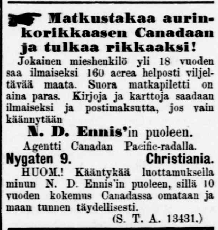
A Canadian Pacific Railway agent from Christiania (now Oslo) posted this enticing advertisement to Finns:
Travel to sun-rich Canada and become rich! Every male person over 18 years receives for free 160 acres of easily cultivable land.18
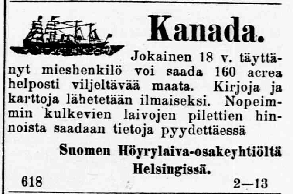
The Finland Steamship Limited Company posted a slightly more restrained advertisement:
Canada. Every male person who has turned 18 years old can receive 160 acres of easily cultivable land.19
While the program was popular, some Finns were skeptical. Governments warned of dishonest solicitations—one German warning was reprinted in the Finnish press—and anyone familiar with Thunder Bay will know that they were right to be skeptical. The real swindler was the Shield itself, a landscape of rock and unforgiving cold. But the Finns, armed with Sisu, marched willingly to meet it.
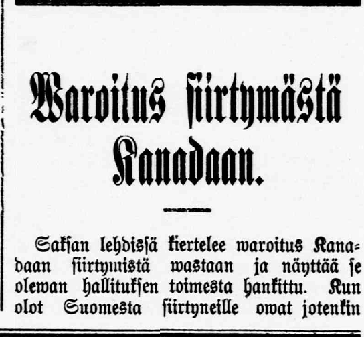
This article, “Warning against migrating to Canada,” was a Finnish reprint of a German government warning. The article goes on to call the Canadian Government, the Canadian Pacific Railway (CPR), and the English Steamship Lines ringleaders of the dishonest solicitation of 160 acres of free land20.
Moses’ Voyage: The Scouts
Moses jumped on the opportunity. On April 25, 1910, the whole household—Moses, his wife Aino, her mother Anna Maria Johnson, and the children Sulo, Reino, and Mirjam—took out passports together, planning to set out at once21,22. In the end only Moses departed on schedule. Likely due to Anna Maria experiencing early stages of an illness that would soon fall upon her, the rest of the family delayed their journey until later that year.
On April 27, only two days after receiving his passport, Moses boarded the Titania from Hanko, Finland, to the UK23. He arrived in Hull and on May 7 he departed from Glasgow on the Pretorian to Canada24. On May 16, he arrived in Quebec City and then rode the Canadian Pacific Railway to Port Arthur25.
In Port Arthur, Moses’ first task was to find a place to live and a way to earn. The land would feed a family but pay no wages, and on his manifest Moses had named his intended Canadian occupation not as a farmer but as a railway labourer26—the cash-paying foothold that drew so many Finns to the Lakehead before they could prove up a homestead.
The place to live all but chose itself. A few blocks up from the harbour, Finnish Port Arthur crowded into the streets remembered as the Finlandia neighbourhood27—Bay, Foley, Secord, Machar—frame rooming houses that boarded the single men of the rail gangs, Finnish bakeries and saunas and, soon, a Finnish co-operative store: a place where a newcomer could rent a room, buy his bread, and be hired out, all without a word of English28. At its centre, two months old when Moses stepped off the train, stood the Finnish Labour Temple at 314 Bay Street—the “Big Finn Hall,” opened that March with three days of ceremonies—with Työkansa, the newspaper of the Finnish socialists, printing in its basement29. Somewhere in these blocks Moses took rooms ahead of his family’s crossing; by the time the record next catches the household, its address was a rented house at 335 Foley Street30, in the heart of Finlandia.
On August 3, Aino, her mother, and the three children boarded the Titania out of Hanko31; on August 12, the Empress of Britain out of Glasgow32; on August 18 they reached Quebec City and rode the Canadian Pacific Railway to Port Arthur33.
Reunited, the family settled into their rented rooms in Port Arthur while Moses turned to his main objective: securing land of their own. This was not something a newcomer could claim on arrival. The Crown kept two doors open to an actual settler—the free-grant location ticket, the permit that made a settler a locatee, the tenant-in-waiting of a parcel he could one day own, or an outright purchase at settler’s prices, carrying the same demand for labour—and either way a man had to establish himself first: find paid work, learn the lay of the country, and scout the ground worth committing years of labour to. So while the homestead was always the goal, it lay a couple of years off; for now, Moses laboured and searched.
In May 1911, as the spring thaw softened a country the family had barely gained a foothold in, Aino was pregnant with the family’s first Canadian-born child34. In the same season, a shadow fell over the household: the death registration would later record her mother, Anna Maria Johnson, as suffering six months of stomach cancer35—placing its onset around this spring.
Just as Aino’s body began to nurture the family’s future, her mother’s body began to fail. If this was the same illness that had delayed the family’s voyage a year before, it had now turned grave.
Family Tree
flowchart TB
    AMJ["<b>Anna Maria</b><br/>Johansson / Johnson<br/>1842"]
    AI["<b>Aina / Aino</b><br/>Karhunen<br/>1881"]
    MO["<b>Moses</b><br/>Karhunen<br/>1879"]
    SU["<b>Sulo</b><br/>Karhunen<br/>1905"]
    RE["<b>Reino</b><br/>Karhunen<br/>1907"]
    MI["<b>Mirjam</b><br/>Karhunen<br/>1909"]
    uAM(["m. 1902"])
    cAJ(( ))

    AMJ --- cAJ --> AI
    AI & MO --- uAM
    uAM --> SU & RE & MI

    classDef male fill:#dae8fc,stroke:#6c8ebf,color:#000
    classDef female fill:#e1d5e7,stroke:#9673a6,color:#000
    classDef marr fill:#ffffff,stroke:#333,color:#000
    classDef conn fill:#bbbbbb,stroke:#bbbbbb,color:#bbbbbb
    class AMJ,AI,MI female
    class MO,SU,RE male
    class uAM marr
    class cAJ conn
timeline
    title Moses' Voyage, 1910
    April : Passports issued in Finland : Moses sails from Hanko on the Titania
    May : Moses arrives in Quebec : Travels on to Port Arthur
    August : Aino, her mother, and children sail and arrive
Petter’s Voyage: The Reinforcement
By the summer of 1911, the Canadian experiment needed more than a pioneer; it needed hands. Moses had broken the ground, and it fell to the youngest of the brothers to follow. At twenty-one, Petter crossed not as a dreamer chasing free land but as a reinforcement called up to steady a position already under strain—and he crossed alone. He boarded the Titania from Hanko to the UK on June 21, 191136; the Tunisian from Liverpool to Canada on June 3037; and on July 9 he arrived in Quebec and rode the Canadian Pacific Railway west to Port Arthur to meet his brother38. The records barely caught him at all: the UK leaving list enters the young labourer as Spin[ster], female—reducing the family’s newest worker to a slip of the pen before he had even landed39.
The town that received him was fresh from a holiday. On the first of July, days before Petter’s train pulled in, the Finnish socialists of Port Arthur had marched four hundred strong from the Labour Temple behind their brass band for Dominion Day—an afternoon of field sports and children’s races with books for prizes, and an evening of speeches, choir, and a play that ran on toward one in the morning40. And the movement was still assembling itself: that October, the Finnish socialist locals across the country would federate as the Finnish Socialist Organization of Canada41. The man and the movement arrived in the same season.
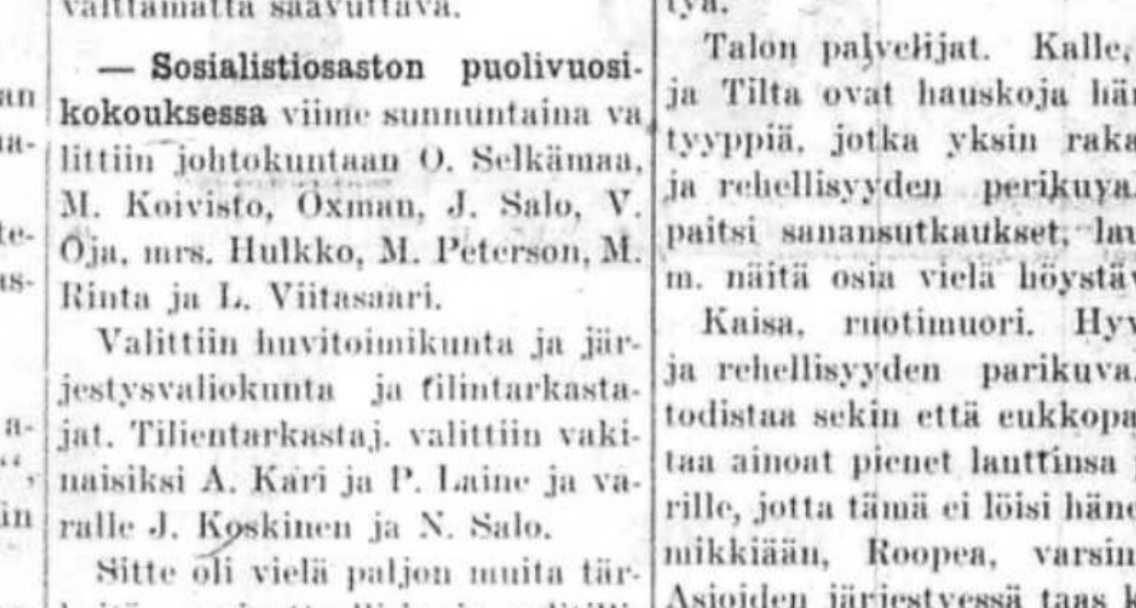
This Työkansa city column of July 4, 1911, reporting the Port Arthur socialist local’s semi-annual meeting held the preceding Sunday, lists an “M. Peterson” among the nine members elected to the local’s executive board (johtokunta), alongside O. Selkämaa, M. Koivisto, Oxman, J. Salo, V. Oja, Mrs. Hulkko, M. Rinta, and L. Viitasaari42.
The initial alone cannot prove this was Moses—Peterson was among the commonest Finnish surnames at the Lakehead—but the identification gains weight from later print: “M. Peterson, A. Peterson” side by side on the local’s July 1912 dues list43, and “Peterson, Mooses” on the Finnish socialists’ municipal voters’ roll of January 191344.
If Petter crossed expecting to join a thriving settlement, what greeted him instead was a home heavy with contradiction. He arrived in the Finlandia neighbourhood, the Finnish heart of Port Arthur, where the family had taken rooms on Foley Street. His sister-in-law Aino met him visibly pregnant with the family’s first Canadian-born child, while her mother, Anna Maria Johnson, was visibly fading from stomach cancer. The household Petter had been called to reinforce was keeping two opposite vigils at once—one for a coming birth, one for an approaching death. He took his own room nearby, likely in a boarding house—the one Port Arthur address later recorded for him is 28 Centre Street45, on a short Finnish commercial street where Wm. Blomqvist’s Finnish bakery stood two doors down at No. 3046—and bent to the work he had come for. Where Moses had declared himself a railway labourer on his way to the rail-built Lakehead, Petter’s manifest named only a plain labourer47—a fitting distinction, for he had been summoned to his brother’s homestead rather than the rail line, and labour was the plainest thing the family needed.
The cycle of life and death turned rapidly that autumn. On October 23, 1911, in the rented house at 335 Foley Street, Aino gave birth to a son, Urho Olavi48. What his arrival brought to those rooms was never set down—but joy and grief must have been hard to tell apart.
Anna Maria outlived the birth by only two weeks. On November 8, after two months of medical care, she died of heart failure at 349 Foley Street49, a few doors up the street—the house recorded in later years as her son Victor’s address. The next day the Labour Temple opened its three-day autumn bazaar, free coffee and brass-band dances every night50; the neighbourhood’s noise carried on around a house in mourning. The infant Urho had arrived just in time to replace the matriarch. But as the family would soon discover, the Shield was not yet satisfied with the exchange.
Family Tree
flowchart TB
    AMW["<b>Anna Maria</b><br/>Westerinen<br/>1853"]
    AMJ["<b>Anna Maria</b><br/>Johnson<br/>1842–1911"]
    PT["<b>Petter / Pekka</b><br/>Karhunen / Westerinen<br/>1890"]
    AI["<b>Aino</b><br/>Peterson<br/>1881"]
    MO["<b>Moses</b><br/>Peterson<br/>1879"]
    UO["<b>Urho Olavi</b><br/>Peterson<br/>1911"]
    SRM["Sulo, Reino, Mirjam"]
    uAM(["m. 1902"])
    cW(( ))
    cJ(( ))

    AMW --- cW --> PT
    AMJ --- cJ --> AI
    AI & MO --- uAM
    uAM --> UO & SRM

    classDef male fill:#dae8fc,stroke:#6c8ebf,color:#000
    classDef female fill:#e1d5e7,stroke:#9673a6,color:#000
    classDef ctx fill:#f5f5f5,stroke:#999,color:#333
    classDef marr fill:#ffffff,stroke:#333,color:#000
    classDef conn fill:#bbbbbb,stroke:#bbbbbb,color:#bbbbbb
    class AMJ,AI female
    class PT,MO,UO male
    class AMW,SRM ctx
    class uAM marr
    class cW,cJ conn
timeline
    title Petter's Voyage, 1911
    June : Petter sails from Hanko on the Titania
    July : Arrives in Quebec : Reaches Port Arthur
    October : Urho Olavi born
    November : Anna Maria Johnson dies
Kalle’s Voyage: The Rear Guard
Having buried his first wife, Olga, in Finland just a year prior, Kalle gathered the remaining pieces of the family for the crossing. But this was not a journey of desperation; it was a journey of reunification.
From where Kalle stood, the “Canadian experiment” was working. His brother Moses had gone ahead to break ground, and Petter had arrived to assist. Most promising of all was the news from across the ocean: Moses and Aino had a healthy son, Urho, nearly a year old—and, though no letter could yet have carried it, another child was already on the way. To the family back in Finland, the news likely signalled that the Karhunen bloodline was successfully taking root in the new world.
On July 31, 1912, he boarded the Arcturus with his mother Anna Maria, son Lauri, and Petter’s intended, Hilda, from Hanko, Finland51.
They arrived in Hull, UK, and on August 4 boarded the Royal George from Bristol to Canada52. On August 14, they arrived in Quebec City. But before they could get off the ship Anna and Hilda were detained53.
While Kalle, as an able-bodied man, and his son, Lauri, were cleared to enter, Anna and Hilda needed to be sponsored by a resident to immigrate. Petter would be able to sponsor his mother Anna; for Hilda, his intended, it was enough for the family to come forward and vouch that she would not become a public charge. The manifest bears this out, recording the two women released to join the brother already settled at Port Arthur, with Hilda still entered as Miss, spinster, domestic. No wedding was required to free her, and none is recorded; Peter and Hilda would live as husband and wife in the manner of their Red Finn community, without a certificate to mark it54. From Quebec, they rode the Canadian Northern Railway to Port Arthur to meet Moses55.
The twin cities they were riding toward were in the last hours of a strike. Through late July and early August the Canadian Northern’s coal-dock and freight men had fought the company across Port Arthur and Fort William—in Fort William it had turned bloody, a striker shot dead and the mayor calling in the militia56—and on the very day the Royal George docked at Quebec, Työkansa’s front page declared the freight-handlers’ complete victory57. The Rear Guard rode the struck company’s own rails into a Finntown of mass meetings, benefit dances, and brass-band parades whose parlour was the Labour Temple on Bay Street—the world Moses and Aino had been living in for two years and, by every sign, belonged to. Three weeks before the crossing, the Port Arthur local’s printed dues roll had carried “M. Peterson, A. Peterson” side by side among the members reminded to pay up or be struck from the rolls—husband and wife enrolled together in Finlandia’s socialist local, and, like much of its rank and file that summer, behind on their dues58.
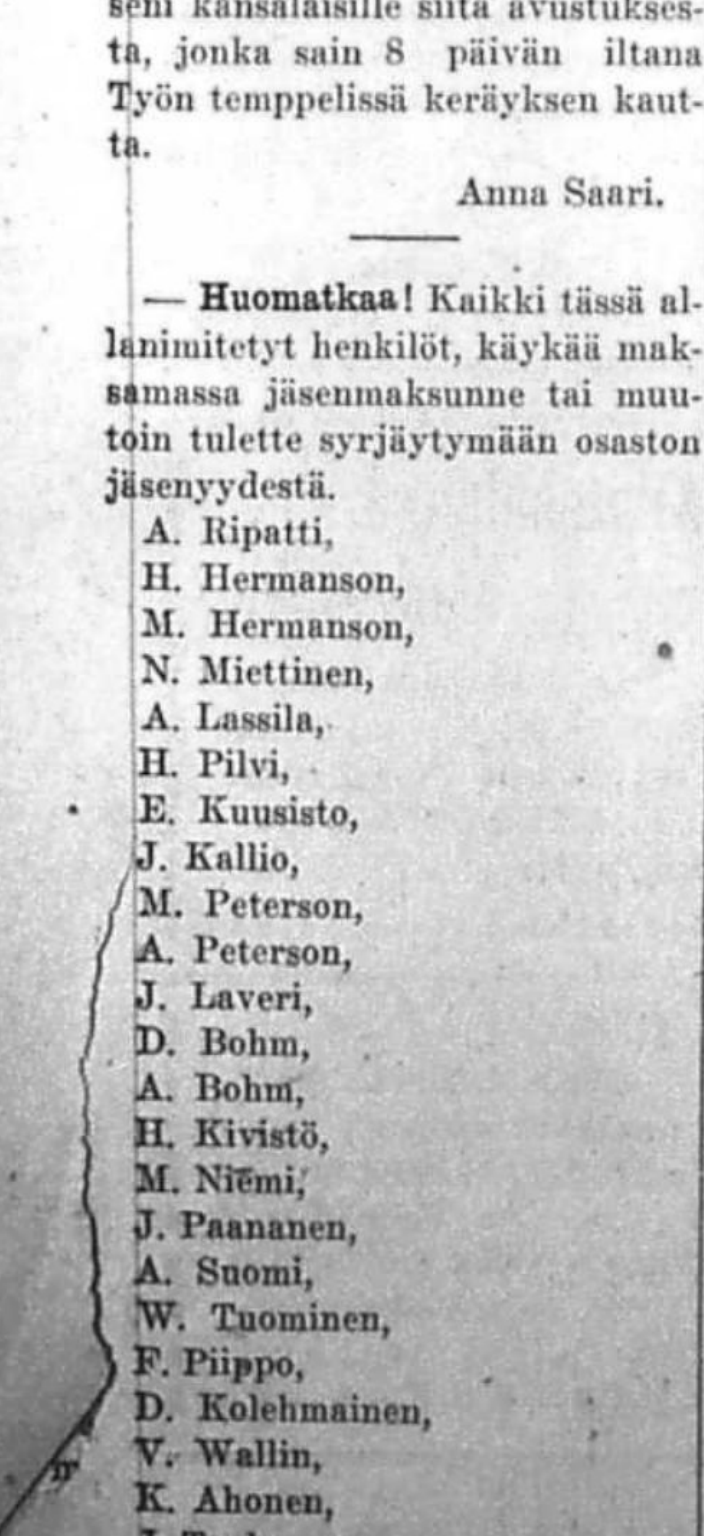
This Työkansa notice of July 10, 1912, prints the Port Arthur socialist local’s list of members in arrears—about twenty-five names, “M. Peterson, A. Peterson” consecutive among them—warning that everyone listed must pay their dues “or you will otherwise be dropped from the local’s membership” (tai muutoin tulette syrjäytymään osaston jäsenyydestä)59.
The initials are the caveat; the husband-and-wife adjacency, the 1911 board election, and the January 1913 voters’ roll entry “Peterson, Mooses” together make the identification strong.
With the immigration hurdle cleared, the deployment was complete: the Scouts had gone ahead in 1910, the Reinforcement had followed in 1911, and now, in 1912, the Rear Guard had landed—the whole crossing accomplished in three staggered waves. The family turned their focus entirely to the land—and to the years of unrelenting labour that securing it would demand. Embracing a new identity along with their new country, they all became the Petersons60, and Petter Westerinen became Peter Peterson.
Family Tree
flowchart TB
    AMW["<b>Anna Maria</b><br/>Westerinen<br/>1853"]
    PE["<b>Peter</b><br/>Peterson<br/>1890"]
    HI["<b>Hilda Maria</b><br/>Ranta<br/>1893"]
    OL["<b>Olga</b><br/>Juvonen<br/>1880–1911"]
    KA["<b>Kalle</b><br/>Karhunen / Peterson<br/>1874"]
    AI["<b>Aino</b><br/>Peterson<br/>1881"]
    MO["<b>Moses</b><br/>Peterson<br/>1879"]
    LA["<b>Lauri</b><br/>Peterson<br/>1906"]
    UO["<b>Urho Olavi</b><br/>Peterson<br/>1911"]
    SRM["Sulo, Reino, Mirjam"]
    uPH(["c. 1912<br/>common-law"])
    uKO(["m. 1899"])
    uAM(["m. 1902"])
    cAW(( ))

    AMW --- cAW
    cAW --> PE & KA & MO
    PE & HI --- uPH
    OL & KA --- uKO
    AI & MO --- uAM
    uKO --> LA
    uAM --> UO & SRM

    classDef male fill:#dae8fc,stroke:#6c8ebf,color:#000
    classDef female fill:#e1d5e7,stroke:#9673a6,color:#000
    classDef ctx fill:#f5f5f5,stroke:#999,color:#333
    classDef marr fill:#ffffff,stroke:#333,color:#000
    classDef cohab fill:#ffffff,stroke:#333,stroke-dasharray:4 3,color:#000
    classDef conn fill:#bbbbbb,stroke:#bbbbbb,color:#bbbbbb
    class AMW,HI female
    class PE,KA,LA male
    class OL,AI,MO,UO,SRM ctx
    class uKO,uAM marr
    class uPH cohab
    class cAW conn
timeline
    title Kalle's Voyage, 1912
    July : Kalle, Anna Maria, Lauri, and Hilda sail from Hanko on the Arcturus
    August : Arrive in Quebec the day the freight-handlers' strike is won : Anna and Hilda detained, then released to the family : Family reaches Port Arthur
III. Land and Loss in Tarmola
Content Warning: Terminal Illness, Death, and Child Loss
Taking Root
The family established their homesteads in adjacent lots in the Tarmola settlement of Gorham Township, effectively surrounding themselves with kin. Peter and Hilda settled in Lot 6, Concession 4 to the north, while Moses, Aino, and the other Petersons moved into Lot 6, Concession 3 directly to the south. To the east of Peter, Aino’s brother Victor Johnson had also claimed a parcel, widening the family’s hold on the new land. The taking was not one journey but a long shifting of weight: for another year after the first papers were signed, the household kept its rented rooms in Finlandia while the men carried their labour out to the lots, and the family lived with a foot in each world.
In August 1912, Kalle arrived with the “Rear Guard,” completing the family unit. For a brief moment, the family must have felt invincible. The brothers were reunited, and the house was full of life. But the land they had come for would feed a family, not pay one; to secure the cash that tools and taxes would demand, Peter and Kalle joined the crews of the Onion Lake Log Drive61.
Aino was not only raising the toddler Urho, but she was also quietly carrying the future. Based on birth records, she would have been early in her pregnancy with her second Canadian-born child62. To Kalle, arriving from the old country, the scene must have looked like the ultimate proof of their success: a family not merely surviving the new world but growing in it.
Taking up this land was itself the fruit of their first years in Canada. Moses had landed in 1910 and Peter in 1911, and only after establishing themselves—earning wages, learning the land, and choosing their parcels—could they commit.
The commitment came within weeks. On September 11, four weeks after the Rear Guard landed, Moses signed with the Crown to buy the family’s first parcel outright—the north half of Lot 6, Concession 3, at fifty cents an acre63. The ground was theirs to break at last. The township they were buying into was already speaking for itself: the week Moses signed, the Ware and Gorham farmers named a delegation—Hendrik Hendrikson, Axel Johnson, and J. A. Koskinen among its Gorham men—to lay the district’s roads and schools before three Ontario cabinet ministers visiting Port Arthur64.
Then, on October 26, just three days after his first birthday, Moses and Aino’s son Urho died—three weeks of what the registration calls intestinal indigestion, four hours of heart failure at the end of it—at 335 Foley Street, in the house where he had been born65. Four days later the death stood in Työkansa’s Port Arthur column: on Saturday afternoon had died toveri—comrade—Moses Peterson’s son Urho Olavi, at his home66. The infant who had replaced the matriarch was gone. And Aino was left to grieve the son she had lost while carrying the son who would replace him.
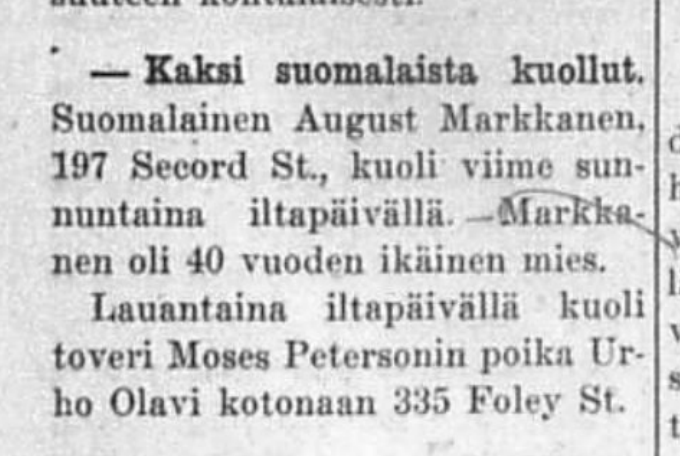
This Työkansa Port Arthur column of October 30, 1912, under the brief “Kaksi suomalaista kuollut” (Two Finns dead), reports: “Lauantaina iltapäivällä kuoli toveri Moses Petersonin poika Urho Olavi kotonaan 335 Foley St.”—“On Saturday afternoon died comrade Moses Peterson’s son Urho Olavi at his home, 335 Foley St.”67
This is the family’s first appearance in the Finnish press by name and address. Kotonaan—“at his home”—settles that 335 Foley Street was the family’s dwelling, and toveri is the movement’s word for a comrade of the socialist local.
The house did not hold them long after that. In the first days of January a classified in Työkansa offered the Foley Street rooms to let—“for a small family”—and the Petersons moved the few blocks to 265 Bay Street, onto the Labour Temple’s own street, into the thick of Finlandia’s shops and halls68. The same issue that carried their advertisement printed the Finnish socialists’ municipal voters’ roll, and there, under the Second Ward, stood “Peterson, Mooses”69: that week the movement counted him among its votes.
On March 19, 1913, at 265 Bay Street, Aino gave birth to Urho Mauno70. His birth was a defiant answer to the land that had taken his brother, but he was born into a house that now understood the precariousness of their tenure. Six weeks later, on the first of May, the largest May Day the twin cities had yet seen—some 1,500 workers of four nationalities—formed up at the Labour Temple on the family’s street and marched71.
The Bay Street household paid its way as Finlandia households did. Ten weeks after the birth the family’s own classified offered a room “for a tidy man”72; in June a masseuse newly landed from Finland received her clients at the same address73. From late autumn a standing advertisement ran daily for “Mrs. Peterson’s café” at 264 Bay Street—a storefront across the road—open nine in the morning to eleven at night, and very likely Aino’s74. Whichever way the rooms at 265 were divided, the household worked its end of Bay Street for its keep: roomers, trades, and coffee carrying a family whose men were more and more out of town.
What the men were doing out there reached the paper in the first week of August. A dam on the Current River had broken years before, and the city had left its timbers scattered along the banks of the country where the family’s lots waited. With the council’s permission, Moses and Victor Johnson salvaged six of them to frame a bridge the district’s settlers sorely needed. At half past twelve on Monday, August 4, 1913, police arrested the two men—“the Finnish homesteaders Moses Peterson and Victor Johnson,” as Työkansa named them—and took them in irons to Fort William over six salvaged timbers75. The paper’s account seethed: the city had never tended the wreck, the bridge would serve everyone, and this, it wrote, was “more than sisu can bear to think of.” Freed that same day, the men stood in court the next, and the case was thrown out76. The episode catches the family mid-stride—town householders in name, bush settlers in fact, building with their own hands the crossings the new country had not built for them.
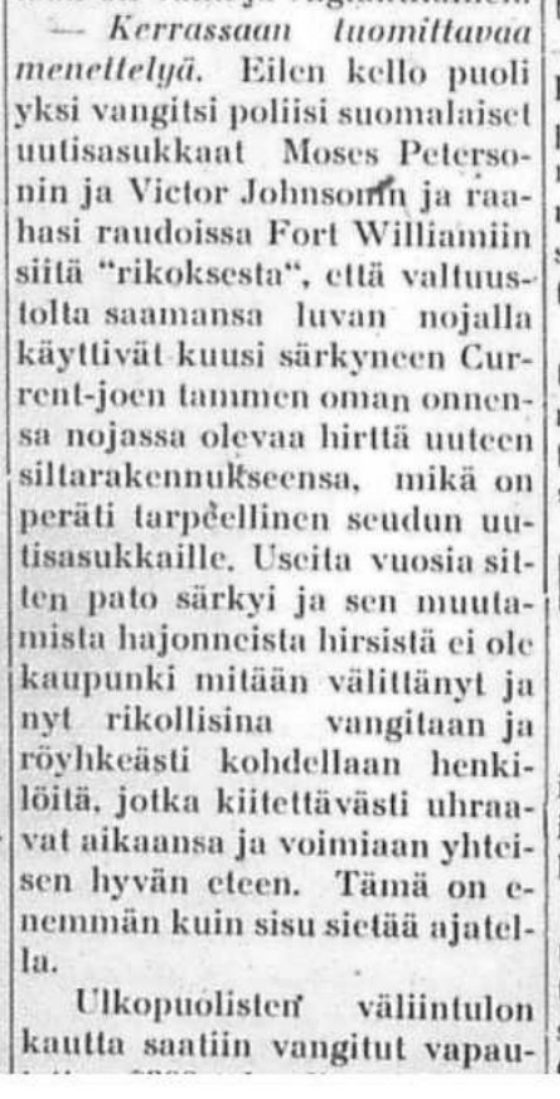
This Työkansa Port Arthur column of August 5, 1913, headed “Kerrassaan tuomittavaa menettelyä” (Utterly condemnable conduct), reports that at half past twelve the previous day police arrested “the Finnish homesteaders (uutisasukkaat) Moses Peterson and Victor Johnson” and hauled them in irons to Fort William for the “crime” of using, under a permit obtained from the council, six timbers of the broken Current River dam—left lying for years untended by the city—for a new bridge “sorely necessary to the district’s settlers.” The column closes: “Tämä on enemmän kuin sisu sietää ajatella”—“This is more than sisu can bear to think of”—and reports the men freed the same day through outside intervention77. The next day’s issue follows up under “Juttu kumottiin”—the case was quashed in court78.
This is the first document to put Moses and his brother-in-law Victor Johnson side by side, and the strongest confirmation that the press’s Moses Peterson is the family’s: the paper pairs the two names the family records pair. Uutisasukkaat—homesteaders—places both men working the Current River country by August 1913, sixteen months before the same river took Sulo.
That October the second door into the land opened: on the 8th, Peter was located as a free-grant settler on the south half of Lot 6, Concession 4—the tenant-in-waiting of Crown land he did not yet own79.
In order for the Crown land to become theirs in title, the land had to be proved—cleared and cultivated, a habitable house built, the family living on it; for Peter’s free grant the law set a three-year clock from the date of location before the patent could issue80. On the stubborn Shield that clock often ran longer.
On December 3, 1914, the ice of the Current River gave way. According to the Port Arthur Daily News, nine-year-old Sulo was skating with his sister Mirjam nine miles upriver, near the Paquette dam, when he stopped to test the ice—jumping on it where it had stretched from bank to bank—and broke through. Mirjam at once raised the alarm, but no rescue could be made; his body was recovered half an hour later81. For the family, the land had taken a second son’s life, and still the farm was not their own.
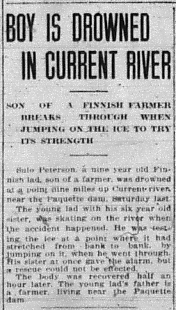
Sulo’s death notice from Port Arthur Daily News in 191482.
The land had a quieter weapon still. One year later, on November 25, 1915, the very water of the settlement turned against them. A typhoid outbreak struck the community, sending Moses to the hospital and forcing the settlement under a strict boil-water advisory83. Still recovering from the loss of a son, the family now feared for its patriarch.
This accumulation of tragedy and illness might have forced a retreat. Instead, their Sisu hardened; they buried their sorrow in the frozen soil and decided that the dream of independence was worth the terrible risk, committing fully to the homestead and the Tarmolan community.
To endure their harsh reality, the family turned to the sounds of their heritage. Aino, who was known to participate diligently in theatre activities, poured her energy into culture, playing the kantele (Finnish lap-harp) and directing plays for the community. Hilda stood by her side, assisting in these productions, while the boys found their own rhythm; Lauri and Reino played the violin or accordion to accompany the evening dances84. These gatherings were an act of defiance against the gloom, a way to keep the family’s spirit alive.
While Aino and the others lifted spirits with music, Moses turned his attention to the community’s future. On August 31, 1916, he sent out an invitation for a school meeting85, a commitment to education that reached beyond his own farm. Moses, perhaps physically slowed by his hospitalization for typhoid in late 1915, invested his remaining energy in the collective good, whereas Peter poured himself entirely into the soil.
On November 15, 1916, Peter met the requirements and received his land patent86. For the first time, the title, and not only the work, would pass down. The victory also marked a difference between the brothers: while Moses toiled under illness and the loss of a child, Peter—eleven years younger, still childless—worked with a heart the land had not yet broken.
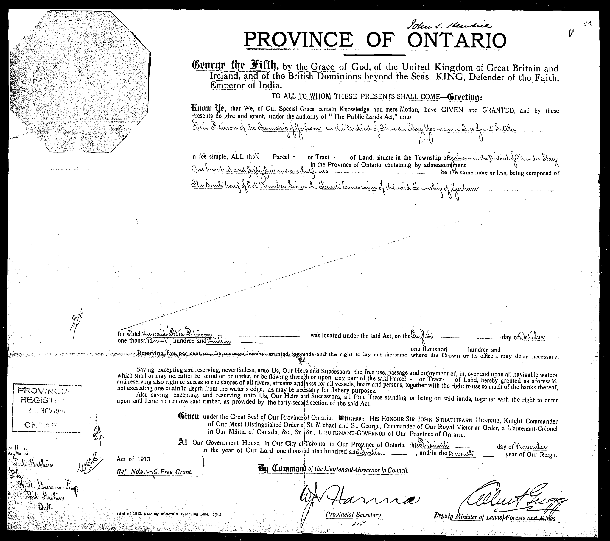
The patent certificate Peter received in 191687. It grants Peter Peterson of Gorham, yeoman, “a Free Grant Settler,” the south half of Lot 6, Concession 4—155½ acres “be the same more or less”—in fee simple under the authority of The Public Lands Act (the Act of 1913); recites that he was located on October 8, 1913; reserves five per cent of the acreage for roads and every pine tree to the Crown; and was signed at Toronto on November 15, 1916, and registered on November 22.
After Peter received his land, both brothers applied for loans under the Northern and North Western Ontario Development Act to fund improvements and livestock. The benefits were uneven; while Moses received $300 on February 10, 191788, Peter’s ownership status allowed him to secure a larger sum of $500 the following week89. Despite this gap in resources, their ambition remained aligned, and with funds in hand, both Peter and Moses turned their attention to additional land.
Peter’s first parcel had come to him as a Free Grant settler; Moses had bought his. For a second parcel there was an option called Allowance for Purchase, by which a settler could take a location ticket on neighbouring land and, if he met the conditions for developing it, buy it at a discounted price90. This is what Moses did, and at some point he acquired a neighbouring parcel as a locatee.
Peter’s route was different, and the registry preserves it only in outline. On July 13, 1917, his neighbour Ivor Wilgren located the north half of Lot 5 in the Fifth Concession as a Free Grant91. Three months later, on October 24, Peter transferred the entirety of his own farm to his wife Hilda for $80092. Side by side, the two entries point to a plan: the law allowed a patented settler another free grant only after he had “bona fide and absolutely parted with” his patented land93, and with the farm made over to Hilda, Peter’s name was clear to carry a location again. What the three of them agreed that summer was never set down, but its shape shows through the deeds—Wilgren to hold the location, Peter to work it, Hilda to keep the family’s title safe in the meantime.
Peter’s ambition, however, wasn’t limited to his own acreage. Around 1917, he donated a portion of his land to the community for the construction of a gathering place. The neighbours rallied around this donation, coming together to build what would become the Tarmola Hall. It was a modest structure, lit only by the warm glow of coal oil lamps94, but it stood as a monument to their collective independence. From farm servants in the old country to owners of the new, their Sisu had seemingly paid off, carving a life out of the rock.
The Reckoning
But the Canadian Shield had not yet finished its accounting; it was merely waiting for the bill to come due. The government’s promise of “free land” was an illusion, and in 1918, the debt was collected not in currency but in health. The Spanish Flu pandemic spread around the world95 and found the Peterson family.
In October 1918, the Spanish Flu breached the isolation of the Peterson homestead, carried into the Canadian Shield by the same railroads that had brought the family there96. It struck with terrifying specificity, bypassing the weak to hunt the strong; both Moses and his twelve-year-old nephew Lauri fell gravely ill. In a desperate bid for survival, they were transported to St. Joseph’s Hospital in Port Arthur, a facility already overwhelmed by the pandemic. What the record gives is stark enough: neither of them left it.
On October 20, Moses succumbed to pneumonia97, and the family lost its anchor. The tragedy was compounded just four days later when Lauri followed his uncle into the silence98, leaving Aino and Kalle to a grief as vast and hard as the land itself. Kalle now faced a fresh wave of tragedy, a blow similar to what his pioneering brother Moses had endured. Moses never lived to see the Crown land become his own. But more than that, he died intestate and left his wife Aino with a complicated estate99. And still there was no reprieve for Aino.
Before the grief for her husband could even settle, her son Urho Mauno was gone too. On April 10, 1919, after suffering from meningitis, he died at home in Gorham at the age of six.
Aino captured this loss in the obituary she prepared, where she included a poem of her own100:
I water your grave with tears
I have no other flowers.
Wait my dearest beloved
I want to come to you.
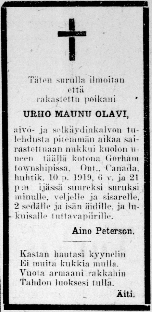
Hereby with sorrow I announce that my beloved son URHO MAUNU OLAVI, after suffering for a longer time from inflammation of the brain and spinal membranes [meningitis], slept into the sleep of death here at home in Gorham Township, Ont., Canada, on April 10, 1919, at the age of 6 years and 21 days, to the great sorrow of myself, [his] brother and sister, 2 uncles and father’s mother, and a numerous circle of acquaintances. Aino Peterson.
| Finnish (original) | English (translation) |
|---|---|
| Kastan hautasi kyynelin | I water your grave with tears |
| Ei muita kukkia mulla. | I have no other flowers. |
| Vuota armaani rakkahin | Wait, my dearest beloved |
| Tahdon luoksesi tulla. | I want to come to you. |
| Äiti. | Mother. |
The announcement spells his name Maunu, an older, more traditional form of Mauno—likely Aino’s deliberate choice for her son’s memorial. The civil records use Mauno (the death registration garbles it to Mano), and the narrative follows Mauno.
Aino was left on the farm with only her daughter Mirjam and son Reino.
Yet, the community gathered to help her bear the weight of this final blow. The day after he died, Urho Mauno was laid to rest in the Kivikoski Cemetery in a service described as “in all its modesty, solemn and touching.” Pastor J. Hirvi officiated, speaking words of comfort about the “hope of eternity” to a mother who had lost so much.
To deal with the overwhelming grief, Aino chose Hymn 157 for the service101. In the hymnal of her day that number belonged to Luther’s Varjele sanaas, Jumala—“Lord, keep us steadfast in Thy Word”—not a hymn of mourning but a prayer for holding fast102. The congregation sang the first verse and the last two, and the hymn closed at the graveside as a plea to the Comforter:
O Holy Spirit, comfort us,
and lead us into peace;
in anguish grant relief,
and even in death, revival.
Family Tree
flowchart TB
    AMP["<b>Anna Maria</b><br/>Peterson<br/>1853"]
    PE["<b>Peter</b><br/>Peterson<br/>1890"]
    HI["<b>Hilda Maria</b><br/>Ranta<br/>1893"]
    KA["<b>Kalle</b><br/>Peterson<br/>1874"]
    AI["<b>Aino</b><br/>Peterson<br/>1881"]
    MO["<b>Moses</b><br/>Peterson<br/>1879–1918"]
    LA["<b>Lauri</b><br/>Peterson<br/>1906–1918"]
    UO["<b>Urho Olavi</b><br/>Peterson<br/>1911–1912"]
    SU["<b>Sulo</b><br/>Peterson<br/>1905–1914"]
    UM["<b>Urho Mauno</b><br/>Peterson<br/>1913–1919"]
    RE["<b>Reino</b><br/>Peterson<br/>1907"]
    MI["<b>Mirjam</b><br/>Peterson<br/>1909"]
    uPH(["c. 1912<br/>common-law"])
    uAM(["m. 1902"])
    cAP(( ))
    cKL(( ))

    AMP --- cAP
    cAP --> PE & KA & MO
    PE & HI --- uPH
    AI & MO --- uAM
    KA --- cKL --> LA
    uAM --> UO & SU & UM & RE & MI

    classDef male fill:#dae8fc,stroke:#6c8ebf,color:#000
    classDef female fill:#e1d5e7,stroke:#9673a6,color:#000
    classDef marr fill:#ffffff,stroke:#333,color:#000
    classDef cohab fill:#ffffff,stroke:#333,stroke-dasharray:4 3,color:#000
    classDef conn fill:#bbbbbb,stroke:#bbbbbb,color:#bbbbbb
    class AMP,HI,AI,MI female
    class PE,KA,MO,LA,UO,SU,UM,RE male
    class uAM marr
    class uPH cohab
    class cAP,cKL conn
timeline
    title Land and Loss in Tarmola
    1912 : Kalle's family arrives : Moses buys his parcel from the Crown : Urho Olavi dies
    1913 : Family moves to 265 Bay Street : Urho Mauno born : Moses and Victor Johnson arrested at the Current River, case dismissed : Peter located on his free grant
    1914 : Sulo drowns in the Current River
    1915 : Typhoid outbreak; Moses hospitalized
    1916 : Peter receives his land patent
    1918 : Moses and Lauri die of Spanish flu
    1919 : Urho Mauno dies of meningitis
IV. Replanting
Content Warning: Terminal Illness, Death, and Child Loss
Moses died without having written a will. Settling the estate was a complicated procedure, but Aino was eventually appointed administratrix and took over her late husband’s parcels. In 1919 she completed the purchase Moses had begun in 1912—$86.50, the full fifty cents an acre for its 173 acres—and finally received the land patent103,104. The second parcel would remain unpatented for decades105.
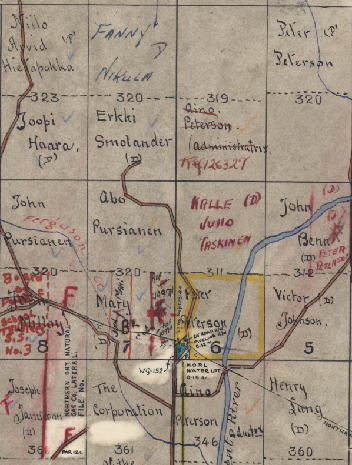
The Peterson lots in Gorham Township shown on the Phillips & Benner O.L.S. Survey done in 1940. The dangerous Current River is shown running through the middle of their lands106.
Her management of his affairs extended beyond the farm’s borders. On August 10, 1919, a petition was circulated to establish a formal school in Tarmola, and notably, Moses’ signature appears on the document107—nearly a year after his death. It was Aino who likely signed on behalf of his estate, ensuring his voice remained present in the community. He had been a champion for education during his life, and through Aino, his name continued to help build the institutions the settlement needed.
Maintaining this public continuity required securing the family’s survival. Holding the weight of the community’s future at the same time as running their homestead would have been an unimaginably heavy burden. This is where Kalle stepped in.
Aino’s words in her son’s obituary make it hard not to fear the family was at risk of losing her, too. On July 24, 1919, only nine months after her husband’s death, Aino married Kalle108. Homestead life made the union an immediate necessity; it reads, too, as an act of stewardship—Kalle preserving what remained of his brother’s family.
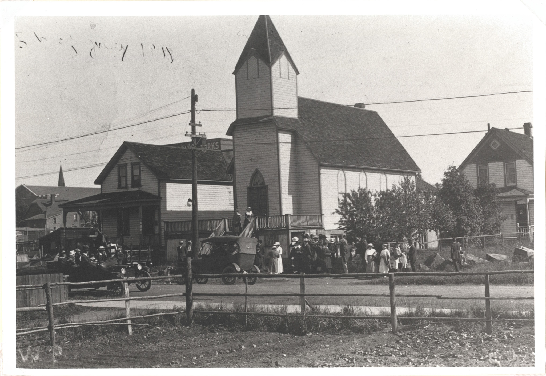
The National Evangelical Lutheran Church in Port Arthur109 hosted the Peterson weddings that left a record—Kalle and Aino’s in 1919, and Peter and Lyyli’s in 1928.
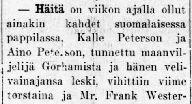
— Weddings have taken place at least twice within the week at the Finnish parsonage. Kalle Peterson and Aino Peterson, a well-known farmer from Gorham and his late brother’s widow, were wed last Thursday, and…110
The Peterson family integrated themselves, as well-known farmers, into the Finnish community of Port Arthur. Two neighbours they would often deal with were Erkki Smolander and John Pursiainen.
In 1920, Hilda sold 23 acres of their land to Erkki111. And in 1921, Peter’s informal gift of the hall land was put on paper at last: the parcel—standing, like the rest of the farm, in Hilda’s name—was formally transferred to Kalle, Erkki, and John Pursiainen112, extending its use to be for Local 28 meetings with the Finnish Organization of Canada113.
The Petersons appeared together with Smolander and Pursiainen in the annual Christmas greetings of the Finnish-Canadian communist newspaper Vapaus. This appearance suggests they maintained friendly relations with the “Red Finn” faction of the community, listing themselves among neighbours wishing for “energy in action” of the coming year.
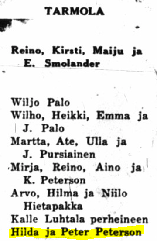
This December 17, 1921, clipping from the newspaper Vapaus lists Hilda and Peter Peterson residing in Tarmola, Ontario (Gorham Township) along with Mirjam, Reino, Aino and K[alle], where they joined neighbours in a collective “Red Finn” holiday greeting wishing “energy in action” for the year 1922114.
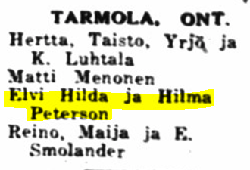
Published on December 21, 1922, in Vapaus, this Tarmola, Ontario clipping lists Elvi, Hilda, and Hilma Peterson under the socialist slogan “Merry Christmas 1922, energy in the struggles of 1923!” indicating the family’s continued presence in the community and the recent birth of daughter Elvi115,116.
Yet, their life on the homestead was driven by more than just politics; it was still driven by the urgent need to secure a future. In the midst of making social connections with the “Red Finns,” Hilda ensured the legal transfer of her assets, signing a will in 1921 that bequeathed everything to Peter117. It was a practical measure, but it also signalled a new chapter of stability.
By 1922, both couples were expecting children in the same year. Peter and Hilda had their first child, Elvi Elina118; in the same season, on July 18, Kalle and Aino welcomed a son, Aaro. For the first time in a decade, the family seemed to be outpacing its dead.
But the reprieve was brief. On July 31, just thirteen days after he was born, Aaro died119. The joy of the dual births was severed at once, returning Kalle and Aino to a grief they already knew. The “Replanting” phase had been breached; while Peter and Hilda nurtured Elvi, Kalle and Aino were forced to bury yet another son in the hard Gorham soil.
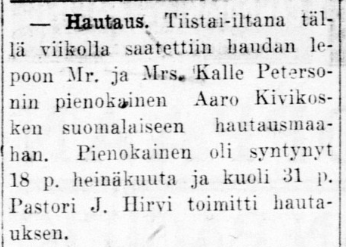
— Funeral. On Tuesday evening of this week, Mr. and Mrs. Kalle Peterson’s little one, Aaro, was laid to rest in the Kivikoski Finnish cemetery. The infant was born on July 18th and died on the 31st. Pastor J. Hirvi officiated the burial.
While the earth of the cemetery was still fresh over Aaro’s grave, the community of Tarmola refused to stagnate in its grief. Life in the settlement pressed forward, driven by the very future of education Moses had fought for before his death. That legacy now bore fruit. While the permanent structure was being finalized, the Tarmola Hall served as a temporary classroom during the winter of 1921 to 1922120.
For the children, this progress offered a rhythm of normalcy. Mirjam, who had been steadily advancing through her grades121, continued her education alongside her brother Reino. When the new schoolhouse, S.S. No. 3 Gorham, finally opened its doors, it became a family affair; both Reino and Mirjam attended, joined by Aino’s niece, Vieno, and nephews, Reino and Tauno Johnson122. On September 19, 1924, the schools of Gorham Township gathered for the “vegetable exhibition,” and against the neighbouring settlements of Kivikoski and Lappi the students of Tarmola took first place for their plants and running events123. For one afternoon, the settlement rang with the cheers of children.
This hunger for connection extended beyond the schoolyard. In September 1923, the adults of Tarmola joined a massive convergence of the regional Finnish sections, travelling to Kivikoski and Fort William for a three-day festival that left the halls packed to capacity. Seats were scarce; the air was thick with amateur theatre, the speeches of agitators like Sanna Kannasto, and dances that lasted until dawn. It drew the rural families out of the backwoods into a shared solidarity.
At the centre of this cultural outpouring was a poetry recitation competition, where “Mrs. Peterson of Tarmola”—almost certainly Aino—stood before the crowded room at the Fort William Pirtti, a year after burying her infant son, and recited verses that earned her a prize alongside women from Kivikoski and Intola124. Her performance was more than a display of the artistic spirit she had long nurtured in the community; it was a public act of endurance.
Surviving on the Canadian Shield required more than just community spirit; it demanded a dangerous kind of pragmatism. By the mid-1920s, the political fault lines in Port Arthur between the “Red Finns” (socialists) and “White Finns” (conservatives) had deepened into a chasm. The division was so severe that in 1924, one local man was reportedly tyrannized to the point of suicide over suspicions of his political alignment back in Finland125. Navigating this landscape was not just a matter of social standing, but of safety and economic survival.
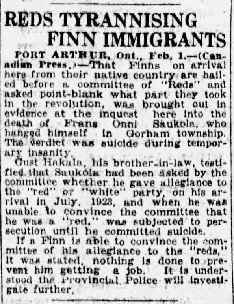
The Peterson family, perhaps out of necessity, appear to have played both sides of this volatile divide. On one hand, they maintained strong ties with the socialist faction; the land for the Tarmola Hall had come from Peter’s farm, made over to the community to host meetings for Local 28 of the Finnish Organization of Canada126, and the family appeared in the “Red” newspaper Vapaus to wish their comrades “energy in action.”
Peter, meanwhile, operated as a shrewd capitalist. He used Canadan Uutiset, the “White” capitalist newspaper, to advertise his livestock127, and in December 1924 the 1917 arrangement surfaced in the registry again: the patent to the north half of Lot 5, Concession 5—the lot Ivor Wilgren had located the same summer Peter moved his farm into Hilda’s name—issued to Peter128. Five months later he and Hilda conveyed it back to Wilgren for $650129, the last entries of a deal seven years in the carrying. He followed it in 1926 with a calculated victory, repurchasing the northern portion of the family’s original land from a neighbour for only $200130. It was significantly less than the $500 Aino had sold it for five years prior131. He held the two in a delicate balance: appearing as a comrade in the hall while working the land registry to his advantage, doing whatever was necessary to keep the farm and family alive.
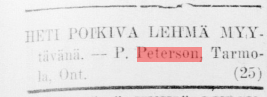
Cow due to calve immediately for sale. — P. Peterson, Tarmola, Ont132.
While Peter successfully threaded the political needle between the “Red” and “White” factions, he found himself defenceless against something far older than any faction. By 1925, with little Elvi only three years old, the harsh reality of life on the rock began to tell on their bodies. Shadows of illness crept into both households in the same season; Hilda began showing the early signs of tuberculosis, while Aino received a diagnosis of esophageal cancer. For over a year, the families were pulled two ways at once—struggling to wring a living from the farm and winter bush while tending to their failing wives.
Hilda’s fight ended in the spring of 1926. In March she was taken into hospital for a month of treatment; when it had done what it could, she came home—to the farm that was, on paper, still hers. She died there on May 12, thirty-two years old133. She was buried in the Kivikoski Cemetery four days later, and on the death registration the informant’s line holds the plainest record of that week we have: Peter Peterson, her husband. Aino endured through one final, dark winter, subjected to painful medical interventions until she too died on January 21, 1927134. Her obituary in Vapaus remembered her as more than a mother: a comrade who had given her voice to the cause, and her years to the community’s stage135.
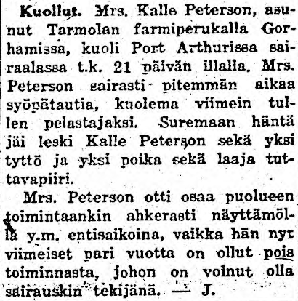
Death. Mrs. Kalle Peterson, who lived at the Tarmola farm settlement in Gorham, died in the Port Arthur hospital on the evening of the 21st of this month. Mrs. Peterson suffered for a long time from cancer, death finally coming as a savior. Left to mourn her were her widower Kalle Peterson as well as one girl and one boy, and a wide circle of acquaintances. Mrs. Peterson also participated diligently in the party’s activities on the stage [theatre] etc. in earlier times, although she has been away from the activities for the last couple of years, for which illness may have been a factor. — J.136
On October 10, 1927, the land title quietly reverted to Peter from Hilda, owing to their preparations137, but the farm felt hollow. The deaths of Aino and Hilda resonated far beyond the walls of their homesteads; Tarmola itself had been silenced. The community had lost its artistic soul in Aino, the poet and playwright who had breathed life into their stage, and lost her steadfast assistant in Hilda. Peter and Kalle were left as widowers on a landscape that demanded partnership to survive, their homes stripped of the warmth and culture that had once defined them.
Trying to fill the void left by the others, their mother, Anna Maria, drove her seventy-four-year-old body hard. The death registration records only a cerebral hemorrhage, after six days in hospital138. What finally brought it on, no record says—perhaps the strain of an overworked body, perhaps nothing more than a breath of cold air. She died on November 30, 1927.
With Anna Maria went the last matriarch, and a silence where three generations of women had once stood. The brothers’ paths diverged. In a year that had taken both Aino and his mother, Kalle decided the land’s price was too high and abandoned the homestead139. Peter refused to yield: he would stay on the farm, and he would find a new partner to make it work.
Family Tree
flowchart TB
    AMP["<b>Anna Maria</b><br/>Peterson<br/>1853–1927"]
    PE["<b>Peter</b><br/>Peterson<br/>1890"]
    HI["<b>Hilda Maria</b><br/>Ranta<br/>1893–1926"]
    KA["<b>Kalle</b><br/>Peterson<br/>1874"]
    AI["<b>Aino</b><br/>Peterson<br/>1881–1927"]
    EL["<b>Elvi Elina</b><br/>Peterson<br/>1922"]
    AA["<b>Aaro</b><br/>Peterson<br/>1922–1922"]
    RE["<b>Reino</b><br/>Peterson<br/>1907"]
    MI["<b>Mirjam</b><br/>Peterson<br/>1909"]
    uPH(["c. 1912<br/>common-law"])
    uKA(["m. 1919"])
    cAP(( ))
    cAR(( ))

    AMP --- cAP
    cAP --> PE & KA
    PE & HI --- uPH
    KA & AI --- uKA
    uPH --> EL
    uKA --> AA
    AI --- cAR --> RE & MI

    classDef male fill:#dae8fc,stroke:#6c8ebf,color:#000
    classDef female fill:#e1d5e7,stroke:#9673a6,color:#000
    classDef marr fill:#ffffff,stroke:#333,color:#000
    classDef cohab fill:#ffffff,stroke:#333,stroke-dasharray:4 3,color:#000
    classDef conn fill:#bbbbbb,stroke:#bbbbbb,color:#bbbbbb
    class AMP,HI,AI,EL,MI female
    class PE,KA,AA,RE male
    class uKA marr
    class uPH cohab
    class cAP,cAR conn
timeline
    title Replanting
    1919 : Kalle marries Aino
    1922 : Elvi Elina born : Aaro born and dies
    1926 : Hilda dies of tuberculosis
    1927 : Aino dies of cancer : Anna Maria dies
V. The River’s Grasp
Content Warning: Child Loss
Lyyli Ingrid Kahila was born on March 3, 1905, in Parkano, a parish in western Finland, the daughter of the itsellinen (landless lodger) Julius Kahila140. On August 3, 1927, she sailed from Helsinki on the Oberon141, reaching Hull; on August 12, the Montcalm out of Liverpool142; on August 20 she landed at Quebec City, alone, with servant’s work already waiting143—possibly with Peter’s family, which would explain why no sponsor was needed at the port.
In Port Arthur she found an established Finnish community, and soon found her way into the orbit of Peter’s household and his daughter Elvi.
On December 6, 1927, Peter once again borrowed $500 under the Northern and North Western Ontario Development Act144. The loan was for the farm—though it is tempting to wonder whether a little of it also went toward hiring Lyyli, or impressing her.
On July 21, 1928, Peter and Lyyli married145. It is hard not to read it as a pragmatic choice—a practical measure to re-establish the stability that the years of illness and death had stripped away.
But as the couple settled into their new life, the world around them was slowing. By 1930 the Great Depression had reached the timber settlements of Gorham, and that October a writer in the local Finnish newspaper Vapaus described the conditions plainly: “Although nowadays it looks as if life is ending here, with no hope of living visible nor any means to get through the winter146.”
The pulpwood industry, which had been the financial lifeline for farmers like Peter and Kalle to earn cash wages, had come to a “complete standstill.” With no timber being bought, the “hope of living” from logging income was gone. To make matters worse, the local dairy in Port Arthur had fallen into ruin due to poor management, cutting off another critical stream of revenue for the farmers.
The infrastructure of the settlement also became a battleground. The roads, already scarce and poor, were now being actively blocked. The Vapaus article noted that the road to Onion Lake had been obstructed, with locks placed on its bridges “by whose orders… Lord knows.” For Peter, this was likely happening on his doorstep; the bridge in question crossed the Current River right beside his farm.
Yet, even as the economy collapsed and roads were barred, the community’s heart continued to beat within Tarmola Hall. On October 11, 1930, the hall hosted a social evening featuring poems, singing, and the play At Life’s Turning Point (Elämän käänteessä147). It was a continuation of the cultural legacy Aino had helped build. The Depression could stop the flow of money, but not the spirit of the community.
Against this backdrop of blocked bridges and vanished wages, Peter held his ground. On August 29, 1930, while others faced “starvation” and ruin, he finished paying off the $500 loan he had taken nearly three years earlier148.
While Peter secured the farm’s finances, Lyyli was securing the family’s future. Through the darkening autumn of 1930, she was well into her pregnancy, carrying a new hope that would soon defy the gloom of the Depression.
On December 6, 1930, they had their first child together, Leo Armas149. His name, Armas, means “beloved” in Finnish—the measure of the hope the family poured into him after a decade of loss.
On January 14, 1931, Peter and Lyyli made a private deal with their neighbour Erkki Smolander—perhaps for logging—registering a caution (a legal claim) against the part of their property east of the Current River150. Two years later Erkki lifted the caution, and on April 27, 1933, they sold that eastern portion outright to Aatu Pitkanen for $675151. It was land the family did not work, and with Lyyli pregnant again, the money mattered more than the acres.
It was in this year, 1933, that Karelian Fever most affected the Finns of Tarmola. From 1931 to 1934, there were recruitment campaigns targeted at the ‘Red’ Finns for them to move to Soviet Karelia and build a socialist utopia. Jaded by the lack of progress on labour rights within Canada, many left Tarmola to join the movement, including Peter’s neighbour Erkki152. Stalin would eventually turn on this community and by 1937 they became the primary targets for arrests and executions153.
Later that year, Peter and Lyyli were expecting their second child together154, another companion for Elvi and a true sibling for Leo. Two young children running through the Gorham homestead: it is easy to imagine the reward that promised for their endurance. Yet the calm did not hold.
On the morning of October 10, after his sister Elvi had left for school, Leo—not yet three—ventured out of his house in search of his mother. She was in the barn milking the cows. Crossing a bridge over the creek on their farm—a small tributary of the Current River—he fell into the chickens’ watering pond and drowned155,156. His body was likely discovered by Lyyli, who—as the Tarmola history remembered it—never recovered from the shock157. Like Moses’ son Sulo and Kalle’s son Lauri, Peter’s first son was taken by the cold grip of the river. Twenty years of “taming” had changed nothing.
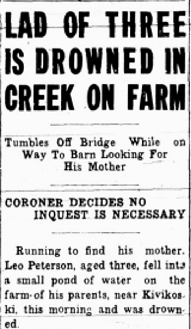
Leo’s death notice from The Daily Times-Journal158 in 1933.
On December 21, only ten weeks later, their daughter Miriam Ingrid was born159. They also had another daughter, Linnea Hilda, whose birth date is uncertain160. Miriam and Linnea were born into a house heavy with the shadow of death and economic hardship. They would never see the Sisu that built Tarmola Hall, or the hope that had carried their parents across an ocean; they knew only the mother and father this era had made—a mother scarred by the shock of that loss, a father broken by the past.
This fracture in Peter’s spirit reached the farm’s finances too. On April 5, 1938, perhaps out of financial desperation, Peter and Lyyli sold a roughly 20-acre portion of the land to David Nikkola for $100161. At $5 an acre—against the nearly $17 an acre of the 1933 sale—it was the price of a family selling under duress.
Despite the selling off of assets, Peter made another land deal, purchasing 80 acres of land for $40162. The amount in consideration suggests he was locatee on an Allowance for Purchase, like his brother Moses over twenty years earlier, which he was obligated to buy. But perhaps he couldn’t afford the full 160 acres at the time and split it with a neighbour.
As financial instability gnawed at the homestead from within, geopolitical forces began to tear at the community from without. During World War II, Finnish-Canadians found themselves in a precarious situation. On June 5, 1940, Justice Minister Ernest Lapointe announced to the House of Commons that sixteen organizations had been outlawed by Order-in-Council under the Defence of Canada Regulations of the War Measures Act; the Finnish Organization of Canada (FOC) stood on the same list as the Communist Party of Canada and the foreign organization of the Nazi Party163. Membership itself became an offence—a man who attended an outlawed organization’s meetings, spoke for it, or passed out its literature was presumed a member unless he could prove otherwise—and the FOC’s property was seized by the Custodian of Enemy Property164. Tarmola Hall, built on the very land Peter had given the community, was part of this confiscation. This hall had been the heart of their social lives—where his late sister-in-law Aino, first wife Hilda, and nephew Lauri had performed on stage and where the families had gathered for music and sports. Although the property was returned in 1944, the damage was done; the custodian never paid property taxes, and the land was ultimately lost to the Crown for nonpayment of arrears in 1945165.
The price of Peter’s homestead was a debt he could no longer pay. By the early 1940s, the Shield’s ledger was finally full.
And the living were leaving. Kalle had long since given the homestead up for town; Erkki and so many others had been drawn away—and destroyed—by Karelian Fever; and the seizure of Tarmola Hall took what remained of the world they had built. It was the last of the long string of losses that turned Peter from his land.
Family Tree
flowchart TB
    LY["<b>Lyyli Ingrid</b><br/>Kahila<br/>1905"]
    PE["<b>Peter</b><br/>Peterson<br/>1890"]
    EL["<b>Elvi Elina</b><br/>Peterson<br/>1922"]
    LE["<b>Leo Armas</b><br/>Peterson<br/>1930–1933"]
    MI["<b>Miriam Ingrid</b><br/>Peterson<br/>1933"]
    LI["<b>Linnea Hilda</b><br/>Peterson<br/>c. 1935"]
    uPL(["m. 1928"])
    cPE(( ))

    LY & PE --- uPL
    uPL --> LE & MI & LI
    PE --- cPE --> EL

    classDef male fill:#dae8fc,stroke:#6c8ebf,color:#000
    classDef female fill:#e1d5e7,stroke:#9673a6,color:#000
    classDef marr fill:#ffffff,stroke:#333,color:#000
    classDef conn fill:#bbbbbb,stroke:#bbbbbb,color:#bbbbbb
    class LY,EL,MI,LI female
    class PE,LE male
    class uPL marr
    class cPE conn
timeline
    title The River's Grasp
    1927 : Lyyli Kahila immigrates
    1928 : Peter marries Lyyli
    1930 : Leo Armas born
    1933 : Leo drowns : Miriam Ingrid born
    1935 : Linnea Hilda born (approx.)
    1940 : Tarmola Hall seized under the War Measures Act
    1945 : Tarmola Hall land lost to the Crown
VI. Room 13
Content Warning: Alcoholism and Death
The cumulative tragedy had finally broken Peter. The Shield, having taken his family, his Sisu, and his sanctuary, claimed the man himself. Unable to cope with the shadows that haunted his house, he left his family behind. What filled those final years the family records do not say; but the manner of his death—the “alcoholic confusion” the coroner would note, with a blood-alcohol reading of 0.23%—reads backward as a man who had, by the end, come to lean hard on drink.
Sometime between 1940166 and 1945167, he left for British Columbia.
The separation was absolute. The silence between him and his kin was so complete that when his brother Kalle died in 1953, the family back in Port Arthur still believed Peter was alive in Vancouver169.
Peter’s final home, 767 East Georgia Street170, was a refuge for the drifters and the unlucky. Rented by-the-week171, the address was chaotic and well known to the police, housing men like Herbert Going, a sixty-five-year-old beggar ordered to “keep off the Skidroad”172, and John Banek, who returned to the rooming house with 27 stitches after a bottle brawl173. Residents like Mike Filip were easy targets for petty thieves174. This was the transient world Peter had resigned himself to.
On his death certificate, the only identifying personal detail was the name of the wife he had left behind: “Lily Ka[h]ila”175. Even in the end, the identity he had tried to outrun was the one thing that named him—though who gave the clerk that name, the record never says.
On March 1, 1951, the landlord of International Rooms176, Yee Sun, grew concerned and called the Vancouver Police to Room 13. When the police arrived, they found the door locked from the inside. They had to force their way in, the wood splintering as they breached Peter’s final sanctuary.
Inside, the room contradicted the streets. The walls were papered in a delicate floral pattern; the furnishings were sparse and makeshift—a simple table covered with a cloth, a coffee pot sitting on a cardboard box.
The instrument of his death was a mundane object sitting on the table: a two-burner gas plate. A tin of Fry’s Cocoa stood nearby, suggesting a simple, final intention: perhaps he just wanted to make a warm drink. The Coroner’s report concluded that in his “alcoholic confusion,” with a blood alcohol level of 0.23%, Peter had turned the burner on fully but neglected to light it. He had not intended to die; he had simply made a mistake177.
The Canadian Shield’s relentless attack was a war waged on two fronts: the soil and the air. It began by rejecting the family’s roots, denying the two Urhos a hold in the stone. Then, it turned to the taking of breath. In the river and its creeks, the Shield first suffocated his nephew Sulo and then his son Leo by drowning. It had seized the breath of Moses, Lauri, and Hilda through the lungs. It even claimed his mother Anna Maria, wearing down an old, overworked body until a vessel in her brain finally gave way.
In the end, Peter’s defeat was a quiet, invisible suffocation in Room 13, far from the rocks of Gorham. The Shield had won, not by taking his land, but by stealing the breath of his life and extinguishing his Sisu.
Epilogue
The End of Sisu
The story of Sisu ended with Peter. It was the force that drove the family to the Shield, but it was also the stubbornness that refused to let go until the cost became too high. Peter’s defeat marked the limit of what endurance alone could achieve.
Miriam and Linnea were left behind by their father, but not by their mother, Lyyli, who remained to pick up the pieces. For them, and the generations that followed, survival would no longer be about battling the landscape with brute force. The cycle of trauma required a different remedy than the one Peter knew. It would take time, but eventually the family would learn what endurance alone could not teach them, breaking the cycle that had claimed so many.
Afterword
The Question of Peter and Hilda’s Marriage
Throughout this book I have written about Peter and Hilda as husband and wife, but I have stopped short of giving them a wedding. That is a deliberate choice, and not an obvious one, so it deserves a frank accounting. Despite a good deal of searching, I have never found a marriage certificate for them—not in Ontario, not in Finland, and not in the Quebec or Montreal church registers where a port wedding would most likely have been entered. A fellow genealogist I have corresponded with goes further and wonders whether there was ever a wedding at all—and over time I have come to think he is probably right. Because this question sits so close to the heart of the story, it deserves a full accounting of what we know, what we don’t, and why I made the choice I did.
There are really three possibilities, and the surviving evidence pulls in more than one direction.
Option One: A Wedding at the Port
The first possibility, and the one earlier drafts of this book weaved into the narrative, is that Peter married Hilda at Quebec City in August 1912, in the days surrounding her detention. The logic is practical rather than romantic. Hilda boarded the Royal George as a “spinster” and a “domestic,” travelling under the borrowed surname Peterson but with no legal claim to it. The Immigration Act of 1910 made “persons likely to become a public charge” a prohibited class, and an order-in-council that May required every arriving immigrant, “male and female,” to land with at least twenty-five dollars178. A penniless domestic was exactly the sort of arrival the inspectors were instructed to stop—and an unaccompanied woman was scrutinized far more closely than a man, her character and her likelihood of needing “charitable assistance” weighed in ways an able-bodied man’s were not179. So while Kalle passed through on his own merit, Anna and Hilda were held: sent to the civil detention quarters at Quebec to be judged by a three-member Board of Inquiry whose decision no court could overturn180.
To be released, a detained woman had to satisfy that board—most often by a resident stepping forward to claim her and guarantee she would not become a public charge. Peter could do this for his mother as her son; for Hilda, the most decisive proof of the bond was simply to make her his wife. A marriage would convert her in a single stroke from an unsponsored single woman into the wife of a settled homesteader. If that is what happened, the record would most likely sit in a Montreal or Quebec City church register—exactly where I have searched without success.
Option Two: A Quiet Marriage Elsewhere
The second possibility is that they married, but not at the port—either earlier, in Finland, before the crossing, or later, once the family had taken root in Tarmola. The manifests argue against a marriage in Finland: Hilda is recorded as “Miss,” a “spinster,” travelling as a single woman, which is not how a wife of two years would ordinarily have been entered. A later marriage in Ontario is harder to dismiss, and here I have to be careful about what “no record” actually means. The searchable indexes of Ontario marriages are built from the sworn affidavit—the return that spells out the couple’s names—not from the marriage licence that often sits one frame before it on the microfilm. A couple who took out a licence but whose affidavit was never filed, or never indexed, would leave a record that no name search could surface181. My empty searches therefore rule out an indexed affidavit; they do not rule out a licence-only record, or a return mis-filed in the Thunder Bay district films, waiting to be found by reading frame by frame.
The likeliest local register, though, has now been checked at the source. The keeper of Epiphany Lutheran Church’s Finnish Lutheran records in Thunder Bay—the books that hold other entries for this family—confirms that the church has no marriage record for Peter and Hilda182. That is a meaningful silence: the family was Lutheran, and Peter himself would marry in this very church in 1928. But it is the church’s silence, not the province’s. A civil marriage, or a licence resting in a separate and unindexed series, would leave no trace in a parish book at all.
Option Three: No Marriage at All
The third possibility, and the one the same genealogist also presses, is that there was never a formal wedding at all. This becomes easy to imagine once Peter and Hilda are placed in their actual community. Nominally the family were Lutherans, as the ship’s manifest records, but among the radical, socialist “Red Finns” who built the Tarmola settlement the church held little authority. As one history of Finnish Canada observes, though nearly all Finns left Europe as Lutherans, “many abandoned religion altogether for humanistic socialism or other philosophies”183; and even among those who kept the Lutheran name, only a minority took an active part in the church184. In that world a couple might simply live together as husband and wife, and be taken as married, without ever standing before a clergyman or a clerk.
This was not a rare or furtive arrangement but a recognized one—and a near-exact precedent lived in their own community. Sanna Kannasto, the foremost organizer of the Finnish-Canadian socialist movement, settled in Port Arthur in 1907 with her partner J. V. Kannasto; she took his surname although the two were never married, “living together without marriage” being, as her biographers put it, “a common habit among radical Finns in North America”185. That is almost precisely Hilda’s situation—a woman carrying the Peterson name onto a ship’s manifest with no certificate behind it. Under this reading, every later document that calls Hilda Peter’s “wife” is recording a lived relationship rather than a licensed one.
The Weight of the Sworn Records
Against the absence of a wedding certificate sits a body of later evidence that consistently treats them as married—and much of it was set down under oath. The earliest of that evidence rises from the land itself. When Peter transferred his homestead to Hilda in October 1917, the transfer was supported by an affidavit sworn by their Tarmola neighbour Erkki Smolander, attesting that the two were husband and wife186; the register duly recorded the parcel passing “to his wife Hilda.” The 1921 census enumerated Hilda plainly as Peter’s “wife.” When Hilda died in 1926, the death registration records her as “married” and names Peter, her husband, as the informant187. And in 1928, swearing the affidavit for his second marriage to Lyyli Kahila, Peter described himself not as a bachelor but as a “widower”188.
It is the bookends that weigh on me most: a neighbour swearing in 1917 that they were married, and Peter swearing in 1928 that he was widowed. A man who had only ever lived common-law would have had little reason to call himself a widower under oath, and a neighbour little reason to swear to a marriage that had never happened. And yet I hold even this loosely. None of these records is a marriage certificate, and a long, openly acknowledged common-law union could have produced every one of them: to a neighbour, to a census-taker, and to Peter himself, a couple who had lived as man and wife for years simply were married. The sworn records prove that Peter and Hilda were taken to be a married couple; they do not, by themselves, prove that a ceremony ever took place.
Why I Tell It Without a Wedding
So why, given the sworn records, have I chosen to tell the story without a wedding? Because it is the reading that asks the least of the evidence. Three things decided me. First, the document closest to the event—the 1912 manifest—releases Hilda from detention not as a new wife but as a single woman vouched for by her family: the heavy ink of the disposition sends the two women “to [the] Brother” at Port Arthur and leaves Hilda entered, in the same breath, as “Miss,” “spinster,” “domestic.” Had a marriage been the instrument of her release, this is the page that should show it, and it does not. Second, the one Lutheran parish that ought to hold a marriage record has none, though it holds the family’s other entries and would host Peter’s own wedding in 1928. Third, the world Peter and Hilda actually lived in—the Red Finn settlement of Tarmola—had little use for the church, and couples like the Kannastos, who lived as husband and wife without a certificate, offered a precedent close to home.
This is not a certainty, and I hold it as a judgement rather than a finding. The sworn “wife” of 1917 and the sworn “widower” of 1928 are real, and they are the strongest reason to hesitate. But they are precisely what a long, openly acknowledged common-law union would have produced in any case: to a neighbour, to a census-taker, and to Peter himself, a couple who had lived as man and wife for years simply were married. I once placed a wedding at the port because it asked the least of the reader; I have come to think it asked too much of the record—inventing a ceremony to explain a silence that the manifest, the parish, and the community already explain between them. I have chosen, then, to honour their union as they most likely lived it: real, lasting, and unsolemnized—married only in the way that mattered to them and to their neighbours, and never in a way that left a certificate to find.
Archetypes
I found these archetypes to be a great way to understand each of Peter’s relatives.
Peter: The Broken
- Born with Sisu as a required “survival mechanism” from his first moments, he was ultimately dismantled by the “cumulative tragedy” of the Canadian Shield. Unable to cope with the loss of his family, he withdrew into estrangement, and—as his death would attest—into drink, until the Shield finally “won… by stealing the breath of his life and extinguishing his Sisu.”
Anna Maria (Johnson): The Canary
- She was the first of the family to succumb to the new world, dying of heart failure in 1911, little more than a year after her arrival. Just as a canary in a mine stops singing to warn miners of toxic air, her death cast a heavy shadow over the new life, serving as the first grim warning that the Canadian Shield was a hostile environment that would exact a heavy toll on them all.
Moses: The Pioneer
- He was the catalyst for the migration, jumping on the opportunity in 1910 to travel ahead of his family to establish the homestead and break ground. Though he died early, his grit secured one thing—the land—successfully transforming the family status from farm servants to landowners.
Anna Maria (Peterson): The Bedrock
- Having lost her husband early, she was the foundation that held the family together through illegitimacy and migration. Even at 74, she pushed her body to the absolute limit to fill the void left by others; her death created an acute crisis of stability, proving she was the pillar the family leaned on.
Kalle: The Steward
- He defined his life by taking on the burdens of continuity, marrying his brother’s widow, Aino, in a cold calculus of homestead survival to keep the farm going. He raised his niece and nephew as his own, ensuring the family line survived despite his own personal losses.
Aino: The Spirit
- She represented the cultural vitality of the family, participating diligently in “party’s activities on the stage” in the Finnish community theatre. Her presence in newspaper greetings wishing for “energy in action” highlights her role in maintaining the family’s social spirit before her illness.
Lyyli: The Stabilizer
- Arriving alone from Finland, she entered the family as a “pragmatic choice” to “re-establish the stability” that years of death had stripped away. She stepped in to mother Peter’s daughter Elvi and attempted to rebuild a future with Peter before further tragedy struck.
Elvi: The Survivor
- She represents the life that persisted amidst the “shadows that haunted his house.” While her brother Leo and cousins Sulo and Lauri were “claimed” by the river and disease, she survived the “cumulative tragedy” of her childhood, becoming the bond between Peter and his second wife, Lyyli.
Sulo, Leo, & Lauri: The Cost
- Sulo and Leo were claimed by the river, while Lauri was taken by the pandemic; the text frames their deaths as the price demanded by the land. With the deaths of Leo and Lauri, the Shield’s ledger was full, marking the terrible toll paid for the family’s survival.
Miriam & Linnea: The Forsaken
- Born into a home already “haunted” by shadows, they never knew the resilient pioneer, only the broken man the Shield had defeated. They are the family Peter left behind when he fled to British Columbia to escape the “unpayable debt” of his grief, grappling with the legacy of a father who had already been defeated.
Urho & Urho: The Seedlings
- They were the family’s first attempts to plant a new generation in Canadian soil. Urho Olavi arrived to replace the matriarch, and Urho Mauno arrived to replace him. But the Shield found the roots too shallow; Urho Olavi succumbed to the physical hardships of the new life, and Urho Mauno was taken by disease. Their deaths were the land’s first clear rejection, proving that the Peterson bloodline had not yet found purchase in the stone.
Reino & Mirjam: The Transplants
- They were saplings dug up from the Old World and forced to strike new roots in the thin, acidic soil of the Shield. Hardier than the brothers lost to sickness and the ice, they survived the shock of migration, yet they remain forever marked by the transition. They bridge the gap between Karttula and Gorham, carrying the unique burden of remembering the home they left while watching this new land consume their siblings, proving that only those with the toughest bark could endure the transplant.
Family Tree
This abridged family tree can help visualize how Peter related to each person in his story.
flowchart TB
    AMW["<b>Anna Maria</b><br/>Westerinen<br/>1853–1927"]
    PK["<b>Pekka</b><br/>Karhunen<br/>1848–1882"]
    AMJ["<b>Anna Maria</b><br/>Hirvensalo / Johansson / Johnson<br/>1842–1911"]
    LY["<b>Lyyli Ingrid</b><br/>Kahila<br/>1905–1975"]
    PE["<b>Petter Westerinen /<br/>Peter Peterson</b><br/>1890–1951"]
    HI["<b>Hilda Maria</b><br/>Ranta<br/>1893–1926"]
    OL["<b>Olga</b><br/>Juvonen<br/>1880–1911"]
    KA["<b>Kalle Karhunen /<br/>Peterson</b><br/>1874–1953"]
    AI["<b>Anna / Aino Juhontytär<br/>Johansson / Johnson</b><br/>1881–1927"]
    MO["<b>Moses Karhunen /<br/>Peterson</b><br/>1879–1918"]
    LEO["<b>Leo Armas</b><br/>Peterson<br/>1930–1933"]
    MIRI["<b>Miriam Ingrid</b><br/>Peterson<br/>1933–2004"]
    LIN["<b>Linnea Hilda</b><br/>Peterson<br/>c. 1935 – c. 2015"]
    ELV["<b>Elvi Elina</b><br/>Peterson<br/>1922–1959"]
    LAU["<b>Lauri</b><br/>Peterson<br/>1906–1918"]
    AAR["<b>Aaro</b><br/>Peterson<br/>1922–1922"]
    UOL["<b>Urho Olavi</b><br/>Peterson<br/>1911–1912"]
    UMA["<b>Urho Mauno</b><br/>Peterson<br/>1913–1919"]
    SUL["<b>Sulo</b><br/>Peterson<br/>1905–1914"]
    REI["<b>Reino</b><br/>Peterson<br/>1907–1971"]
    MIR["<b>Mirjam</b><br/>Peterson<br/>1909–1965"]
    uW(["m."])
    uPL(["m. 1928"])
    uPH(["c. 1912<br/>common-law"])
    uKO(["m. 1899"])
    uKA(["m. 1919"])
    uAM(["m. 1902"])
    cAJ(( ))

    AMW & PK --- uW
    uW --> KA & MO
    AMW -.->|illegitimate| PE
    AMJ --- cAJ --> AI
    LY & PE --- uPL
    PE & HI --- uPH
    OL & KA --- uKO
    KA & AI --- uKA
    AI & MO --- uAM
    uPL --> LEO & MIRI & LIN
    uPH --> ELV
    uKO --> LAU
    uKA --> AAR
    uAM --> UOL & UMA & SUL & REI & MIR

    classDef male fill:#dae8fc,stroke:#6c8ebf,color:#000
    classDef female fill:#e1d5e7,stroke:#9673a6,color:#000
    classDef marr fill:#ffffff,stroke:#333,color:#000
    classDef cohab fill:#ffffff,stroke:#333,stroke-dasharray:4 3,color:#000
    classDef conn fill:#bbbbbb,stroke:#bbbbbb,color:#bbbbbb
    class AMW,AMJ,LY,HI,OL,AI,MIRI,LIN,ELV,MIR female
    class PK,PE,KA,MO,LEO,LAU,AAR,UOL,UMA,SUL,REI male
    class uW,uPL,uKO,uKA,uAM marr
    class uPH cohab
    class cAJ conn
Timeline
The family trees show who the characters were; this timeline shows when the events of their lives unfolded. It gathers the births, deaths, marriages, and migrations recorded throughout the story into a single chronological view.
timeline
    title The Peterson Family, 1882–1953
    section Finland
        1882 : Elder Petter Karhunen dies; family declares bankruptcy
        1890 : Petter Westerinen born in Karttula
        1899 : Kalle marries Olga Juvonen
        1902 : Moses marries Aino
        1905 : Sulo born
        1906 : Lauri born
        1907 : Reino born
        1909 : Mirjam born
    section The Crossing
        1910 : Moses sails to Port Arthur (the Scouts) : Aino, her mother, and children follow
        1911 : Petter immigrates (the Reinforcement) : Urho Olavi born : Anna Maria Johnson dies
        1912 : Kalle, Anna Maria, Lauri, and Hilda immigrate (the Rear Guard) : Peter and Hilda begin their union (no formal marriage) : Moses buys his Tarmola parcel from the Crown : Urho Olavi dies
    section Land and Loss in Tarmola
        1913 : Urho Mauno born : Peter located on his Tarmola free grant
        1914 : Sulo drowns in the Current River
        1916 : Peter receives his land patent
        1918 : Moses dies of Spanish flu : Lauri dies of Spanish flu
        1919 : Urho Mauno dies of meningitis : Kalle marries Aino
    section Replanting
        1922 : Elvi Elina born : Aaro born and dies
        1926 : Hilda dies of tuberculosis
        1927 : Aino dies of cancer : Anna Maria dies : Lyyli Kahila immigrates
        1928 : Peter marries Lyyli
    section The River's Grasp
        1930 : Leo Armas born
        1933 : Leo drowns in the creek : Miriam Ingrid born
        1935 : Linnea Hilda born (approx.)
    section Room 13
        1951 : Peter dies in Vancouver
        1953 : Kalle dies
Research
This section gathers the archival records behind the story—one group per chapter, in the order events unfold. Each record appears as it was found, with the researcher’s summary, a transcription, a translation where the original is not in English, and a note drawing out what it tells us. The chapters cite these records by footnote; here they are, in full.
I. Karttula
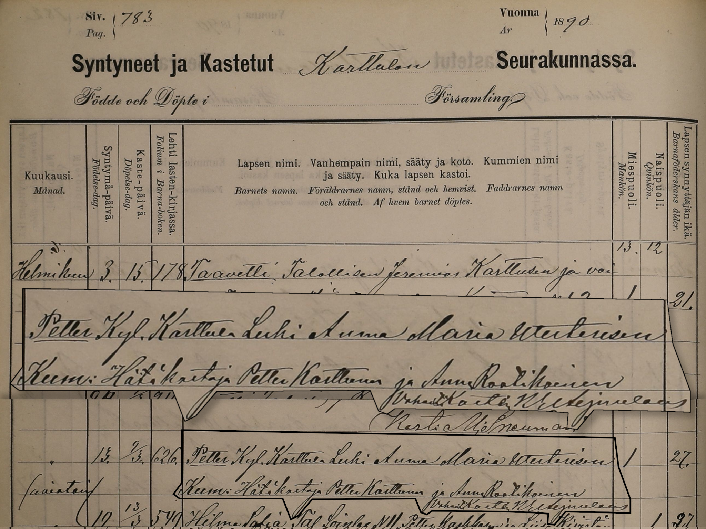
This syntyneet ja kastetut (birth and baptism) record shows that on February 13, 1890, Petter, male, avioton (illegitimate), was born to Anna Maria Westerinen, 27-years-old, loinen (landless lodger) in Karttula. An emergency baptism was performed by Petter Karttunen, which was confirmed on March 9, with Anna Raatikainen as a witness189.
The term avioton is penned in the month column of the left side between two slashes. It was difficult to understand that it is not a month, but in fact describes Petter’s birth. This record points to page 626 of the Karttula Lastenkirja (children’s book) where we will find his family.
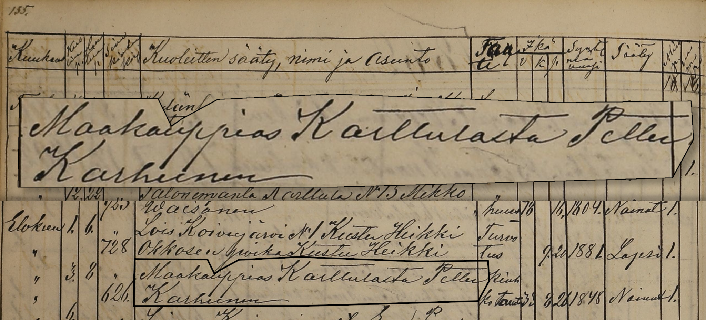
This kuolleet (death) record shows that on August 3, 1882, Petter Karhunen, born 1848, 33-years-8-months-26-days-old, male, nainut (married), maakauppias (country shopkeeper), from Karttula, died of keuhkotauti (lung disease, i.e. tuberculosis) and was buried on August 8190.
This record also points to page 626 of the Karttula Lastenkirja (children’s book) where we find the family he left behind.
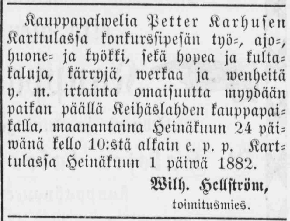
This newspaper clipping from Savo is a notice of the bankruptcy estate sale of Petter Karhunen of Karttula, scheduled to take place on July 24 at 10 am on-site at the Keihäslahti marketplace191.
Shop assistant Petter Karhunen’s bankruptcy estate in Karttula: work, driving, room, and kitchen [items], as well as silver and gold items, carts, cloth, and boats etc. movable property will be sold on-site at the Keihäslahti marketplace, on Monday, July 24th starting from 10 a.m. In Karttula, July 1st, 1882. Wilh. Hellström, administrator.
This bankruptcy represents the turning point for the family when they began the “social slide” into farm labour.
The above death record and estate sale notice present a tragic timeline. As his health failed, the business likely crumbled due to neglect, leading to bankruptcy. In the final days of his illness, while he was still on his deathbed, the bankruptcy sale was held and his possessions sold off. Tuberculosis was a deadly illness. The only reprieve would be if his family shielded him from the crumbling world around him, but the timing of his death suggests not. He likely knew what was happening; he died only ten days later.
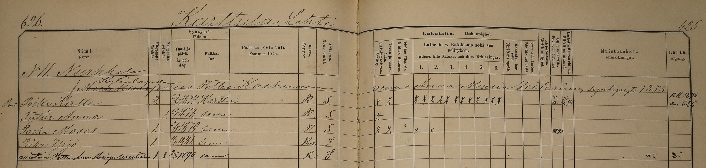
This Karttula lastenkirja (Children’s book) record shows the household at farm No. 11 Nurkkala in Karttula, listing Anna Maria Vesterinen (born 1855) as the wife of cottager Petter Karhunen. Below her name are four older children—Kalle, Anna, Moses, and Yrjö—followed by the entry for Petter Annanpoika Westerinen, who is recorded as born on February 13, 1890, and explicitly distinguished as avioton (illegitimate)192.
| Name | Relationship | Sex | Born (or Baptized?) |
|---|---|---|---|
| Kalle Karhunen | Petter’s son | male | April 29, 1874 |
| Anna Karhunen | Petter’s daughter | female | January 13, 1878 |
| Moses Karhunen | Petter’s son | male | November 21, 1879 |
| Yrjö Karhunen | Petter’s son | male | October 11, 1881 |
| Petter Westerinen | Anna Maria’s son | male | March 9, 1890 |
V and W appear to be interchangeable.
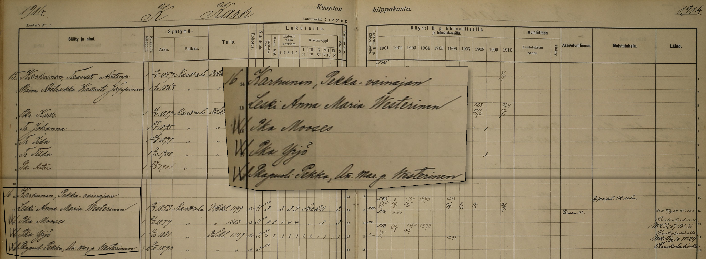
This Karttula rippikirja (communion book) record identifies the family of Pekka Karhunen and Anna Maria Westerinen having children Moses, Yrjö, and Pekka Westerinen in 1910. In the right-most column, we can see that the brothers Moses, Yrjö, and Pekka [Petter] moved to Ruokolahti193.
Their children Anna and Kalle are notably missing, but being the oldest, they got married and moved with their new families.
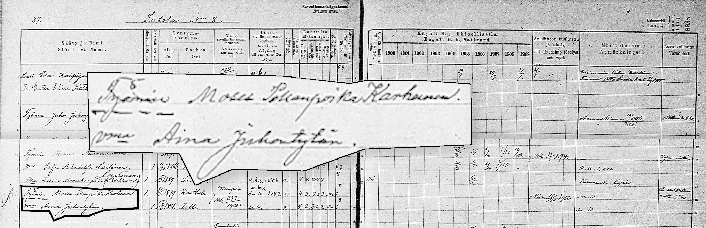
This Ruokolahti rippikirja (communion book) record identifies Moses Pekkanpoika Karhunen and vaimo (wife) Aina Juhontytär as having married on October 19, 1902, arrived in 1905 and moved to [North] Am[erica] in 1910194.
Poissa kutsunnasta 1902
Absent from the draft [conscription] in 1902.
Juhontytär = Juho + tytär (Juho’s daughter). Juho can be translated to Johan or John. Later in her life, she appears with last names Johansson and Johnson and this is where they come from. Coincidentally, we will later see their son Sulo get mistranscribed as Johan (Sulo → Juho → Johan) during their voyage to Canada.
Aino’s own records bear this out. Her Asikkala birth record names her father as the työmies (labourer) Johan Johanson195, and the family’s page in the Ruokolahti communion book (Siitola 4) records him in full as Juho Fredrik Juhonpoika (1844–1903), with his wife Anna Maria Kaarlentytär, born 1842, and their daughter Aina196. The full name explains why Aino’s later Canadian records call her father both John Johnson (her 1927 death registration) and Frederick Johnston (her 1919 marriage affidavit)—all correct variations of the same man. Kaarlentytär (Carl’s daughter) likewise surfaces as Anna Mary Carlson on that affidavit, and the HisKi index of Anna Maria’s baptism—born May 19, 1842, to the crofter Carl Andersson—places her at the Hirvensalo croft in Paaso, the farm name that appears beside her in the Afterword’s family tree197. (The communion book enters her birthday as April 14, 1842; this book follows the baptism index’s May 19.)
The conscription note is a fascinating historical detail. In the early 1900s, Finland was under Russian rule (the “First Period of Oppression”). In 1901, a new Conscription Act was passed that forced Finns to serve in the Russian Imperial Army, which many Finns considered illegal and unconstitutional. In response, a widespread Conscription Strike (kutsuntalakko) occurred. In 1902, thousands of Finnish men refused to show up for the draft as a form of passive resistance / civil disobedience198. This note indicates that Moses was one of those men who refused to attend the Russian military call-up.
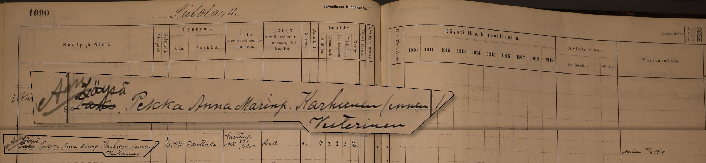
This Ruokolahti rippikirja (Communion book) record identifies Pekka Anna Marianpoika Karhunen ennen (formerly) Vesterinen, löysä (itinerant labourer), as having arrived on June 10, 1910, and moved to [North] Am[erica] in 1912199.
This record suggests Petter adopted the last name Karhunen and he will later apply for a passport using this last name. Note that Pekka is interchangeable with Petter in Finland.
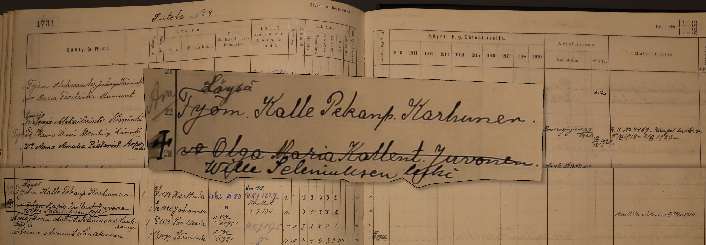
This Ruokolahti rippikirja (communion book) record identifies Kalle Pekkanpoika Karhunen, löysä (itinerant labourer), from Karttula, as moved to [North] Am[erica] in 1912. His late wife Olga Juvonen, from Johannes, died on July 3, 1911200.
II. Moses’ Voyage
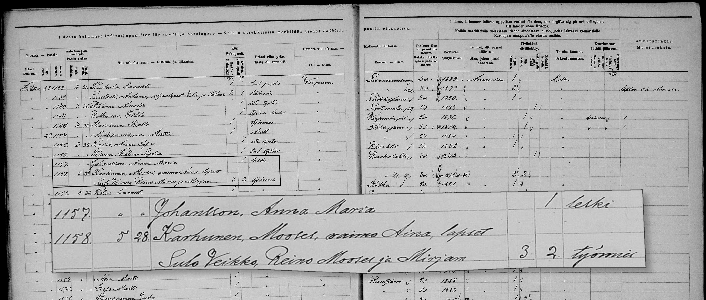
This Finnish passport register shows that on April 25, 1910, passport number 1157 was issued to Aino’s mother Anna Maria Johansson206. Next it shows that passport number 1158 was issued to Karhunen, Mooses, työmies (labourer), vaimo (wife) Aina, lapset (children) Sulo Veikka, Reino Mooses and Mirjam for 5 marks, 28 pennies207.
Notice how the “j” in Mirjam looks like a “g.” During the family’s journey there were many spelling errors, mistranscriptions, and mistranslations because they could not speak English.
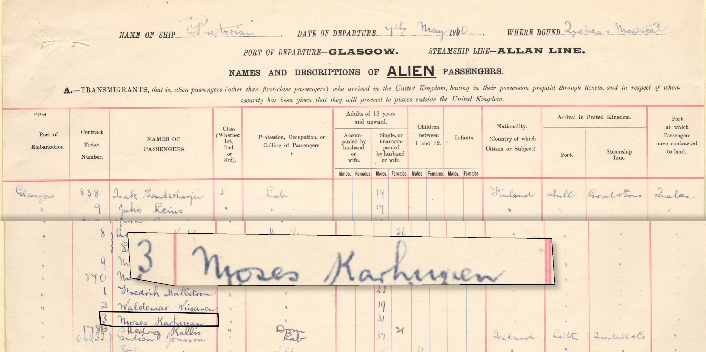
This UK passenger leaving list shows that on May 7, 1910, Moses Karhunen boarded the ship Pretorian from Glasgow, UK to Canada, ticket number 873, lab[ourer], 31-year-old male, unaccompanied208.
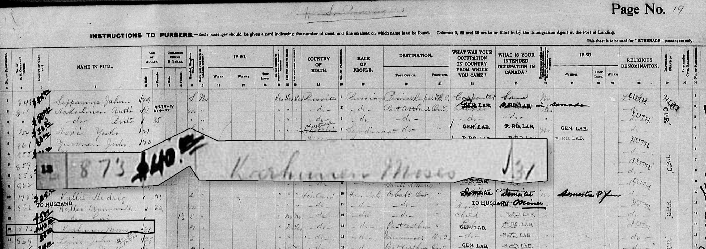
This Canada passenger list shows that on May 16, 1910, Moses Karhunen arrived in Quebec City from the ship Pretorian, ticket number 873, 31-year-old male, Finnish, a labourer whose declared intended occupation in Canada was railway labourer (R.R.D. Lab.), Lutheran, bound for Port Arthur, via the Canadian Pacific Railway209.
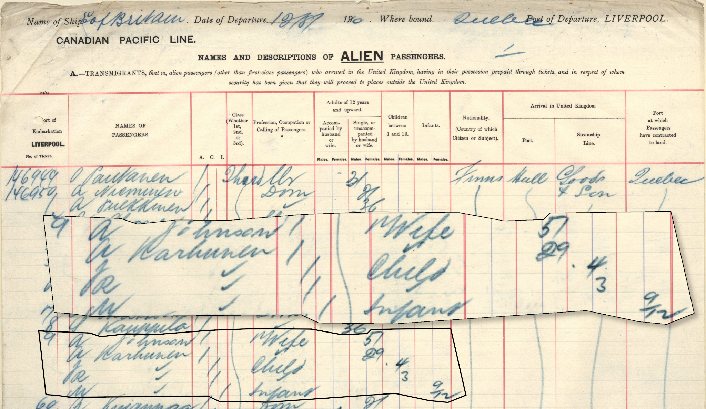
This UK passenger leaving list shows that on August 12, 1910, A[ino] Karhunen, her mother A[nna] Johnson, and her children [Sulo], R[eino] and M[irjam] boarded the ship Empress of Britain from Glasgow, UK to Canada, ticket number 146959210.
Notice the capital S for Sulo has been miswritten as a J. This is a common transcription error. Also Mirjam’s age is 9 months and correctly under the female column (this will change later). She was actually 12 months old at this time. The discrepancy in age suggests they may have offered an incorrect age to secure a travel discount.
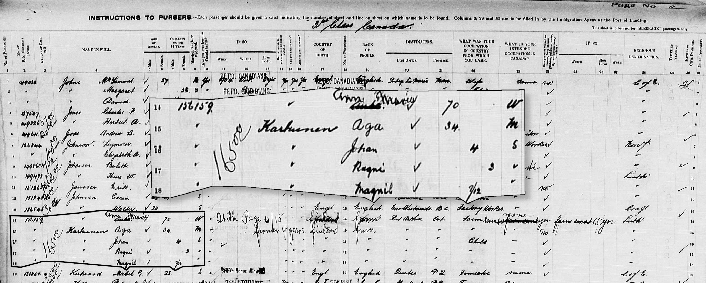
This Canada passenger list shows that on August 18, 1910, A[ino] Karhunen, her mother Ann[a] Maria Johnson, and her children [Sulo], R[eino] and M[irjam] arrived in Quebec City from the ship Empress of Britain, ticket number 156159, headed for Port Arthur211.
This is a great example of how difficult it can be to find ancestral records. Nobody in the family spoke English at the time and so we are dealing with misspellings, mistranscriptions, and mistranslations. Anna Maria is the most accurate record. She was widowed and her age is off by only a couple years. Here is what I think happened for the rest. In hasty cursive, the sequence of the lowercase letters ‘i’ and ‘n’ in Aina likely merged together to visually resemble the descending loop of a ‘g’, resulting in the transcription Aga. The decorative upper loop of the capital ‘S’ in Sulo was confused with a capital ‘J’, and a sloppy cursive loop on the ‘l’ made it look like ‘h’ leading the clerk to read it as “Juho” and then translate it to the Swedish form Johan. The handwriting for Reino was ambiguous enough that the clerk defaulted to the phonetically similar Swedish name Ragni, a known name that matched the visual shape of the letters. The descending tail of the lowercase ‘j’ in the passport spelling of Mirjam was misread as a ‘g’, causing the clerk to transcribe the name as the Swedish variant Magnil. Another error you will notice is Mirjam’s age became 7 months and she was moved into the male column. 7s do look like 9s and they likely guessed the infant’s gender because of the language barrier. Even the ticket number is off by a couple of digits. But it’s the same ship they left the UK from and all of the important discriminating digits match.
II. Petter’s Voyage
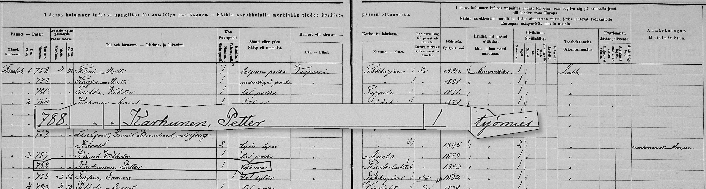
This Finnish passport register shows that on May 3, 1911, Petter Karhunen, male, työmies (labourer), of Ruokolahti, born 1890, Lutheran religion, destination Amerikka (America), was issued passport number 788 in Viipuri for 4 marks, 32 pennies212.
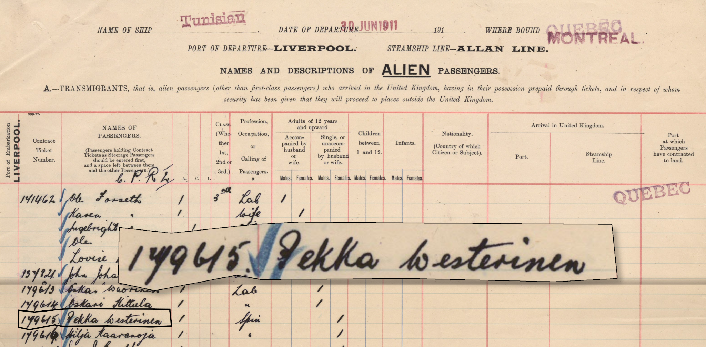
This UK passenger leaving list shows that on June 30, 1911, Pekka Westerinen boarded the ship Tunisian from Liverpool to Quebec, ticket number 149615213.
He was incorrectly noted as Spin[ster] / female. This was a typo. He should have been noted as Lab[ourer] / male.
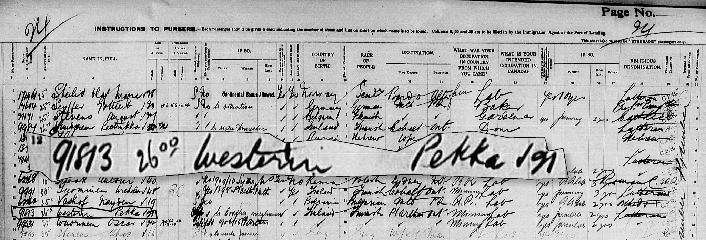
This Canadian passenger list shows that on July 9, 1911, Pekka Westerinen, 21-year-old, male, labourer, arrived in Quebec City from the ship Tunisian, ticket number 91813, to meet his brother in Port Arthur214.
While the ticket number doesn’t match his record on the UK leaving list, it is the same ship.
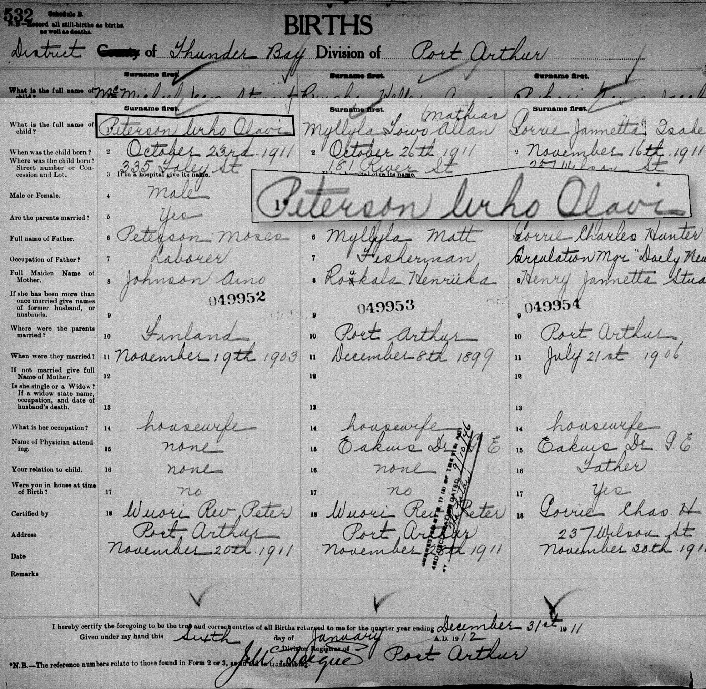
This Port Arthur, Thunder Bay District birth registration, number 049954, shows that on October 23, 1911, Urho Olavi Peterson, male, was born at 335 Foley Street to father Moses Peterson, labourer, and mother Aino Johnson, housewife, married in Finland on November 19, 1903215. His birth was certified by Rev[erend] Peter Wuori in Port Arthur on November 20, 1911, who went on to serve as president of the National Evangelical Lutheran Church, the Finnish-American Lutheran body, from 1914 to 1918216.
335 Foley Street was the family’s own home. I once left open whether it might instead have been a house where the Finns of the neighbourhood went to give birth; the community’s press settles it—Työkansa’s death notice a year later records Urho dying kotonaan, at his home, at this address, and the family placed its own classifieds on the house217,218.
The registration’s “married in Finland on November 19, 1903” is the informant’s slip. The Ruokolahti communion book records the marriage on October 19, 1902, and Urho Mauno’s 1913 birth registration gives October 19, 1903. This book follows the communion book, the record made closest to the event.
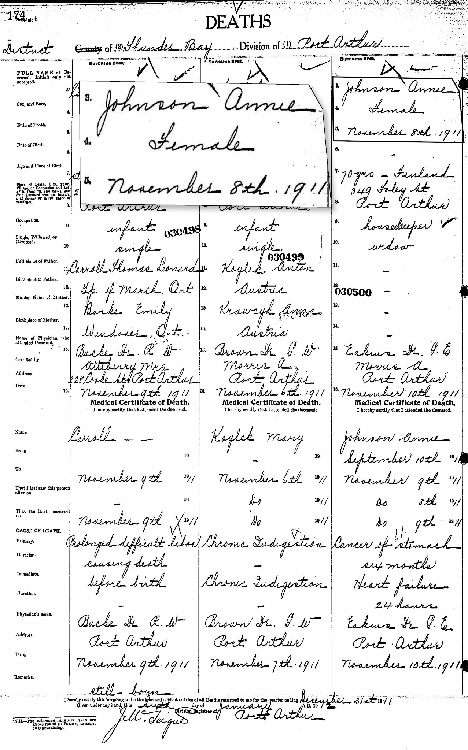
This Port Arthur, Thunder Bay District death registration, number 030500, shows that on November 8, 1911, Annie Johnson, female, widow, housekeeper, died at 349 Foley Street, Port Arthur from heart failure that lasted 24 hours due to cancer of the stomach that lasted six months. From September 10 to November 8 she was attended by Dr. G[eorge] E. Eakins219, who was president of the Thunder Bay Historical Society from 1933 to 1934 and president of the Thunder Bay Medical Society in 1915, 1925 and 1936220.
It is because both this death and Urho’s birth happened on Foley Street that suggests Moses and his family rented a house on this street or close by. This would situate them in the Finlandia neighbourhood of Port Arthur221. 349 was also the address of Aino’s brother Victor Johnson in later years. So perhaps the Johnsons rented the room in this boarding house together.
II. Kalle’s Voyage
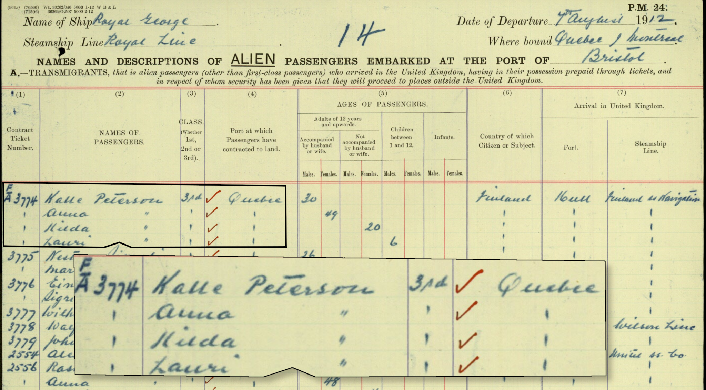
This UK passenger leaving list shows that on August 4, 1912, Kalle Peterson, male, 30, Anna Peterson, 49, female, Hilda Peterson, 20, female, and Lauri Peterson, 6, male, of Finland, arrived in Hull, UK, and then boarded the ship Royal George from Bristol to Quebec, ticket number 3774, 3rd class222.
It erroneously shows that Kalle and Anna are married. Anna was Kalle’s mother. Hilda was Peter’s future wife. Lauri was Kalle’s son. The ages are off too: Kalle, born in 1874, was 38, not 30, and Anna Maria, born in 1853, was 59, not 49—one more record placing her birth a decade late (see the note on her death registration).
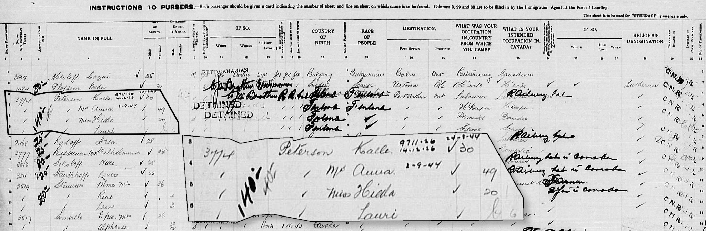
This Canada passenger list shows that on August 14, 1912, Kalle Peterson, male, 30, labourer, Ms. Anna Peterson, 49, female, widow, housekeeper, Miss Hilda Peterson, 20, female, spinster, domestic, and Lauri Peterson, 6, male, scholar, of Finland, Lutheran, arrived in Quebec City from the ship Royal George, ticket number 3774, to meet Kalle’s brother in Port Arthur via the C.N.R. Like Moses before him, Kalle declared his intended occupation in Canada as a railway labourer. However, Anna and Hilda were detained223.
Kalle, being an able-bodied adult male, would have been allowed to immigrate with his son Lauri. Anna and Hilda needed to wait for Petter or Moses to sponsor them.
Read closely, this single page was written in several hands at different moments. The first is the purser’s: the original entries listing the family as they boarded—Kalle a labourer, Anna a widowed housekeeper, Hilda a Miss, spinster and domestic. The second belongs to the inspecting officer at Quebec, who struck a bold DETAINED across Anna’s and Hilda’s lines—and theirs alone—flagging the two unsponsored women before the Board of Inquiry ever convened. The third is heavier, darker ink entered around the hearing: a relative-to-join disposition reading “to Brother, R.R. Lab.”—released to join the brother already established as a railway labourer at Port Arthur. Tellingly, this disposition leaves Hilda’s entry exactly as written, Miss / spinster / domestic; nothing on the page amends her to a wife.
A later hand annotated the manifest decades after the crossing. Faint verification marks—dated to late 1926 and again to 1944 (24-8-44, 2-9-44), with check marks set against the family’s lines—record occasions when a government office pulled this very sheet to confirm a date of landing. Such verifications were demanded when an immigrant applied for naturalization, a passport, or an Old Age Pension; the 1944 cluster fits Kalle precisely, who turned seventy—the pension age—that year. Each mark is a thread still to be pulled: the verifications point to separate files (the naturalization records of 1915–1951 are indexed at Library and Archives Canada) that may yet name dates, residences, and kin not captured here.
III. The Reckoning
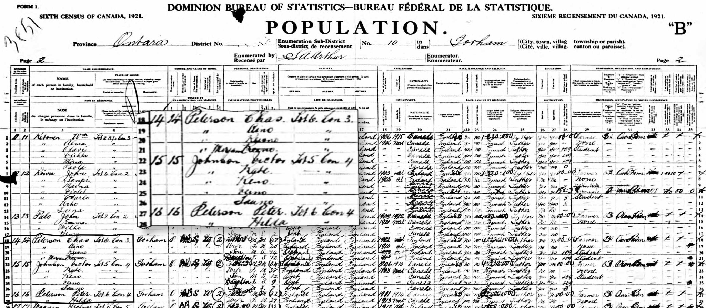
These 1921 Canada Census records show the two Peterson families and the Johnson family. Victor Johnson was Aino’s brother. The three families each lived in a 2 room wood house that they own, were all Finnish speaking, Lutheran, and born in Finland, except for Victor’s three children who were born in Ontario. Kalle’s family, number 14, was at Lot 6 Con[cession] 3224; Victor’s family, number 15, was at Lot 5 Con[cession] 4225; and Peter’s family, number 16, was at Lot 6 Con[cession] 4226.
| Fam. | Name | Rel. | Sex | Marital | Age | Imm. | Nat. | Occup. | Eng. | Read | Write |
|---|---|---|---|---|---|---|---|---|---|---|---|
| 14 | Chas. [Kalle] Peterson | head | male | married | (47) | 1912 | naturalized | farmer | no | no | no |
| 14 | Aino Peterson | wife | female | married | 40 | 1910 | naturalized | none | no | no | no |
| 14 | Ryeno [Reino] Peterson | son | male | single | 12 | 1910 | alien | student | yes | yes | yes |
| 14 | Mirjam Peterson | daughter | female | single | 12 | 1910 | alien | student | yes | yes | yes |
| 15 | Victor Johnson | head | male | married | (34) | 1906 | 1910 | miner | no | yes | no |
| 15 | Kate Johnson | wife | female | married | 39 | 1908 | naturalized | none | no | no | no |
| 15 | Reino Johnson | son | male | single | 12 | n/a | n/a | student | yes | yes | yes |
| 15 | Vino [Vieno] Johnson | daughter | female | single | 9 | n/a | n/a | student | yes | yes | yes |
| 15 | Tauno Johnson | son | male | single | 7 | n/a | n/a | student | yes | yes | yes |
| 16 | Peter Peterson | head | male | married | (32) | 1911 | 1914 | farmer | yes | yes | yes |
| 16 | Hilda Peterson | wife | female | married | 27 | 1913 | naturalized | none | no | no | no |
(Read and Write record literacy in English or French.)
Interestingly, Peter was the only adult of the families who could speak, read and write in English. Hilda actually immigrated with Kalle in August 1912. Perhaps she misremembered and gave 1913. Chas. is the abbreviation of Charles, which is the Anglicization of Kalle (in Swedish it is Karl). They were all neighbours in a lot / concession grid, with Peter Peterson and Victor Johnson on Concession 4 (Lots 6 and 5) and Kalle Peterson on Lot 6 of Concession 3. The census’s own cells wobble: Reino’s “12” runs behind (he was thirteen or fourteen at the June 1921 count), Mirjam’s “12” a year ahead (she was eleven), and Peter’s “(32)” a year over (he was thirty-one).
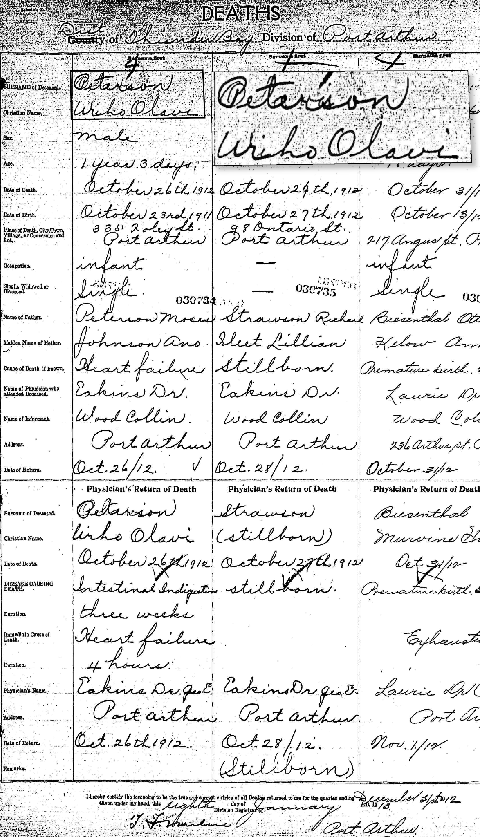
This Port Arthur, Thunder Bay District death registration, number 030734, shows that on October 26, 1912, Urho Olavi Peterson, male, infant, 1-year-3-days old, with father Moses Peterson, and mother Aino Johnson, died at 335 Foley Street, Port Arthur due to heart failure that lasted 4 hours due to intestinal indigestion that lasted 3 weeks. He was attended by Dr. Geo[rge] E. Eakins. Collin Wood was the informant227.
335 Foley Street is the same address Urho was born at, and Työkansa’s death notice printed four days later says he died kotonaan—at his home—confirming the house as the family’s rented dwelling228.
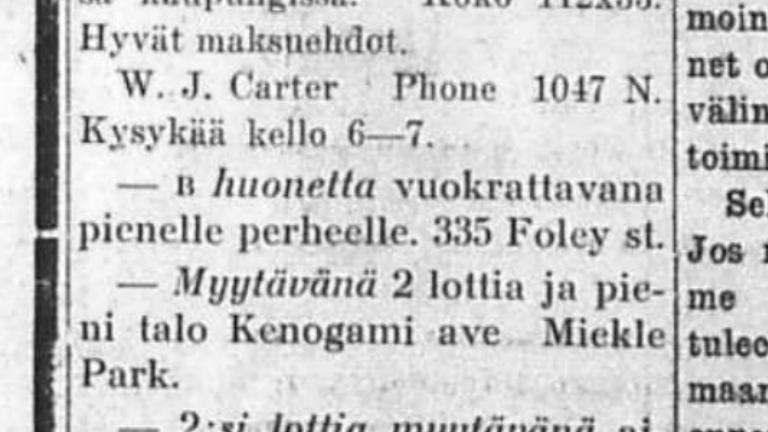
This Työkansa classified of early January 1913 offers the family’s house to let: “— [2] huonetta vuokrattavana pienelle perheelle. 335 Foley st.”—rooms to let for a small family229. The advertisement ran about a week.
The leading character is battered type—a 2, or possibly a ½. Ten weeks after Urho died in the house, the family was advertising it to the next small family; by Urho Mauno’s birth that March their address was 265 Bay Street.
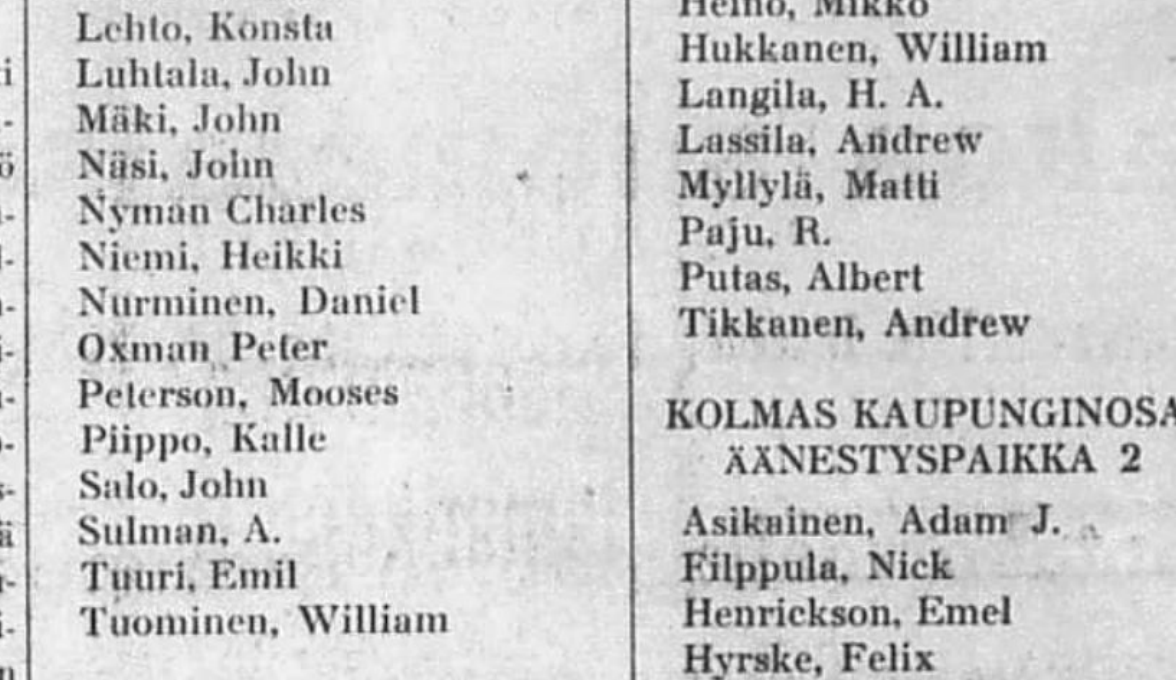
The same January 1913 issue prints the Finnish socialists’ roll of municipal voters for the January 6 election, organized by ward and polling place; “Peterson, Mooses” stands in the Second Ward list230.
Here the name is printed in full. The 1911 leads gave only “M. Peterson”—an initial, on a surname that was among the commonest at the Lakehead—while “Mooses” is the family’s own form, and it draws the recurring Port Arthur Peterson and the man of 335 Foley into one. The company is telling: Luhtala, Kannasto, Selkämaa, Kivelä, Oxman and several Johnsons, the local’s working figures, on a list the paper set in type to turn its own people out ward by ward and polling place by polling place, the columns beside it urging comrades to vote and noting that the roll is posted at city hall. It is the household inside the movement’s machinery.
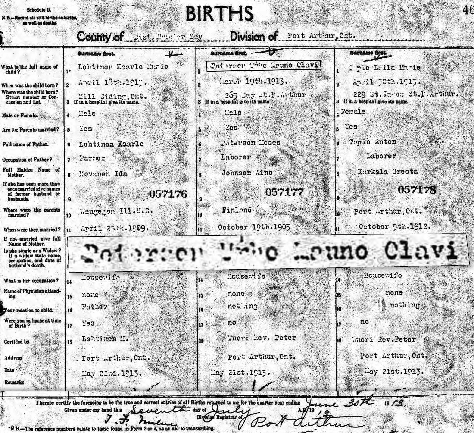
This Port Arthur, Thunder Bay District birth registration, number 057177, shows that on March 19, 1913, Urho Mauno Olavi Peterson, male, with father Moses Peterson, labourer, and mother Aino Johnson, housewife, married in Finland on October 19, 1903, was born at 265 Bay Street, Port Arthur. His birth was certified by Rev. Peter Wuori on May 21, 1913231.
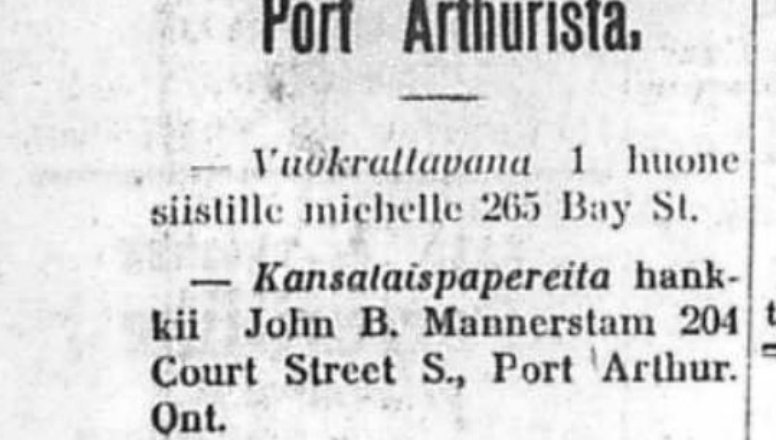
This Työkansa Port Arthur column of June 2, 1913, opens with a classified on the family’s new address: “— Vuokrattavana 1 huone siistille miehelle 265 Bay St.”—to let, one room for a tidy man232. The advertisement first appears on May 30, ten weeks after Urho Mauno’s birth in the house.
No name is attached—the family never signed its classifieds. Later the same month another notice placed a masseuse “just arrived from Finland” receiving clients at 265 Bay St.233—a boarder, or kin; the town’s established masseuses worked from their own addresses.
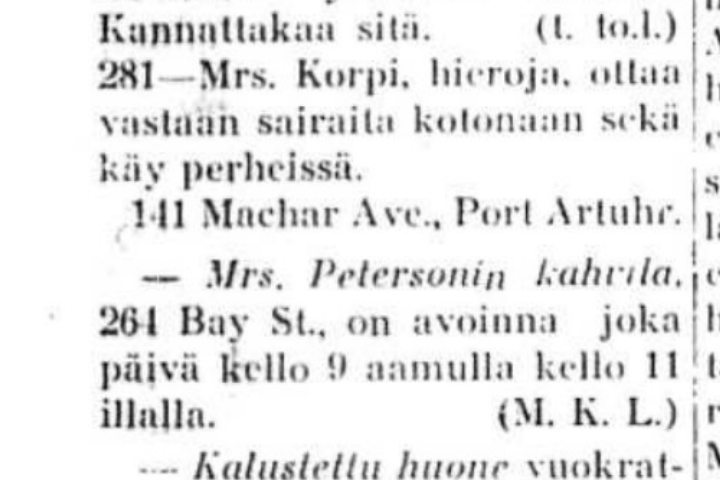
From late November 1913 Työkansa carries a standing daily advertisement: “— Mrs. Petersonin kahvila, 264 Bay St., on avoinna joka päivä kello 9 aamulla kello 11 illalla.”—Mrs. Peterson’s café, 264 Bay St., open every day from 9 in the morning to 11 at night. It closes with the printed tag “(M. K. L.),” of a kind with the insertion codes on the neighbouring classifieds234.
264 Bay Street is not the family’s 265. It is a commercial address on the even side of the street, opposite their rooms, and it turned over its tenants like one: Whitehead Ltd’s coal and wood through March 1913 (the ad runs some three dozen times), then N. Partti’s shop from April to July (the classifieds call the trade a tailor’s, the May services directory a shoe shop), then a café — unnamed in the paper — already running at the number by September 5. The Peterson advertisement itself only stands from late November, so it marks when the café took the name in print, not when a café opened there. A Finnish “Mrs. Peterson” keeping a café at the family’s own doorstep is very likely Aino, but Peterson was a common name, the café stood on separate premises, and no other record yet proves the identification.
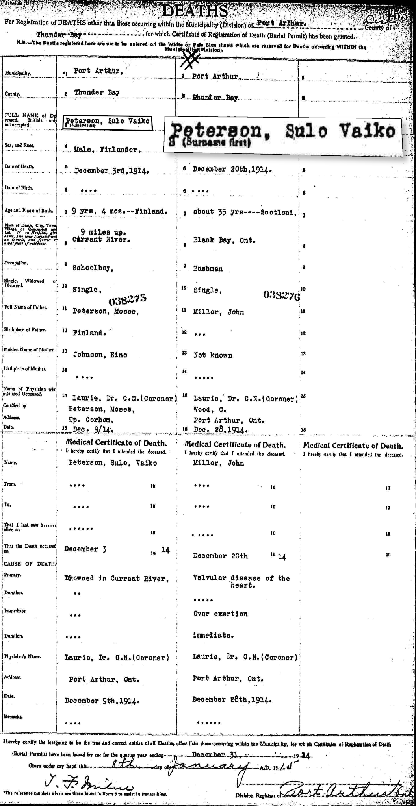
The Port Arthur, Thunder Bay District death registration, number 038275, shows that on December 3, 1914, Sulo Vaiko Peterson, male, 9-years-4-months old, schoolboy, with father Moses Peterson and mother [A]ino Johnson, all of Finland, drowned 9 miles up the Current River. His father Moses and Dr. C. N. Laurie, coroner, certified his death on December 9235.
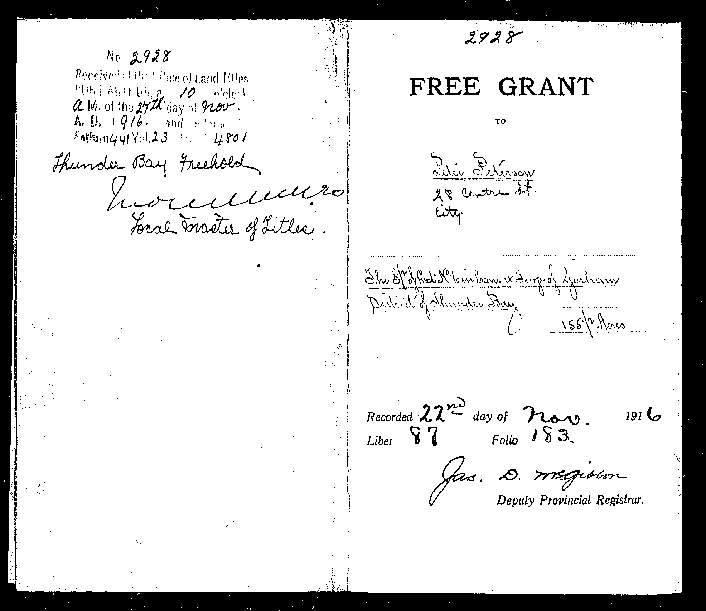
This first page of Peter’s free grant patent shows he lived at 28 Centre St236.
Today, there is no Centre Street in the area previously known as Port Arthur. This likely was a boarding house in the Finlandia neighbourhood where he would have rented a room; a Työkansa classified of July 24, 1913—“Kalustettuja huoneita vuokrattavana 28 Centre st”—confirms the address let furnished rooms, and the street was a small Finnish commercial strip with Wm. Blomqvist’s bakery two doors down at No. 30237,238.
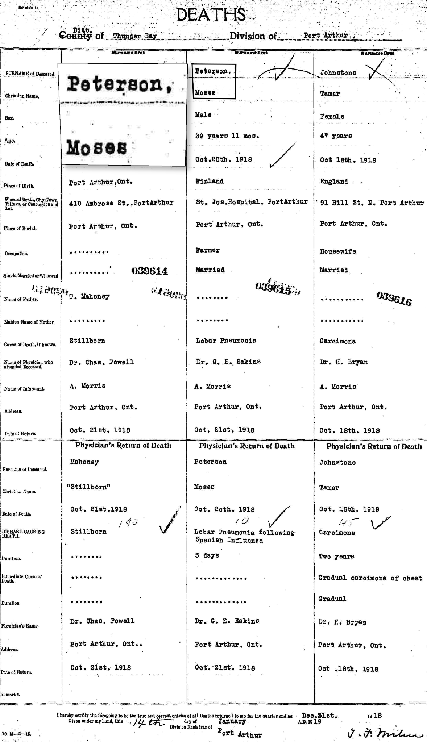
This Port Arthur, Thunder Bay District death registration, number 039615, shows that on October 20, 1918, Moses Peterson, male, 39-years-11-months old, of Finland, farmer, married, died in St. Joseph’s Hospital, Port Arthur of lobar pneumonia following Spanish influenza that lasted 3 days. He was attended by Dr. G[eorge] E. Eakins and his informant was A. Morris. He was buried in Port Arthur239.
The registration’s “39-years-11-months” runs a year ahead: born on November 21, 1879, Moses was 38 years and 11 months old.
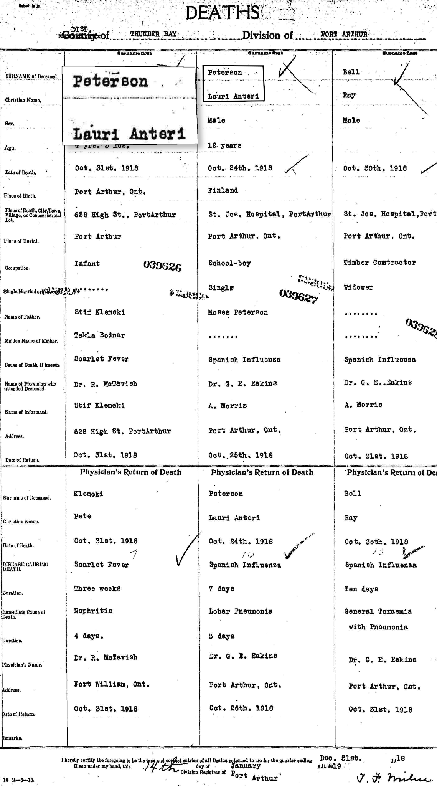
This Port Arthur, Thunder Bay District death registration, number 039627, shows that on October 24, 1918, Lauri Anteri Peterson, male, 12-years-old, of Finland, schoolboy, with father Moses Peterson [sic], died from lobar pneumonia that lasted 3 days caused by Spanish influenza that lasted 7 days. He was attended by Dr. G[eorge] E. Eakins and his informant was A. Morris. He was buried in Port Arthur240.
It’s likely that Moses and Lauri were quarantined away from the rest of the family at the time and so the informant, A. Morris, may have been under the impression that they were father and son, but this wasn’t actually true. Moses was Lauri’s uncle and Lauri’s father was Kalle.
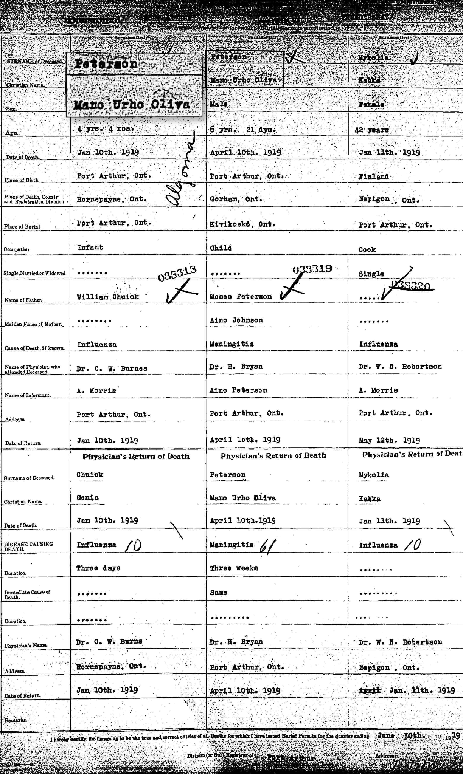
This Port Arthur, Thunder Bay District death registration, number 033319, shows that on April 10, 1919, Mano Urho Oliva Peterson, male, 6-years-21-days-old [sic], with father Moses Peterson, and mother Aino Johnson, died at home in Gorham from meningitis that lasted 3 weeks. He was attended by Dr. H. Bryan. He was buried in the Kivikoski Cemetery241.
The Kivikoski Cemetery is a cemetery dedicated to the Finnish pioneers of the Lakehead region. Several of the Petersons are buried there or are present on a plaque dedicated to them242. Be careful when researching this cemetery. There is a Roots Web page by Jude Mitchell which is insufficiently researched and has at least one incorrect date.
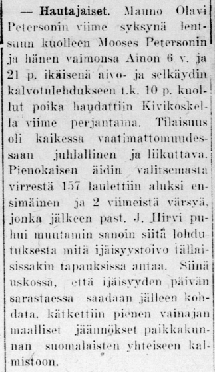
— Funeral. Mauno Olavi Peterson, the son of Mooses Peterson (who died of the flu last autumn) and his wife Aino, who died at the age of 6 years and 21 days on the 10th of this month from cerebrospinal meningitis, was buried in Kivikoski last Friday. The occasion was, in all its modesty, solemn and touching. From Hymn 157, chosen by the little one’s mother, the first and the last two verses were sung at the beginning, after which Pastor J. Hirvi spoke a few words about the comfort that the hope of eternity provides even in cases like this. In the faith that when the day of eternity dawns we will meet again, the earthly remains of the small deceased were laid to rest in the local Finns’ common cemetery243.
Hymn 157
Verse 1 Varjele sanaas, Jumala, ja niiden voima masenna, jotk’ yrittävät alati kukistaa valtaa Poikasi!
Verse 4 Ain’ anna heidän tuntea, ett’et sä laumaas unhota, mut tahdot auttaa, vahvistaa, kun hätä sitä ahdistaa!
Verse 5 O Pyhä Henki, lohduta, ja rauhaan meitä johdata, tuskissa anna huojennus ja kuolossakin virvoitus!244
Preserve your Word, O God, and crush the power of those who ceaselessly strive to overthrow the rule of your Son. Let them always know that you do not forget your flock, but will help and strengthen it when distress besets it. O Holy Spirit, comfort us, and lead us into peace; in anguish grant relief, and even in death, revival.
The funeral notice says only “Hymn 157,” and an earlier draft of this book quoted No. 157 of the modern hymnal—Hemminki of Masku’s Maailma täynnä turhuuttaan (“The world, full of its vanity”), which entered the hymnal at that number only with the 1938 revision245. In April 1919 the congregation sang from the 1886 hymnal, and there No. 157 is Luther’s Varjele sanaas, Jumala (Erhalt uns, Herr, bei deinem Wort, known in English as “Lord, keep us steadfast in Thy Word”)246. The notice’s “first and the last two verses” fits the five-verse hymn as verses 1, 4, and 5, transcribed above; the closing verse is a prayer to the Holy Spirit, the Comforter. The English rendering is the book’s own.
IV. Replanting
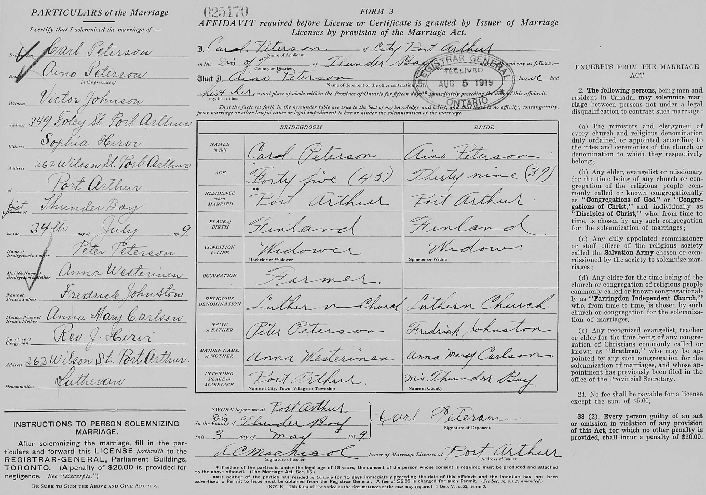
This Ontario marriage affidavit shows that on July 24, 1919, Carl [Kalle] Peterson, 45-years-old, widower, farmer, of Port Arthur, born in Finland to father Peter Peterson and mother Anna Westerinen, and Aino Peterson, 39-years-old, widow, of Port Arthur, born in Finland to father Frederick Johnston and mother Anna Mary Carlson, were married by Rev. J. Hirvi, of 262 Wilson Street, in the Lutheran denomination. Their witnesses were Victor Johnson, of 349 Foley Street, and Sophia Hirvi of 262 Wilson Street247.
Victor Johnson was Aino’s brother. His address, 349 Foley Street, is where his mother Anna Maria Johnson died in 1911, suggesting that it was the Johnson residence while 335 Foley Street, where Urho Olavi was born in 1911, was the Peterson residence. Rev. Jacob Hirvi was pastor of the National Evangelical Lutheran Church in Port Arthur. His wife was Sophia248. The affidavit’s ages wobble by a year: Aino, born March 17, 1881, was 38, not 39 (Kalle’s 45 is exact).
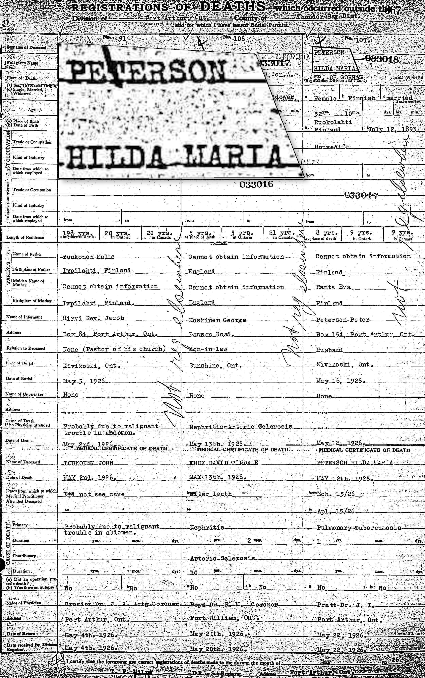
This Port Arthur, Thunder Bay District death registration, number 033017, shows that on May 12, 1926, Hilda Maria Peterson, female, Finnish, married, 32-years-10-months-old, housewife, born in Ruokolahti, Finland, July 12, 1893, to mother Eva Ranta, died at home of pulmonary tuberculosis that lasted 1 year. She was attended by Dr. J. I. Pratt from March 15 to April 15. Peter Peterson, her husband, was the informant. She was buried in the Kivikoski Cemetery on May 16249.
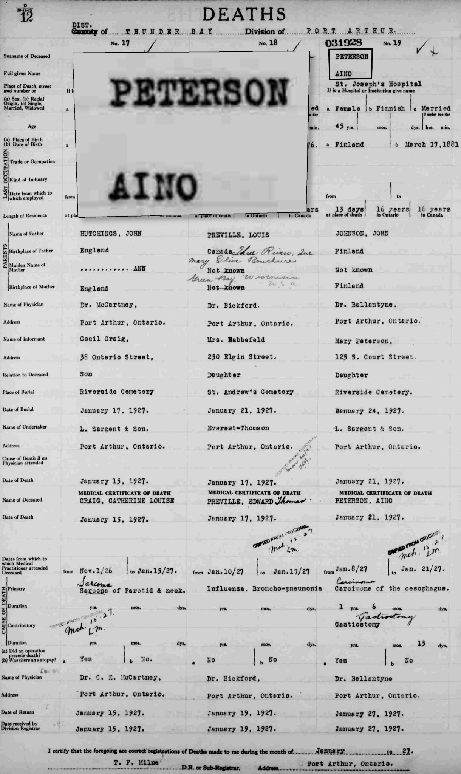
This Port Arthur, Thunder Bay District death registration, number 031928, shows that on January 21, 1927, Aino Peterson, female, Finnish, married, 45-years-old, born in Finland on March 17, 1881, to father John Johnson, died at St. Joseph’s Hospital due to a gastrostomy that lasted 13 days due to esophageal cancer that lasted 1 year and 6 months. She was attended by Dr. Bellantyne from January 8 to 21. M[irjam] Peterson, her daughter, 125 South Court Street, was her informant. She was buried in Riverside Cemetery on January 24, 1927, by undertaker L. Sargent & Son250.
A gastrostomy is a surgical procedure where an opening is created into the stomach from the abdominal wall.
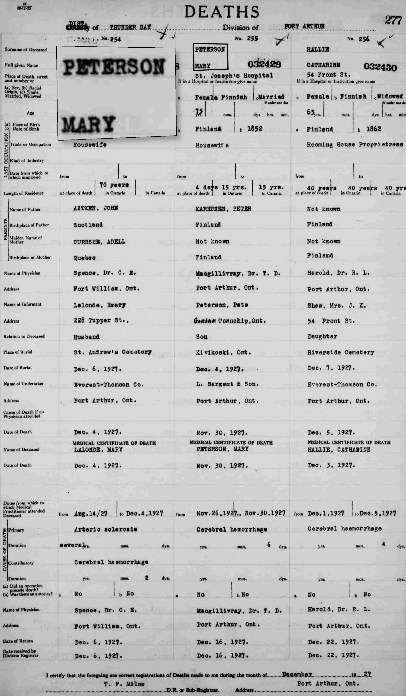
This Port Arthur, Thunder Bay District death registration, number 032429, shows that on November 30, 1927, Mary Peterson, female, Finnish, married [sic], 75-years-old, housewife, born in 1852 to father Peter Karhunen, died at St. Joseph’s Hospital from a cerebral hemorrhage that lasted 6 days. She was attended by Dr. T. D. Macgillivray from November 26 to 30. Pete[r] Peterson, her son, of Gorham Township, was the informant. She was buried in Kivikoski Cemetery on December 4, 1927, by undertaker L. Sargent & Son251.
The Karttula communion book gives her exact birth as March 15, 1853, which makes her 74 at her death—not 75—and puts the “1852” here a year out. (The “father Peter Karhunen” is also confused: that was her late husband’s name, supplied by their son Peter, the informant.) Such slips are routine across her records: her son Petter’s 1890 birth register put her age at 27 when she was 36, and the household lastenkirja recorded her birth year as 1855. The communion book, which records the day itself, is the most precise of the four and is the date this book follows252.
V. The River’s Grasp
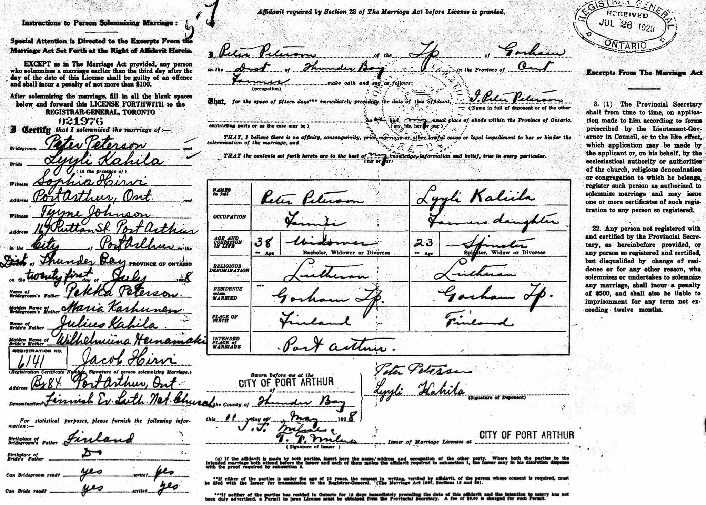
This Ontario marriage affidavit shows that on July 21, 1928, Peter Peterson, farmer, 38-years-old, widower, of Gorham, born to father Pekka Peterson and mother Maria Karhunen, and Lyyli Kahila, farmer’s daughter, 23-years-old, spinster, of Gorham, born to father Julius Kahila and mother Wilhelmina Heinämäki, were married by [Rev.] Jacob Hirvi in the Lutheran denomination. Their witnesses were Sophia Hirvi and Tyyne Johnson, of 167 Ruttan Street253.
Tyyne Johnson may have been related to Aino given their shared last name. She was a member of the same Lutheran Church254.
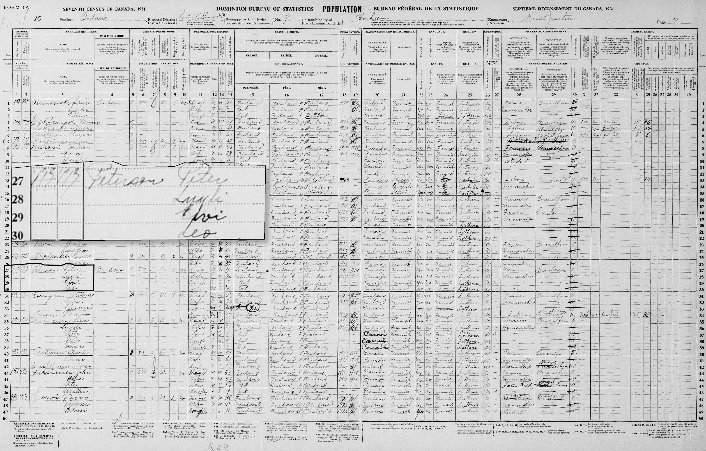
These 1931 Census of Canada records show the Peter Peterson family, number 108255, as well as the families of his neighbours with whom he transacted land: Eric [Erkki] Smolander, number 107256, and John Pursiainen, number 112257.
| Fam. | Name | Relationship | Age | Immigrated | Speak English | Occupation |
|---|---|---|---|---|---|---|
| 107 | Eric Smolander | head | 45 | 1911 | no | farmer |
| 107 | Maria Smolander | wife | 39 | 1913 | no | homemaker |
| 108 | Peter Peterson | head | 41 | 1911 | yes | farmer |
| 108 | Lyyli Peterson | wife | 26 | 1927 | no | homemaker |
| 108 | Elvi Peterson | daughter | 9 | yes | ||
| 108 | Leo Peterson | son | 1/12 | no | ||
| 112 | John Pursiainen | head | 53 | 1911 | no | farmer |
| 112 | Ulla Pursiainen | wife | 47 | 1913 | no | homemaker |
| 112 | Ate Pursiainen | son | 16 | yes | farm help | |
| 112 | Martha Pursiainen | daughter | 9 | yes |
For some strange reason, the enumerator put “no” across the board for “Can read or write” on this page. Peter was capable of reading and writing English and the children certainly were too. Leo’s age is another slip: entered as “1/12”—one month—though, born on December 6, 1930, he was about six months old at the June 1931 count.
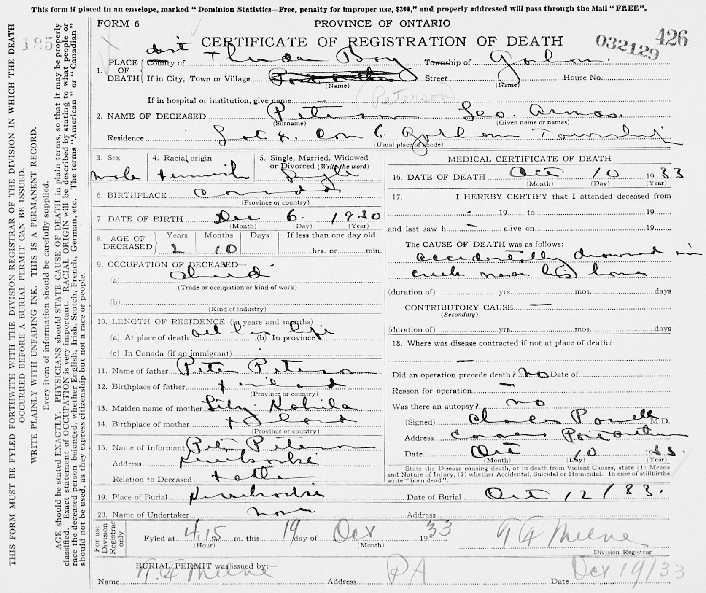
This Ontario death registration certificate, number 032129, shows that on October 10, 1933, Leo Armas Peterson, of Lot 4 Con. 6, Gorham, 2-years-10-months-old, male, born in Canada on December 6, 1930, to father Peter Peterson, of Finland and mother Lily Kahila, of Finland, accidentally drowned in the creek near his farm. The coroner was [Dr.] Charles Powell. His father, Peter Peterson, was the informant. He was buried in Kivikoski Cemetery on October 12258.
The registration’s “Lot 4 Con. 6” is the registrar’s transposition: the farm was Lot 6, Concession 4, and no other record places the family anywhere else.
VI. Room 13
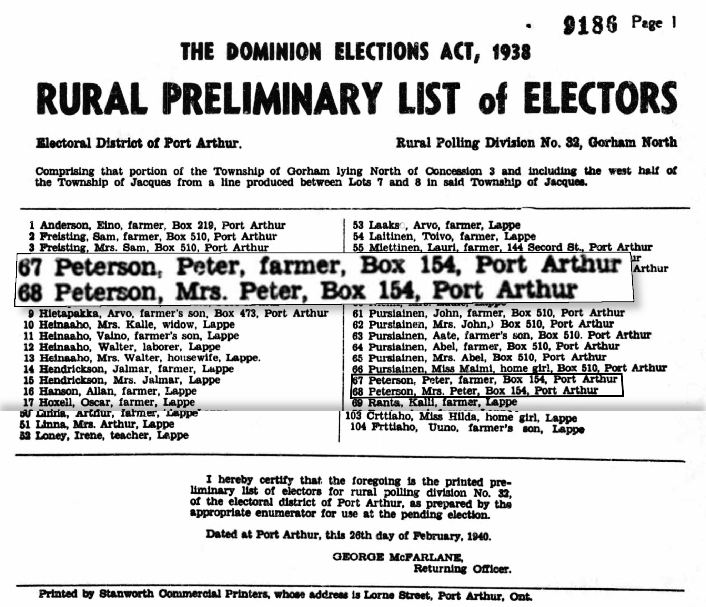
This 1940 Voter List shows Peter259 and Mrs. [Lyyli] Peterson260 lived together as well as John Pursiainen261 who helped buy the land for Tarmola Hall with Erkki and Kalle.
The Smolanders were absent, suggesting they never returned from Karelia.
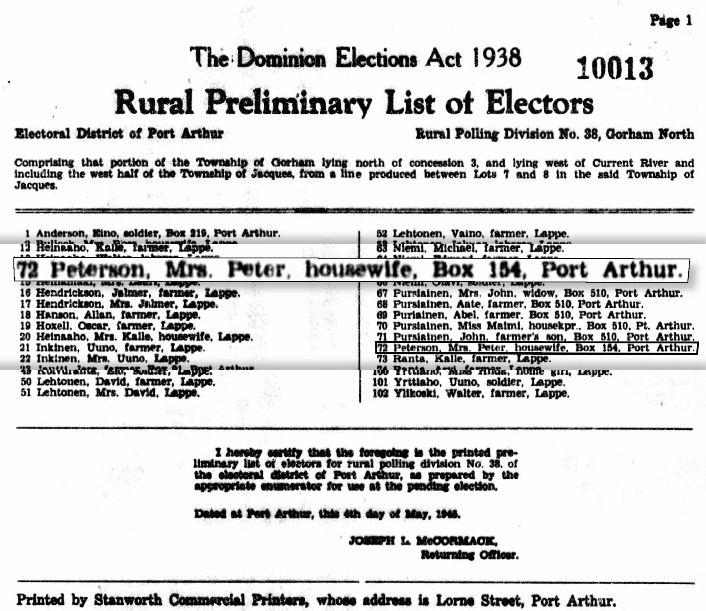
This 1945 Voter List shows the absence of Peter which sets an upper bound on when he left the family262.
It also shows that his friend John Pursiainen’s wife was widowed263 in the same time period Peter went missing, adding another layer to Peter’s grief.
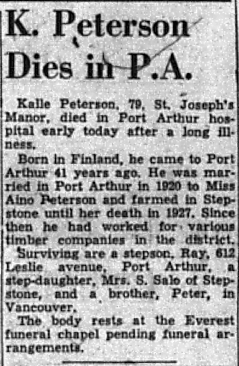
Kalle’s obituary from the Fort William Daily Times-Journal in 1953 mentioned Peter surviving his brother Kalle in Vancouver264.
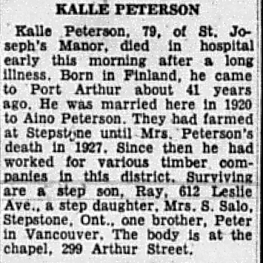
Kalle’s obituary from the Port Arthur Daily News265.
Both obituaries also mention Kalle leaving Stepstone in 1927 after Aino died, which certainly made life harder for Peter. If you look up Stepstone on Google Maps, that is almost exactly where their homesteads were and is the centre point of what was previously known as Tarmola. It is most likely that Reino (Ray)266 or Mirjam (Mrs. S[ulo] Salo)267 wrote these obituaries and they didn’t know Peter had already died. Peter may have kept in touch with Kalle but it’s unlikely considering how close Reino and Mirjam were to their step-father.
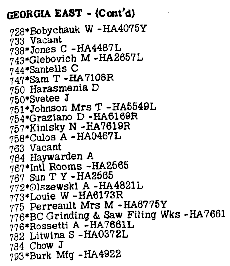
This 1951 B.C. City Directory clipping shows that International Rooms was at 767 East Georgia Street, Vancouver. Sun T Y, the landlord, appears on the next row268.
The building no longer exists today.
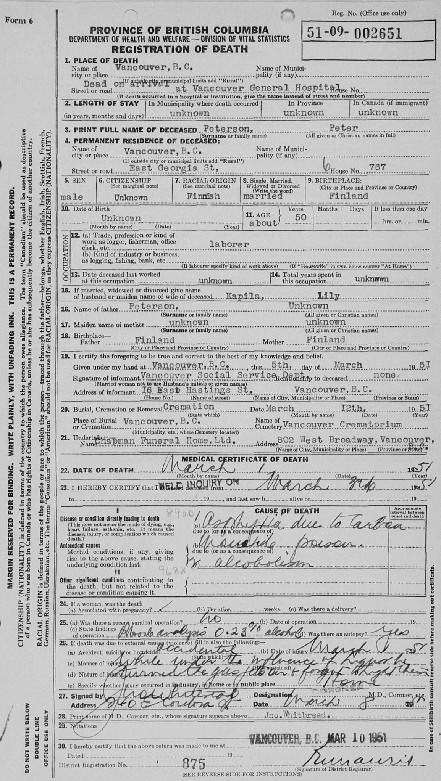
This British Columbia death registration, number 51-09-002651, shows that on March 1, 1951, Peter Peterson, male, Finnish, of 767 East Georgia Street, about 50-years-old, labourer, with wife Lily Kapila [sic], was dead on arrival at Vancouver General Hospital due to asphyxia due to carbon monoxide poisoning due to alcoholism. His death was certified by the coroner, J.D. Whitbread. His informant was the Vancouver Social Services Department. He was cremated at Vancouver Crematorium on March 12269.
J.D. Whitbread held an inquiry which is a very basic investigation into the cause of death. It provided more information but unfortunately did not reveal how the informant knew his wife’s name270. With the Vancouver Social Services Department as the informant, it paints a clear picture of Peter being poor and homeless at the time.

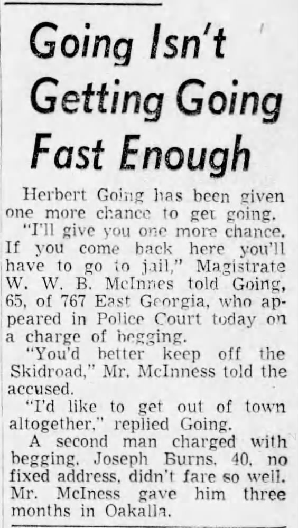
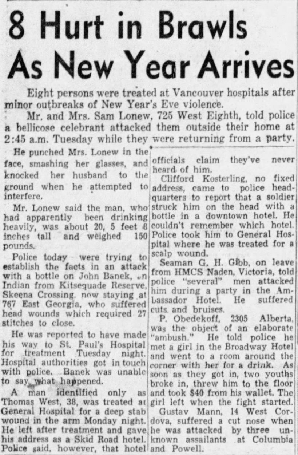
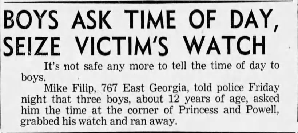
The above newspaper clippings provide us with some insight into the kind of property 767 East Georgia Street was271,272,273,274.
Bibliography
Archives & Digital Collections at Lakehead University Library. early 1900s. “Finnish National Evangelical Lutheran Church.” Archive. early 1900s. Accessed January 1, 2026. https://digitalcollections.lakeheadu.ca/items/show/2580.
Asikkalan seurakunta (Asikkala Parish). 1881. “Syntyneet Ja Kastetut 1880–1885 (MKO76-83) — Aina, b. March 17, 1881.” Suomen Sukuhistoriallinen Yhdistys (SSHY). Accessed July 3, 2026. http://www.sukuhistoria.fi/sshy/sivut/jasenille/paikat.php?bid=16024&pnum=61.
Austermann, Harold. 1970. “A History of the National Evangelical Lutheran Church to Merger with the Lutheran Church--Missouri Synod.” Bachelor of Divinity research paper, Concordia Seminary. Accessed July 3, 2026. https://scholar.csl.edu/bdiv/773.
Auttaja (Ironwood, Michigan). 1933. “Suomalainen Lapsi Hukkui Pieneen Puroon Kotinsa Lähellä Gorhamissa.” October 26, p. 1.
B.C. Directories Limited. 1951. “Intl Rooms, 767 Georgia East.” Address Book Record. B.C. Directories Limited. British Columbia City Directories 1860-1955; 1951 Vancouver and New Westminster City Directory, p. 272; Reel 980037. Vancouver Public Library. Accessed February 4, 2026. https://bccd.vpl.ca/title/1951/Vancouver_and_New_Westminster_City_Directory.html.
Beamish, Roy. 1940. “Red-Tinged Bodies Banned Along With ‘Cultural’ Societies | FASCISTS ALSO | 16 Groups Held to be Illegal.” The Globe and Mail (1936-) (Toronto, Ontario, Canada), June 6, p. 1–2. ISSN 03190714. Accessed January 29, 2026. https://www.proquest.com/docview/1356011217/abstract/772697CB61C4490DPQ/1.
Beaulieu, Michel S., David K. Ratz, and Ronald N. Harpelle, eds. 2018. Hard Work Conquers All: Building the Finnish Community in Canada. UBC Press.
Beaulieu, Michel S., David Ratz, Thorold Tronrud, and Jenna Kirker. n.d. Thunder Bay and the First World War, 1914-1919. Thunder Bay Museum. Accessed July 3, 2026. https://www.thunderbaymuseum.com/product/thunder-bay-and-the-first-world-war-1914-1919/.
Belshaw, John Douglas. n.d. “Female Immigrants and the Canadian State, 1860s Through the 20th Century.” In Canadian History: Post-Confederation. BCcampus Open Education. Accessed June 27, 2026. https://opentextbc.ca/postconfederation/chapter/5-10-female-immigrants-and-the-canadian-state-1860s-through-the-20th-century/.
Board of Trade. 1910a. “A Karhunen.” Passenger Leaving UK. FindMyPast, August 12. BT 27; Board Of Trade: Commercial And Statistical Department And Successors: Outwards Passenger Lists; Passenger Lists Leaving UK 1890-1960; Canadian Pacific “Empress of Britain”; Ticket 169202. The National Archives; database with images, FindMyPast. Accessed December 21, 2025. https://www.findmypast.co.uk/transcript?id=TNA%2FBT27%2F0662000052%2F00698.
Board of Trade. 1910b. “Moses Karhunen.” Passenger Leaving UK. FindMyPast, May 7. BT 27; Board Of Trade: Commercial And Statistical Department And Successors: Outwards Passenger Lists; Passenger Lists Leaving UK 1890-1960; Allan Line “Pretorian”; Ticket 873. The National Archives; database with images, FindMyPast. Accessed December 21, 2025. https://www.findmypast.co.uk/transcript?id=TNA%2FBT27%2F0646000013%2F00100.
Board of Trade. 1911. “Pekka Westerinen.” Passenger Leaving UK. FindMyPast, June 30. BT 27; Board Of Trade: Commercial And Statistical Department And Successors: Outwards Passenger Lists; Passenger Lists Leaving UK 1890-1960; Allan Line “Tunisian”; Ticket 149615. The National Archives; database with images, FindMyPast. Accessed December 21, 2025. https://www.findmypast.co.uk/transcript?id=TNA%2FBT27%2F0708000050%2F00905.
Board of Trade. 1912. “Kalle Peterson.” Passenger Leaving UK. FindMyPast, August 7. BT 27; Board Of Trade: Commercial And Statistical Department And Successors: Outwards Passenger Lists; Passenger Lists Leaving UK 1890-1960; Royal Line “Royal George”; Ticket 3774. The National Archives; database with images, FindMyPast. Accessed December 21, 2025. https://www.findmypast.co.uk/transcript?id=TNA%2FBT27%2F0742000033%2F00517.
Board of Trade. 1927. “Lyyli Kahila.” Passenger Leaving UK. FindMyPast, August 12. BT 27; Board Of Trade: Commercial And Statistical Department And Successors: Outwards Passenger Lists; Passenger Lists Leaving UK 1890-1960; Canadian Pacific “Montcalm”; Ticket 169202. The National Archives; database with images, FindMyPast. Accessed December 28, 2025. https://www.findmypast.co.uk/transcript?id=TNA%2FBT27%2F1158000020%2F00594.
Britannica. 2025. “Canadian Shield.” Encyclopedia. November 7. Accessed December 29, 2025. https://www.britannica.com/place/Canadian-Shield.
British Columbia Coroners Service, and J.D. Whitbread. 1951. “B.C. Coroner’s Inquiry. Peter Peterson.” Coroner’s Inquiry. Vancouver, B.C., March 3. C-81-4-89. British Columbia Archives.
British Columbia Vital Statistics Agency. 1951. “Peter Peterson.” Death Registration. British Columbia Vital Statistics Agency, March 1. Reg. No. 1951-09-002651; Film B13207; GSU Film 2032699. British Columbia Archives. Accessed December 28, 2025. https://search-collections.royalbcmuseum.bc.ca/Genealogy/Results?as.type_death=true&as.registration_num=1951-09-002651.
Canada, Office of the Chief Electoral Officer. 1940a. “John Pursiainen.” Voter List. Ancestry.com. RG113-B (R1003-6-3-E); Electoral District of Port Arthur, Rural Polling Division No. 32, Gorham North, image 117 of 215. Row 61. Library and Archives Canada; database with images, Ancestry.com. Accessed January 3, 2025. https://www.ancestry.ca/search/collections/2983/records/28970184.
Canada, Office of the Chief Electoral Officer. 1940b. “Mrs. Peter Peterson.” Voter List. Ancestry.com. RG113-B (R1003-6-3-E); Electoral District of Port Arthur, Rural Polling Division No. 32, Gorham North, image 117 of 215. Row 68. Library and Archives Canada; database with images, Ancestry.com. Accessed January 3, 2025. https://www.ancestry.ca/search/collections/2983/records/28970184.
Canada, Office of the Chief Electoral Officer. 1940c. “Peter Peterson.” Voter List. Ancestry.com. RG113-B (R1003-6-3-E); Electoral District of Port Arthur, Rural Polling Division No. 32, Gorham North, image 117 of 215. Row 67. Library and Archives Canada; database with images, Ancestry.com. Accessed January 3, 2025. https://www.ancestry.ca/search/collections/2983/records/28970184.
Canada, Office of the Chief Electoral Officer. 1945a. “Mrs. John Pursiainen.” Voter List. Ancestry.com. RG113-B (R1003-6-3-E); Electoral District of Port Arthur, Rural Polling Division No. 38, Gorham North, image 120 of 248. Row 67. Library and Archives Canada; database with images, Ancestry.com. Accessed January 3, 2025. https://www.ancestry.ca/search/collections/2983/records/28970184.
Canada, Office of the Chief Electoral Officer. 1945b. “Mrs. Peter Peterson.” Voter List. Ancestry.com. RG113-B (R1003-6-3-E); Electoral District of Port Arthur, Rural Polling Division No. 38, Gorham North, image 120 of 248. Row 72. Library and Archives Canada; database with images, Ancestry.com. Accessed January 3, 2025. https://www.ancestry.ca/search/collections/2983/records/28970184.
Canadan Uutiset (Port Arthur, Thunder Bay District, Ontario, Canada). 1922. “Hautaus.” Paikkakunnalta. August 3, p. 7. ISSN 0008-2775. Kansalliskirjaston digitaaliset aineistot. Accessed January 15, 2026. https://digi.kansalliskirjasto.fi/sanomalehti/binding/2786485?page=7.
Canadan Uutiset (Sudbury). 1915. “Lavantautia Tarmolassa.” November 25, p. 5. ISSN 0008-2775. Kansalliskirjaston digitaaliset aineistot. Accessed January 15, 2026. https://digi.kansalliskirjasto.fi/sanomalehti/binding/2781281?term=Tarmolan&page=5.
Canadan Uutiset (Sudbury). 1916. “Koulukokous.” August 31, p. 2. ISSN 0008-2775. Kansalliskirjaston digitaaliset aineistot. Accessed January 15, 2026. https://digi.kansalliskirjasto.fi/sanomalehti/binding/2781326?term=Tarmolan&page=2.
Canadan Uutiset (Sudbury). 1919a. “Hautajaiset: Urho Mauno Olavi.” April 17, p. 7. ISSN 0008-2775. Kansalliskirjaston digitaaliset aineistot. Accessed December 31, 2025. https://digi.kansalliskirjasto.fi/sanomalehti/binding/2786025?page=7.
Canadan Uutiset (Sudbury). 1919b. “Paikkakunnalta: Häitä.” July 31, p. 7. ISSN 0008-2775. Kansalliskirjaston digitaaliset aineistot. Accessed December 31, 2025. https://digi.kansalliskirjasto.fi/sanomalehti/binding/2786018?page=7.
Canadian Museum of Immigration at Pier 21. n.d.-a. “Immigration Act, 1910.” Halifax, Nova Scotia. Accessed June 27, 2026. https://pier21.ca/research/immigration-history/immigration-act-1910.
Canadian Museum of Immigration at Pier 21. n.d.-b. “Port of Precedence: A History of Immigration at the Port of Quebec.” Halifax, Nova Scotia. Accessed June 27, 2026. https://pier21.ca/research/immigration-history/port-precedence-history-quebec-1.
City of Thunder Bay. n.d. Finnish Labour Temple, 314 Bay Street. City of Thunder Bay. Accessed July 17, 2026. https://www.thunderbay.ca/en/city-hall/resources/Documents/HistoryHeritageandRecords/Finnish-Labour-Temple---ACC.pdf.
Dominion Bureau of Statistics. 1921a. “1921 Census of Canada: Family 14, Chas. Peterson.” Census Record. Ottawa, Ontario, Canada, June 1. RG 31; Reel T-25833; Image e003029549; Census Place: District 120, Port Arthur and Kenora, Subdistrict 10, Gorham Township (Ware), Ontario; Page: 2; Line 18. Library and Archives Canada. Accessed December 27, 2025. https://recherche-collection-search.bac-lac.gc.ca/eng/home/record?app=census&IdNumber=64984717&ecopy=e003029549.
Dominion Bureau of Statistics. 1921b. “1921 Census of Canada: Family 15, Victor Johnson.” Census Record. Ottawa, Ontario, Canada, June 1. RG 31; Reel T-25833; Image e003029549; Census Place: District 120, Port Arthur and Kenora, Subdistrict 10, Gorham Township (Ware), Ontario; Page: 2; Line 22. Library and Archives Canada. Accessed January 23, 2026. https://recherche-collection-search.bac-lac.gc.ca/eng/home/record?app=census&IdNumber=64984721&ecopy=e003029549.
Dominion Bureau of Statistics. 1921c. “1921 Census of Canada: Family 16, Peter Peterson.” Census Record. Ottawa, Ontario, Canada, June 1. RG 31; Reel T-25833; Image e003029549; Census Place: District 120, Port Arthur and Kenora, Subdistrict 10, Gorham Township (Ware), Ontario; Page: 2; Line 27. Library and Archives Canada. Accessed December 27, 2025. https://recherche-collection-search.bac-lac.gc.ca/eng/home/record?app=census&IdNumber=64984726&ecopy=e003029549.
Dominion Bureau of Statistics. 1921d. “1921 Census of Canada: Family 48, Jacob Hirvi.” Census Record. Ottawa, Ontario, Canada, June 1. RG 31; Reel T-25833; Image e003029640; Census Place: District 120, Port Arthur and Kenora, Subdistrict 17, Port Arthur City - Second Ward, Ontario; Page: 4; Line 43. Library and Archives Canada. Accessed January 24, 2026. https://recherche-collection-search.bac-lac.gc.ca/eng/Home/Record?app=census&IdNumber=64987290&ecopy=e003029640.
Dominion Bureau of Statistics. 1931a. “1931 Census of Canada: Family 107, Eric Smolander.” Census Record. Ottawa, Ontario, Canada, June 1. Image e011672189; Census Place: District 144B, Port Arthur-Thunder Bay, Subdistrict 9, Gorham and Jacques (Townships), Ontario; Page: 10; Line: 25. Library and Archives Canada. Accessed December 27, 2025. https://recherche-collection-search.bac-lac.gc.ca/eng/Home/Record?app=census&IdNumber=81315112&ecopy=e011672189.
Dominion Bureau of Statistics. 1931b. “1931 Census of Canada: Family 108, Peter Peterson.” Census Record. Ottawa, Ontario, Canada, June 1. Image e011672189; Census Place: District 144B, Port Arthur-Thunder Bay, Subdistrict 9, Gorham and Jacques (Townships), Ontario; Page: 10; Line: 27. Library and Archives Canada. Accessed December 27, 2025. https://recherche-collection-search.bac-lac.gc.ca/eng/Home/Record?app=census&IdNumber=81315114&ecopy=e011672189.
Dominion Bureau of Statistics. 1931c. “1931 Census of Canada: Family 112, John Pursiainen.” Census Record. Ottawa, Ontario, Canada, June 1. Image e011672189; Census Place: District 144B, Port Arthur-Thunder Bay, Subdistrict 9, Gorham and Jacques (Townships), Ontario; Page: 10; Line: 43. Library and Archives Canada. Accessed December 27, 2025. https://recherche-collection-search.bac-lac.gc.ca/eng/Home/Record?app=census&IdNumber=81315130&ecopy=e011672189.
Dufault, Harriet. 1920. “Gorhamissa, Tarmolan koululla No. 3, ovat tutkinnon suoritta- neet seuraavat oppilaat ja ylennetty luokilla.” Canadan Uutiset (Sudbury), July 1, p. 7. ISSN 0008-2775. Kansalliskirjaston digitaaliset aineistot. Accessed December 31, 2025. https://digi.kansalliskirjasto.fi/sanomalehti/binding/2786051?page=7.
Finland Steamship Company. 1910a. “Anna Maria Johnson.” Passenger List Record. Migration Institute of Finland, August 3. List 82, Page 46. Åbo Akademi University Library, Manuscript Collections. Accessed January 22, 2026. https://siirtolaisrekisteri.siirtolaisuusinstituutti.fi/passenger_list/15047896/.
Finland Steamship Company. 1910b. “Moses Karhunen.” Passenger List Record. Migration Institute of Finland, April 27. List 77, Page 96. Åbo Akademi University Library, Manuscript Collections. Accessed January 22, 2026. https://siirtolaisrekisteri.siirtolaisuusinstituutti.fi/passenger_list/15035456/.
Finland Steamship Company. 1911. “Pekka Westerinen.” Passenger List Record. Migration Institute of Finland, June 21. List 95, Page 12. Åbo Akademi University Library, Manuscript Collections. Accessed December 1, 2025. https://siirtolaisrekisteri.siirtolaisuusinstituutti.fi/passenger_list/15078518/.
Finland Steamship Company. 1912. “Kalle Peterson.” Passenger List Record. Migration Institute of Finland, July 31. List 86, Page 79. Åbo Akademi University Library, Manuscript Collections. Accessed December 18, 2025. https://siirtolaisrekisteri.siirtolaisuusinstituutti.fi/passenger_list/14423214/.
Finland Steamship Company. 1927. “Lyyli Kahila.” Passenger List Record. Migration Institute of Finland, August 3. List 122, Page 54. Åbo Akademi University Library, Manuscript Collections. Accessed December 28, 2025. https://siirtolaisrekisteri.siirtolaisuusinstituutti.fi/passenger_list/15136339/.
Finlandia Neighbourhood. 2009. “The Neighbourhood.” Thunder Bay, Ontario, Canada. Accessed January 21, 2026. http://www.finlandianeighbourhood.com/neighbourhood.html.
Finnish Archives Thunder Bay. 2022. “Työkansa Online!” May 25. Accessed July 17, 2026. https://finnisharchivestbay.wordpress.com/2022/05/25/tyokansa-online/.
H, T. 1924. “Kivikoski, Ont.” Canadan Uutiset (Sudbury), October 2, p. 6. ISSN 0008-2775. Kansalliskirjaston digitaaliset aineistot. Accessed January 15, 2026. https://digi.kansalliskirjasto.fi/sanomalehti/binding/2795790?term=Tarmolan&page=6.
Harris, Cole. 2010. “The Spaces of Early Canada.” Canadian Historical Review 91 (4): p. 753. Accessed December 29, 2025. https://research-ebsco-com.barrie.idm.oclc.org/linkprocessor/plink?id=1c5680ca-ae01-3cf6-b771-15d2f752d677.
Hellström, Wilh. 1882. “Kauppapalwelia Petter Karhusen Karttulassa konkurssipesän.” Savo (Kuopio, Finland), July 4, p. 3. ISSN 1458-655X. Kansalliskirjaston digitaaliset aineistot. Accessed February 5, 2026. https://digi.kansalliskirjasto.fi/sanomalehti/binding/450085?term=Petter%20Karhusen&page=3.
HisKi Project, Genealogical Society of Finland. 1842. “Kastetut — Anna Maria, b. May 19, 1842, baptized May 21, Paaso, Hirvensalo; father tp. Carl Andersson, mother Hedvig Johansdotter.” Accessed July 3, 2026. https://hiski.genealogia.fi/hiski?en+t1303757+2754404357+-1678796047.
Immigration Branch, Department of Interior, Canada. 1910a. “Aga Karhunen.” Passenger List Record. FamilySearch, August 18. Canada, Passenger Lists, 1881-1922; Microfilm T-4770; DGS: 004542873; Image: 476; Quebec “Empress of Britain”; Page 11; Ticket 156159. Library and Archives Canada; database with images, FamilySearch. Accessed January 26, 2026. https://familysearch.org/ark:/61903/1:1:2HLM-14F.
Immigration Branch, Department of Interior, Canada. 1910b. “Moses Karhunen.” Passenger List Record. FamilySearch, May 16. Canada, Passenger Lists, 1881-1922; Microfilm T-4766; DGS: 004542746; Image: 214; Quebec “Pretorian”; Page 19; Ticket 873. Library and Archives Canada; database with images, FamilySearch. https://familysearch.org/ark:/61903/1:1:2H25-91N.
Immigration Branch, Department of Interior, Canada. 1911. “Pekka Westerinen.” Passenger List Record. FamilySearch, July 9. Canada, Passenger Lists, 1881-1922; Microfilm T-4778; DGS: 004543097; Image: 466; Quebec “Tunisian”; Page 94; Ticket 91813. Library and Archives Canada; database with images, FamilySearch. https://familysearch.org/ark:/61903/1:1:2HL8-B5C.
Immigration Branch, Department of Interior, Canada. 1912. “Kalle Peterson.” Passenger List Record. FamilySearch, August 14. Canada, Passenger Lists, 1881-1922; Microfilm T-4790; DGS: 004543957; Image: 96; Quebec “Royal George”; Ticket 3774. Library and Archives Canada; database with images, FamilySearch. https://www.familysearch.org/ark:/61903/1:1:2HLT-7J8.
Immigration Branch, Department of Interior, Canada. 1927. “Lyyli Kahila.” Passenger List Record. Ancestry.com Operations Inc, August 20. Passenger Lists, 1865-1935; Series: RG 76-C; Roll: T-14737; Quebec, 1927, 08, Image: 499; Quebec “Montcalm”; Page 28; Ticket 22. Library and Archives Canada; database with images, Ancestry.com. https://www.ancestry.ca/search/collections/1263/records/2573196.
Johanneksen seurakunta (Johannes Parish). 1880. “Syntyneiden ja kastettujen luettelot 1866–1903 (I C:6), tiedosto 94 — Olga, b. December 3, 1880, Pukkisaari.” Johanneksen seurakunnan arkisto, I Väestörekisteriarkisto, I C Syntyneiden ja kastettujen luettelot, I C:6. Kansallisarkisto (National Archives of Finland).
Karttulan seurakunta (Karttula Parish). 1882. “Petter Karhunen.” Death Record. Karttula, Finland, August 3. Kuolleet 1850-1897 (Deaths 1850-1897); Signum: AP I F:3; Page 135 (image 71). Kansallisarkisto (National Archives of Finland); digital images, SSHY (Finnish Family History Association). Accessed December 29, 2025. https://www.sukuhistoria.fi/sshy/sivut_eng/jasenille/paikat.php?bid=39969&pnum=71.
Karttulan seurakunta (Karttula Parish). 1890a. “N11. Nurkkala. Petter Karhunen vaimo Anna Maria Vesterinen.” Children’s Book Record. Karttula, Finland, March 9. Lastenkirja 1880-1890 (Children 1880-1890); Signum: AP_2 I Ab:13; Page 626 (image 296). Kansallisarkisto (National Archives of Finland); digital images, SSHY (Finnish Family History Association). Accessed January 25, 2026. https://www.sukuhistoria.fi/sshy/sivut/jasenille/paikat.php?bid=39871&pnum=296.
Karttulan seurakunta (Karttula Parish). 1890b. “Petter Westerinen.” Birth & Baptism Record. Karttula, Finland, February 13. Syntyneet ja Kastetut 1880-1890 (Born and Baptized 1880-1890); Signum: AP I C:4; Page 783 (image 189). Kansallisarkisto (National Archives of Finland); digital images, SSHY (Finnish Family History Association). Accessed December 29, 2025. https://www.sukuhistoria.fi/sshy/sivut/jasenille/paikat.php?bid=39892&pnum=189.
Karttulan seurakunta (Karttula Parish). 1890c. “Rippikirja 1881–1890, Karttula 11 Nurkkala — Anna Maria Westerinen (b. March 15, 1853).” Communion Record. Karttula, Finland. Rippikirja 1881–1890; Signum MKO59-93; Page 626 (image 628). Kansallisarkisto (National Archives of Finland); digital images, SSHY (Finnish Family History Association). Accessed June 28, 2026. http://www.sukuhistoria.fi/sshy/sivut/jasenille/paikat.php?bid=15486&pnum=628.
Karttulan seurakunta (Karttula Parish). 1910. “Pekka Karhunen.” Communion Record. Karttula, Finland. Rippikirja 1901-1910 (Communion 1901-1910); Vol. 5 of 6; Signum: AP_4 I Aa:24; Page 1914 (image 235). Kansallisarkisto (National Archives of Finland); digital images, SSHY (Finnish Family History Association). Accessed December 29, 2025. https://www.sukuhistoria.fi/sshy/sivut/jasenille/paikat.php?bid=39838&pnum=235.
Kielitoimiston Sanakirja. 2024. “Loinen.” Dictionary. Kotimaisten kielten keskus ja Kielikone Oy. Accessed February 7, 2026. https://www.kielitoimistonsanakirja.fi/#/loinen.
“Kivikoski Cemetery.” n.d. CanadaGenWeb’s Cemetery Project. Accessed January 24, 2026. https://cemetery.canadagenweb.org/cem-details/.
Kysy kirjastonhoitajalta (Ask a Librarian). n.d. “Koska juhannus siirtyi viikonlopuksi, niin että aatto on pe jne.” Kirjastot.fi. Accessed July 3, 2026. https://www.kirjastot.fi/kysy/koska-juhannus-siirtyi-viikonlopuksi-niin.
Lindström, Varpu. n.d. “History of Finland-Canada Relations.” Finland Abroad: Canada. Accessed January 11, 2026. https://finlandabroad.fi/web/can/history-of-finland-canada-relations.
N., Ennis D. 1895. “Matkustakaa aurinkorikkaasen Canadaan ja tulkaa rikkaaksi!” Rauman Lehti (Finland), January 5. 2nd ed., p. 4. ISSN 1458-2643. Kansalliskirjaston digitaaliset aineistot. Accessed December 29, 2025. https://digi.kansalliskirjasto.fi/sanomalehti/binding/556868?page=4.
Ontario. 1868. “Free Grants and Homesteads.” In Statutes of the Province of Ontario. Queen’s Printer.
Ontario. 1897. “An Act respecting Free Grants and Homesteads to Actual Settlers on Public Lands (The Free Grants and Homesteads Act), R.S.O. 1897, c. 29; and An Act respecting Free Grants and Homesteads to Actual Settlers on Public Lands in the District of Rainy River, c. 30.” In The Revised Statutes of Ontario, 1897, Vol. I. L.K. Cameron.
Ontario. 1913. “An Act respecting Public Lands and the Department of Lands, Forests and Mines (The Public Lands Act), S.O. 1913, 3-4 Geo. V, c. 6.” In Statutes of the Province of Ontario, 1913. L.K. Cameron. Accessed July 17, 2026. https://archive.org/details/statutesofprovin1913onta.
Ontario District Court, Thunder Bay District. 1919. “Estate of Moses Peterson.” Probate Record. Thunder Bay, Ontario, Canada. Image Group Number 008445271, images 2055-2068 of 2923. FamilySearch. Accessed January 2, 2026. https://www.familysearch.org/ark:/61903/3:1:3Q9M-C3MZ-KTPN.
Ontario District Court, Thunder Bay District. 1926. “Estate of Hilda Maria Ranta Peterson.” Probate Record. Thunder Bay, Ontario, Canada. Image Group Number 008445277, images 197-209. FamilySearch. Accessed January 2, 2026. https://www.familysearch.org/ark:/61903/3:1:3Q9M-C3MZ-P42V.
Ontario Land Registry Office 55. 1916a. “Free Grant (Peter Peterson).” Land Registry Instrument. OnLand, November 22. LRO 55; Document; Instrument PPA2928. ServiceOntario; OnLand. https://www.onland.ca/ui/55/documents/instrument.
Ontario Land Registry Office 55. 1916b. “Parcel 4801.” Land Register. OnLand. LRO 55; Abstract/Parcel Register Book; Book 13; Thunder Bay; Freehold Parcel 4695 to 4803; Page 368; Vol. 23 (Freeholds). ServiceOntario; OnLand. https://www.onland.ca/ui/55/books/78263/viewer/755971?page=368.
Ontario Land Registry Office 55. 1917a. “Notice of Government Loan (Peter Peterson, $500).” Land Registry Instrument. OnLand, February 23. LRO 55; Document; Instrument 14306 (Notice of Loan); Parcel 4801. ServiceOntario; OnLand. https://www.onland.ca/ui/55/books/78263/viewer/755971?page=368.
Ontario Land Registry Office 55. 1917b. “Transfer (Peter Peterson to Hilda Maria Ranta Peterson, $800).” Land Registry Instrument. OnLand, November 5. LRO 55; Document; Instrument 14936 (Transfer); Parcel 4801. ServiceOntario; OnLand. https://www.onland.ca/ui/55/books/78263/viewer/755971?page=368.
Ontario Land Registry Office 55. 1919. “Parcel 5126.” Land Register. OnLand. LRO 55; Abstract/Parcel Register Book; Book 16; Thunder Bay; Freehold Parcel 5031 to 5137; Page 273; Vol. 24 (Freeholds). ServiceOntario; OnLand. https://www.onland.ca/ui/55/books/76151/viewer/581473050?page=201.
Ontario Land Registry Office 55. 1921a. “Transfer (Aino Peterson to Lauri Waananen, $500).” Land Registry Instrument. OnLand, July 26. LRO 55; Document; Instrument 16655 (Transfer); Parcel 5126 to Parcel 5320. ServiceOntario; OnLand. https://www.onland.ca/ui/55/books/76151/viewer/581473050?page=201.
Ontario Land Registry Office 55. 1921b. “Transfer of Tarmola Hall Land (Hilda Peterson to Kalle Peterson, John Pursiainen & Erkki Smolander).” Land Registry Instrument. OnLand, April 20. LRO 55; Document; Instrument 16473 (Transfer); Parcel 4801 to Parcel 5291. ServiceOntario; OnLand. https://www.onland.ca/ui/55/books/78263/viewer/755971?page=368.
Ontario Land Registry Office 55. 1924. “Parcel 5650.” Land Register. OnLand. LRO 55; Abstract/Parcel Register Book; Book 21; Thunder Bay; Freehold Parcel 5589 to 5698; Page 201; Vol. 27 (Freeholds). ServiceOntario; OnLand. https://www.onland.ca/ui/55/books/76151/viewer/581473050?page=201.
Ontario Land Registry Office 55. 1925. “Transfer (Peter & Hilda Peterson to Ivor Wilgren, $650).” Land Registry Instrument. OnLand, April 23. LRO 55; Document; Instrument 18305 (Transfer); Parcel 5650. ServiceOntario; OnLand. https://www.onland.ca/ui/55/books/76151/viewer/581473050?page=201.
Ontario Land Registry Office 55. 1926. “Transfer (Lauri Waananen to Peter Peterson, $200).” Land Registry Instrument. OnLand, January 26. LRO 55; Document; Instrument 18617 (Transfer); Parcel 5320. ServiceOntario; OnLand. https://www.onland.ca/ui/55/books/76161/viewer/563712025?page=225.
Ontario Land Registry Office 55. 1927a. “Notice of Government Loan (Peter Peterson, $500, 1927).” Land Registry Instrument. OnLand, December 10. LRO 55; Document; Instrument 11445 (Notice of Loan); Parcel 4801. ServiceOntario; OnLand. https://www.onland.ca/ui/55/books/78263/viewer/755971?page=368.
Ontario Land Registry Office 55. 1927b. “Transmission (Hilda Peterson, Deceased, to Peter Peterson).” Land Registry Instrument. OnLand, November 12. LRO 55; Document; Instrument 19417 (Transmission); Parcel 4801. ServiceOntario; OnLand. https://www.onland.ca/ui/55/books/78263/viewer/755971?page=368.
Ontario Land Registry Office 55. 1928. “Transfer (Kalle Peterson, John Pursiainen & Erkki Smolander to Finnish Organization of Canada).” Land Registry Instrument. OnLand, January 5. LRO 55; Document; Instrument 19467 (Transfer); Parcel 5291. ServiceOntario; OnLand. https://www.onland.ca/ui/55/books/76161/viewer/833323817?page=121.
Ontario Land Registry Office 55. 1931. “Caution (Erkki Smolander, Parcel 4801 East of Current River).” Land Registry Instrument. OnLand, July 11. LRO 55; Document; Instrument 20996 (Caution); Parcel 4801. ServiceOntario; OnLand. https://www.onland.ca/ui/55/books/78263/viewer/755971?page=368.
Ontario Land Registry Office 55. 1938. “Transfer (Peter & Lyyli Peterson to David Nikkola, $100).” Land Registry Instrument. OnLand, April 20. LRO 55; Document; Instrument 25253 (Transfer); Parcel 4801 to Parcel 7408. ServiceOntario; OnLand. https://www.onland.ca/ui/55/books/78263/viewer/755971?page=368.
Ontario Land Registry Office 55. 1939. “Free Grant (Peter Peterson, Parcel 7275, $40).” Land Registry Instrument. OnLand, September 20. LRO 55; Document; Instrument 4664 (Free Grant Patent); Parcel 7275. ServiceOntario; OnLand. https://www.onland.ca/ui/55/books/76041/viewer/850100251?page=102.
Ontario Land Registry Office 55. 1945. “Notice of Forfeiture to the Crown (Parcel 5291).” Land Registry Instrument. OnLand, October 29. LRO 55; Document; Instrument 29878 (Notice of Forfeiture); Parcel 5291. ServiceOntario; OnLand. https://www.onland.ca/ui/55/books/76161/viewer/833323817?page=121.
Ontario Land Registry Office 55. 1962. “Parcel 13072.” Land Register. OnLand. LRO 55; Abstract/Parcel Register Book; Book 67; Thunder Bay; Freehold Parcel 12901 to 13100; Page 202; Vol. 62 (Freeholds). ServiceOntario; OnLand. https://www.onland.ca/ui/55/books/76202/viewer/545821498?page=202.
Parkanon seurakunta (Parkano Parish). 1905. “Syntyneet Ja Kastetut 1897–1916, Parkano — Lyyli Ingrid Kahila (b. March 3, 1905).” Birth & Baptism Record. Parkano, Finland. Syntyneet ja kastetut 1897–1916; Signum AP I C:4; Page 310 (March 1905, no. 1). Kansallisarkisto (National Archives of Finland); digital images, SSHY (Finnish Family History Association). Accessed June 28, 2026. http://www.sukuhistoria.fi/sshy/sivut/jasenille/paikat.php?bid=31070&pnum=158.
Parks Canada. 2024. “The Spanish Flu in Canada (1918-1920) National Historic Event.” July 4. Accessed December 27, 2025. https://parks.canada.ca/culture/designation/evenement-event/grippe-espagnole-spanish-flu.
Peterson, Aino. 1919. “Kuollut: Urho Mauno Olavi.” Canadan Uutiset (Sudbury), April 17, p. 7. ISSN 0008-2775. Kansalliskirjaston digitaaliset aineistot. Accessed December 31, 2025. https://digi.kansalliskirjasto.fi/sanomalehti/binding/2786025?page=7.
Peterson, P. 1922. “HETI POIKIVA LEHMÄ MYYTÄVÄNÄ.” Canadan Uutiset (Sudbury), June 15, p. 7. ISSN 0008-2775. Kansalliskirjaston digitaaliset aineistot. Accessed January 2, 2025. https://digi.kansalliskirjasto.fi/sanomalehti/binding/2786462?page=7.
Phillips & Benner. 1940. “Crown Land Plan. Gorham. Thunder Bay District.” Ontario Land Survey. Patent Plans Collection. Ontario Archives. Accessed December 29, 2025. https://maps.library.utoronto.ca/datapub/Ontario/PatentPlans/PatentPlansOntario/PP.html#gorham.
Port Arthur Daily News (Port Arthur, Thunder Bay District, Ontario, Canada). 1953. “Kalle Peterson.” December 4, p. 3. Thunder Bay Public Library.
Port Arthur Daily News (Port Arthur, Thunder Bay District, Ontario, Canada). 1965. “Mrs. T. Johnson Dies at Age 81.” November 27, p. 3. Thunder Bay Public Library.
Port Arthur Daily News (Port Arthur). 1914. “Boy is Drowned in Current River.” December 10, p. 1. Thunder Bay Public Library.
Port Arthur News-Chronicle. 1959a. “Miss E. Peterson.” Deaths. August 17, p. 3. Port Arthur Daily News / Port Arthur News-Chronicle Obituary Index, 1906–1972.
Port Arthur News-Chronicle. 1959b. “Notice to Creditors — estate of Elvi Elina Peterson.” November 9, p. 20. Port Arthur Daily News / Port Arthur News-Chronicle, 1906–1972.
Port Arthur News-Chronicle. 1965. “Mrs. Sulo Salo Dies at Age 56.” November 15, p. 3. Port Arthur Daily News / Port Arthur News-Chronicle Obituary Index, 1906–1972.
Port Arthur News-Chronicle. 1971. “PETERSON—Ray (Reino).” Vital Statistics: Deaths. January 4, p. 3. Port Arthur Daily News / Port Arthur News-Chronicle Obituary Index, 1906–1972.
Raiskila, Erja. 2018. “The Sisu Within You: The Finnish Key to Life, Love and Success.” Blog. This Is FINLAND, March 8. Accessed December 29, 2025. https://finland.fi/arts-culture/sisu-within-finnish-key-life-love-success/.
Ranta, Martha. 1976. “Tarmola.” In A Chronicle of Finnish Settlements in Rural Thunder Bay, edited by Gordon Burkowski. Canadan Uutiset.
Registrar General of Ontario. 1911a. “Annie Johnson.” Death Record. FamilySearch, November 8. Canada, Ontario, Deaths, 1869-1937 and Overseas Deaths, 1939-1947; Thunder Bay, Port Arthur, No. 030500; Microfilm 1854825; DGS: 004176378; Image: 1421; Batch: B04593-2. Archives of Ontario; database with images, FamilySearch. Accessed December 27, 2025. https://familysearch.org/ark:/61903/1:1:JXHD-SYR.
Registrar General of Ontario. 1911b. “Urho Olavi Peterson.” Birth Record. FamilySearch, October 23. Canada, Ontario, Births, 1869-1912; Thunder Bay, Port Arthur, No. 049952; Microfilm 2424652; DGS: 004530267; Image: 1482; Batch: C05683-0. Archives of Ontario; database with images, FamilySearch. https://www.familysearch.org/ark:/61903/1:1:FMH1-BYW.
Registrar General of Ontario. 1912. “Urho Olavi Peterson.” Death Record. FamilySearch, October 26. Canada, Ontario, Deaths, 1869-1937 and Overseas Deaths, 1939-1947; Thunder Bay, Port Arthur, No. 030734; DGS: 004171745; Image: 1471. Archives of Ontario; database with images, FamilySearch. Accessed December 27, 2025. https://familysearch.org/ark:/61903/1:1:JXXZ-XYC.
Registrar General of Ontario. 1913. “Urho Mauno Olavi Peterson.” Birth Record. Ancestry.com, March 19. Series: Registrations of Births and Stillbirths, 1869-1913; Reel: 244; Record Group: RG 80-2; Thunder Bay, Port Arthur, No. 057177; Thunder Bay, 1910-1913, Image: 220. Archives of Ontario; database with images, Ancestry.com. Accessed December 29, 2025. https://www.ancestry.com/imageviewer/collections/8838/images/32915_258596-00394?pId=2579461.
Registrar General of Ontario. 1914. “Sulo Vaiko Peterson.” Death Record. FamilySearch, December 3. Canada, Ontario, Deaths, 1869-1937 and Overseas Deaths, 1939-1947; Thunder Bay, Port Arthur, No. 038275; Microfilm 1861981; DGS: 004170219; Image: 1187 Batch: B04589-9. Archives of Ontario; database with images, FamilySearch. Accessed December 27, 2025. https://familysearch.org/ark:/61903/1:1:J61P-Q8Z.
Registrar General of Ontario. 1918a. “Lauri Anteri Peterson.” Death Record. FamilySearch, October 24. Canada, Ontario, Deaths, 1869-1937 and Overseas Deaths, 1939-1947; Thunder Bay, Port Arthur, No. 039627; Microfilm 1862886; DGS: 004170890; Image: 1216; Batch: B04547-9. Archives of Ontario; database with images, FamilySearch. Accessed December 27, 2025. https://familysearch.org/ark:/61903/1:1:JDJH-L58.
Registrar General of Ontario. 1918b. “Moses Peterson.” Death Record. FamilySearch, October 20. Canada, Ontario, Deaths, 1869-1937 and Overseas Deaths, 1939-1947; Thunder Bay, Port Arthur, No. 039615; Microfilm 1862886; DGS: 004170890; Image: 1212; Batch: B04547-9. Archives of Ontario; database with images, FamilySearch. Accessed December 27, 2025. https://familysearch.org/ark:/61903/1:1:JDJH-LPL.
Registrar General of Ontario. 1919a. “Carl Peterson & Aino Peterson.” Marriage Affidavit. FamilySearch, July 24. Canada, Ontario, Marriages, 1869-1927; Thunder Bay, Port Arthur, C 57394 025170; Microfilm 002210761; DGS: 005309569; Image: 1049. Archives of Ontario; database with images, FamilySearch. Accessed December 27, 2025. https://www.familysearch.org/ark:/61903/1:1:27D7-9DM.
Registrar General of Ontario. 1919b. “Mano Urho Oliva Peterson.” Death Record. FamilySearch, April 10. Canada, Ontario, Deaths, 1869-1937 and Overseas Deaths, 1939-1947; Thunder Bay, Port Arthur, No. 033319; Microfilm 1862970; DGS: 004170910; Image: 281; Batch: B04555-9. Archives of Ontario; database with images, FamilySearch. Accessed December 31, 2025. https://familysearch.org/ark:/61903/1:1:JDLV-KZB.
Registrar General of Ontario. 1926. “Hilda Maria Peterson.” Death Record. FamilySearch, May 12. Canada, Ontario, Deaths, 1869-1937 and Overseas Deaths, 1939-1947; Thunder Bay, Port Arthur, No. 033017; DGS: 004171425; Image: 1028. Archives of Ontario; database with images, FamilySearch. Accessed December 27, 2025. https://familysearch.org/ark:/61903/1:1:JFP3-9QY.
Registrar General of Ontario. 1927a. “Aino Peterson.” Death Record. FamilySearch, January 21. Canada, Ontario, Deaths, 1869-1937 and Overseas Deaths, 1939-1947; Thunder Bay, Port Arthur, No. 031928; DGS: 004000398; Image: 287. Archives of Ontario; database with images, FamilySearch. Accessed December 27, 2025. https://familysearch.org/ark:/61903/1:1:JKWK-4MP.
Registrar General of Ontario. 1927b. “Mary Peterson.” Death Record. FamilySearch, November 30. Canada, Ontario, Deaths, 1869-1937 and Overseas Deaths, 1939-1947; Thunder Bay, Port Arthur, No. 032429; DGS: 004000398; Image: 534. Archives of Ontario; database with images, FamilySearch. Accessed December 27, 2025. https://familysearch.org/ark:/61903/1:1:JKWK-CYZ.
Registrar General of Ontario. 1928. “Peter Peterson & Lyyli Kahila.” Marriage License & Marriage Affidavit. Ancestry.com, July 21. Ontario, Canada, Marriages, 1826-1943; Thunder Bay, F3186 6141; Year 1928; Images: 751-752. Archives of Ontario; database with images, Ancestry.com. Accessed December 29, 2025. https://www.ancestry.com/imageviewer/collections/7921/images/32916_258625-02001.
Registrar General of Ontario. 1933a. “Birth Certificate of Miriam Peterson.” Birth certificate. Ontario, Canada, December 21. Registration No. 33-05-111363; Private Collection of Eric Porter. Office of the Registrar General.
Registrar General of Ontario. 1933b. “Leo Armas Peterson.” Death Record. FamilySearch, October 10. Canada, Ontario, Deaths, 1869-1937 and Overseas Deaths, 1939-1947; Thunder Bay, Port Arthur, No. 032129; Microfilm 2358845; DGS: 004530363; Image: 1827; Batch: V01362-0. Archives of Ontario; database with images, FamilySearch. Accessed December 28, 2025. https://familysearch.org/ark:/61903/1:1:JKXK-9XZ.
Ruokolahden seurakunta (Ruokolahti Parish). 1909. “Rippikirja 1900–1909 (MKO277-295), sivu 872, Siitola no 4 — Juho Fredrik Juhonpoika, Anna Maria Kaarlentytär & Aina Juhontytär.” Suomen Sukuhistoriallinen Yhdistys (SSHY). Accessed July 3, 2026. http://www.sukuhistoria.fi/sshy/sivut_eng/jasenille/paikat.php?bid=15465&pnum=237.
Ruokolahden seurakunta (Ruokolahti Parish). 1910. “Siitola 8. Moses Karhunen.” Communion Record. Ruokolahti, Finland. Rippikirja 1900-1909 (Communion 1900-1909); Vol. 3 of 3; Signum: MKO296-298; Page 37 (image 37). Kansallisarkisto (National Archives of Finland); digital images, SSHY (Finnish Family History Association). Accessed December 29, 2025. https://www.sukuhistoria.fi/sshy/sivut/jasenille/paikat.php?bid=15466&pnum=37.
Ruokolahden seurakunta (Ruokolahti Parish). 1912a. “Siitola 11. Pekka Anna Marianpoika Karhunen ennen Vesterinen.” Communion Record. Ruokolahti, Finland. Rippikirja 1909-1919 (Communion 1909-1919); Vol. 2 of 3; Signum: AP_II I Aa:27; Page 1090 (image 491). Kansallisarkisto (National Archives of Finland); digital images, SSHY (Finnish Family History Association). Accessed December 29, 2025. https://www.sukuhistoria.fi/sshy/sivut/jasenille/paikat.php?bid=30346&pnum=491.
Ruokolahden seurakunta (Ruokolahti Parish). 1912b. “Siitola 8. Kalle Pekkanpoika Karhunen.” Communion Record. Ruokolahti, Finland. Rippikirja 1909-1919 (Communion 1909-1919); Vol. 3 of 3; Signum: AP_III I Aa:28; Page 1731 (image 533). Kansallisarkisto (National Archives of Finland); digital images, SSHY (Finnish Family History Association). Accessed December 29, 2025. http://www.sukuhistoria.fi/sshy/sivut_eng/jasenille/paikat.php?bid=30347&pnum=533.
Saramo, Samira S. 2014. Life Moving Forward: Soviet Karlia in the Letters & Memoirs of Finnish North Americans.
Suomalainen Virsikirja (1886). n.d. “Virsi 157: Varjele sanaas, Jumala (Suomalainen Virsikirja, 1886).” Koraali.fi. Accessed July 3, 2026. https://www.koraali.fi/1886/157.html.
Suomen Höyrylaiva Osakeyhtiö. 1895. “Kanada.” Keski-Suomi (Finland), April 30. 50th ed., p. 4. ISSN 1457-4640. Kansalliskirjaston digitaaliset aineistot. Accessed December 29, 2025. https://digi.kansalliskirjasto.fi/sanomalehti/binding/524295?page=4.
The Canadian Encyclopedia. n.d. “Finnish Canadians.” Accessed June 27, 2026. https://www.thecanadianencyclopedia.ca/en/article/finns.
The Daily Times-Journal (Fort William, Thunder Bay District, Ontario, Canada). 1953. “K. Peterson Dies in P.A.” December 4, p. 2. Thunder Bay Public Library.
The Daily Times-Journal (Fort William). 1933. “Lad of Three is Drowned in Creek on Farm.” October 10, p. 1. Thunder Bay Public Library.
The Montreal Star (Montreal, Quebec, Canada). 1924. “Reds Tyrannising Finn Immigrants.” February 1, p. 2. newspapers.com. Accessed January 3, 2026. https://www.newspapers.com/article/the-montreal-star-reds-tyrannising-finn/187969188/.
The Province (Vancouver, B.C.). 1952. “8 Hurt in Brawls As New Year Arrives.” January 2, p. 17. newspapers.com. Accessed January 2, 2026. https://www.newspapers.com/article/the-province-8-hurt-in-brawls-as-new-yea/187900983/.
The Vancouver Sun (Vancouver, B.C.). 1949. “Comfortable sleeping rooms.” October 24, p. 30. newspapers.com. Accessed January 2, 2026. https://www.newspapers.com/article/the-vancouver-sun-comfortable-sleeping-r/188052583/.
The Vancouver Sun (Vancouver, B.C.). 1950. “Boys Ask Time of Day, Seize Victim’s Watch.” February 11, p. 17. newspapers.com. Accessed January 2, 2026. https://www.newspapers.com/article/the-vancouver-sun-boys-ask-time-of-day/187901016/.
The Vancouver Sun (Vancouver, B.C.). 1951. “Going Isn’t Getting Going Fast Enough.” May 7, p. 17. newspapers.com. Accessed January 2, 2026. https://www.newspapers.com/article/the-vancouver-sun-going-isnt-getting-go/187900656/.
Thunder Bay Museum. 1872. “George E. Eakins Fonds.” Series A 52. Thunder Bay Museum. Accessed January 23, 2026. https://www.thunderbaymuseum.com/wp-content/uploads/George-E-Eakins-fonds.pdf.
Turner, Bob, Marianne Quat, Mark Smyk, Ruth Debicki, and Phil Thurston. 2015. Thunder Bay: Geology of the Lakehead region. GeoTours Northern Ontario. Natural Resources Canada, Ontario Geological Survey & Laurentian University. Accessed December 29, 2025. https://files.ontario.ca/ndmnrf-geotours-3/ndmnrf-geotours-thunder-bay-en-2021-12-13.pdf.
Turner, Robert D. 1997. “Railways in the Queen Charlotte Islands.” Canadian Rail. Wayback Machine. Accessed January 29, 2026. https://web.archive.org/web/20200725083243/https://www.exporail.org/can_rail/Canadian%20Rail_no457_1997.pdf.
Työkansa (Port Arthur, Ont.). 1911a. “[Advertisement: Twin City Labor Exchange, Korpi & Paju, 192 Park St. - Finnish employment office].” October 17. Lakehead University Digital Collections.
Työkansa (Port Arthur, Ont.). 1911b. “[Advertisement: Wm. Blomqvist’s bakery (LEIPOMO), 30 Centre St., tel. 345].” August 15. Lakehead University Digital Collections.
Työkansa (Port Arthur, Ont.). 1911c. “Dominion päivän vietto Port Arthurissa [Dominion Day celebration in Port Arthur].” July 4, p. 1. Lakehead University Digital Collections.
Työkansa (Port Arthur, Ont.). 1911d. “[Port Arthur column: the Labour Temple’s three-day giant bazaar, November 9-11].” November 7, p. 15. Lakehead University Digital Collections.
Työkansa (Port Arthur, Ont.). 1911e. “Port Arthurista [socialist local semi-annual meeting; johtokunta incl. M. Peterson].” July 4, p. 15. Lakehead University Digital Collections.
Työkansa (Port Arthur, Ont.). 1911f. “Pöytäkirja: The Co-operative Trading Co. puolivuosikokous [Port Arthur co-op semi-annual meeting minutes].” August 11, p. 13. Lakehead University Digital Collections.
Työkansa (Port Arthur, Ont.). 1912a. “[City column: the Ware and Gorham farmers’ delegation to the visiting Ontario ministers].” September 19, p. 7. Lakehead University Digital Collections.
Työkansa (Port Arthur, Ont.). 1912b. “[Death notice: Urho Olavi Peterson, son of Moses Peterson, 335 Foley St.].” October 30, p. 7. Lakehead University Digital Collections.
Työkansa (Port Arthur, Ont.). 1912c. “[Huomatkaa! — Port Arthurin s.s. osaston jäsenmaksulista: M. Peterson, A. Peterson].” July 10, p. 7. Lakehead University Digital Collections.
Työkansa (Port Arthur, Ont.). 1912d. “Reilitokkatyöläiset voittaneet täydellisesti [The rail-dock workers have won completely].” August 14, p. 1. Lakehead University Digital Collections.
Työkansa (Port Arthur, Ont.). 1912e. “Verisesti alkanut lakko [A strike begun in blood].” July 31, p. 1. Lakehead University Digital Collections.
Työkansa (Port Arthur, Ont.). 1913a. “[Advertisement: Mrs. Peterson’s café, 264 Bay St.].” November, p. 11. Lakehead University Digital Collections.
Työkansa (Port Arthur, Ont.). 1913b. “[Classified: rooms to let for a small family, 335 Foley St.].” January, p. 11. Lakehead University Digital Collections.
Työkansa (Port Arthur, Ont.). 1913c. “Juttu kumottiin [the Peterson–Johnson Current River case quashed].” August 6, p. 11. Lakehead University Digital Collections.
Työkansa (Port Arthur, Ont.). 1913d. “Juuri Suomesta saapunut hieroja tavattavissa 265 Bay st. [a masseuse newly arrived from Finland receiving at 265 Bay].” June 20, p. 11. Lakehead University Digital Collections.
Työkansa (Port Arthur, Ont.). 1913e. “Kalustettuja huoneita vuokrattavana 28 Centre st, Port Arthur [furnished rooms at Peter Westerinen’s 1910–11 address].” July 24, p. 11. Lakehead University Digital Collections.
Työkansa (Port Arthur, Ont.). 1913f. “Kerrassaan tuomittavaa menettelyä [Moses Peterson & Victor Johnson arrested at the Current River dam].” August 5, p. 11. Lakehead University Digital Collections.
Työkansa (Port Arthur, Ont.). 1913g. “Neljän kansallisuuden sosialistien jättiläismäinen vappukulkue Port Arthurissa [The four nationalities’ giant socialist May Day procession in Port Arthur].” May 2, p. 1. Lakehead University Digital Collections.
Työkansa (Port Arthur, Ont.). 1913h. “[Port Arthur Finnish socialist municipal voters’ roll: ‘Peterson, Mooses,’ 2nd Ward].” January, p. 13. Lakehead University Digital Collections.
Työkansa (Port Arthur, Ont.). 1913i. “Vuokrattavana 1 huone siistille miehelle. 265 Bay St. [room-to-let at the Peterson household’s address].” May 30, p. 11. Lakehead University Digital Collections.
Uusi Aura (Finland). 1900. “Waroitus siirtymästä Kanadaan.” February 1. 25th ed., p. 3. ISSN 1458-0543. Kansalliskirjaston digitaaliset aineistot. Accessed December 29, 2025. https://digi.kansalliskirjasto.fi/sanomalehti/binding/744180?page=3.
Valittu. 1930. “Tarmolan ja Kivikosken perukoilta.” Naisten Osasto. Vapaus (Sudbury), October 7, p. 4. Newspapers, p. 4. Simon Fraser University. Accessed January 15, 2026. https://newspapers.lib.sfu.ca/vapaus2500-55710/page-4.
Vapaus (Sudbury, Ontario, Canada). 1921. “Hauskaa joulua, tarmoa toiminnassa v. 1922. Ontario, Tarmola.” December 17, p. 1. ISSN 0839-2145. Kansalliskirjaston digitaaliset aineistot. Accessed December 17, 2025. https://digi.kansalliskirjasto.fi/sanomalehti/binding/2765533?page=1.
Vapaus (Sudbury, Ontario, Canada). 1922. “Hauskaa Joulua 1922, tarmoa taistoissa 1923! Ontario, Tarmola.” December 21, p. 3. ISSN 0839-2145. Kansalliskirjaston digitaaliset aineistot. Accessed December 21, 2025. https://digi.kansalliskirjasto.fi/sanomalehti/binding/2765506?page=3.
Vapaus (Sudbury). 1923. “Port Arthur, Fort William ja ymparisto.” September 11, p. 3. Newspapers, p. 3. Simon Fraser University. Accessed January 27, 2026. https://newspapers.lib.sfu.ca/vapaus2500-64308/page-2.
Vapaus (Sudbury). 1927. “Port Arthurin uutisia: Kuollut (Mrs. Kalle Peterson).” January 26, p. 4. Newspapers, p. 4. Simon Fraser University. Accessed December 29, 2025. https://newspapers.lib.sfu.ca/vapaus2500-61092/page-4.
Viipurin lääninhallitus (Provincial Government of Viipuri). 1910a. “Anna Maria Johansson.” Passport Register No. 1157. Kansallisarkisto (National Archives of Finland), April 25. Finland, Passport Registers, 1900-1920, image 115, record 1157. FamilySearch. Accessed December 21, 2025. https://www.familysearch.org/ark:/61903/1:1:6J2M-58H7.
Viipurin lääninhallitus (Provincial Government of Viipuri). 1910b. “Mooses Karhunen.” Passport Register No. 1158. Kansallisarkisto (National Archives of Finland), April 25. Finland, Passport Registers, 1900-1920, image 115, record 1158. FamilySearch. Accessed December 21, 2025. https://www.familysearch.org/ark:/61903/1:1:6J2M-58HW.
Viipurin lääninhallitus (Provincial Government of Viipuri). 1911. “Petter Karhunen.” Passport Register No. 788. Kansallisarkisto (National Archives of Finland), May 3. Finland, Passport Registers, 1900-1920, image 115, record 1157. FamilySearch. Accessed December 21, 2025. https://www.familysearch.org/ark:/61903/1:1:6JPP-RRLC.
Villemaire, Tom. 2015. “How Immigrants and Others Were Enticed to Build Farms from the Forests.” Newspaper. The Sarnia Observer, November 23. Accessed January 8, 2026. https://www.theobserver.ca/2015/11/23/how-immigrants-and-others-were-enticed-to-build-farms-from-the-forests.
“Virsi 157 - Maailma täynnä turhuuttaan.” 2017. Virsikirja.fi, December 8. Accessed January 27, 2026. https://virsikirja.fi/virsi-157-maailma-taynna-turhuuttaan/.
Wiipuri (Viipuri, Viipuri, Finland). 1899a. “Kirkollisia ilmoituksia. Wiipurin kaupungissa. Awioliittoon kuulutettuja.” June 4, p. 1. ISSN fk14883. Page 1; Column 1, p. 1. Kansalliskirjaston digitaaliset aineistot. Accessed February 6, 2026. https://digi.kansalliskirjasto.fi/sanomalehti/binding/737373?term=Kalle%20Karhunen&page=1.
Wiipuri (Viipuri, Viipuri, Finland). 1899b. “Kirkollisia ilmoituksia. Wiipurin kaupungissa. Awioliittoon kuulutettuja.” July 9, p. 1. ISSN fk14883. Page 1; Column 1, p. 1. Kansalliskirjaston digitaaliset aineistot. Accessed February 6, 2026. https://digi.kansalliskirjasto.fi/sanomalehti/binding/737412?term=Kalle%20Karhunen&page=1.
Wiipuri (Viipuri, Viipuri, Finland). 1899c. “Muuttokirjaa owat anoneet.” August 13, p. 1. ISSN fk14883. Page 1; Column 1, p. 1. Kansalliskirjaston digitaaliset aineistot. Accessed February 6, 2026. https://digi.kansalliskirjasto.fi/sanomalehti/binding/737452?term=Kalle%20Karhunen&page=1.
Wiipuri (Viipuri, Viipuri, Finland). 1899d. “Wihittyjä.” July 16, p. 1. Kansalliskirjaston digitaaliset aineistot. Accessed July 3, 2026. https://digi.kansalliskirjasto.fi/sanomalehti/binding/737420?page=1.
Wikipedia. 2025. “Kutsuntalakko.” February 27. Accessed December 30, 2025. https://fi.wikipedia.org/w/index.php?title=Kutsuntalakko&oldid=23063405.
Wikipedia. n.d. “Sanna Kannasto.” Accessed June 27, 2026. https://en.wikipedia.org/wiki/Sanna_Kannasto.
Footnotes
Before 1955, Finland kept Midsummer on fixed dates—juhannusaatto (St. John’s Eve) on June 23 and juhannuspäivä (St. John’s Day) on June 24; only with the 1955 almanac—on the model Sweden had adopted in 1953—was the holiday moved to the Saturday falling between June 20 and 26 (Kysy kirjastonhoitajalta (Ask a Librarian), n.d.). In 1889 the eve therefore fell on Sunday, June 23. The midsummer bonfire (kokko) and the night’s loosening of ordinary social custom are long-documented features of Finnish folk practice.↩︎
As passed in 1868, the Act granted 100 acres to any settler eighteen or older—200 to the head of a family—with the patent earned by settlement duties (Ontario 1868). By the 1897 consolidation the free-grant territory was defined as the Districts of Algoma, Thunder Bay, Rainy River and Nipissing (with parts of the Ottawa–Georgian Bay country); the statute capped a location at two hundred acres and left the working amounts to Order-in-Council regulations, while the companion Rainy River Act fixed the family grant at a 160-acre quarter section outright (R.S.O. 1897, c. 29, ss. 4, 6; c. 30, s. 5) (Ontario 1897). The Thunder Bay townships were surveyed and granted on the same standard—the round 160 acres the advertisements promised; Peter’s own patent, for the surveyed south half of Lot 6, Concession 4, ran to 155½ acres “be the same more or less,” and Moses’ half-lot next door to 173 (Ontario Land Registry Office 55 1916a, 1919).↩︎
(Viipurin lääninhallitus (Provincial Government of Viipuri) 1910a)↩︎
(Viipurin lääninhallitus (Provincial Government of Viipuri) 1910b)↩︎
(Immigration Branch, Department of Interior, Canada 1910b)↩︎
(Immigration Branch, Department of Interior, Canada 1910b)↩︎
The neighbourhood’s fabric is documented in Työkansa’s own advertising columns of 1910–1913: the recurring room-to-let classifieds on Foley, Bay, Secord, and Albert Streets, Wm. Blomqvist’s Finnish bakery at 30 Centre Street (Työkansa 1911b), the Port Arthur Co-operative Trading Company with its meat department (Työkansa 1911f), and the Finnish-run Twin City Labor Exchange employment office at 192 Park Street (Työkansa 1911a).↩︎
The Finnish Building Company bought the lot in June 1907 and built the hall from 1908; it opened with three days of ceremonies in March 1910 (City of Thunder Bay, n.d.), and Työkansa was printed in its basement from 1910 (Finnish Archives Thunder Bay 2022).↩︎
(Immigration Branch, Department of Interior, Canada 1910a)↩︎
I have spent considerable time looking for a record of a marriage and have found none—not in Ontario, not in Finland, and not in the Montreal or Quebec City church registers where a wedding at the port would most likely have been entered. The genealogist I have corresponded with goes further and doubts there was ever a formal wedding at all, and the longer I have looked the more I have come to share his view. The 1912 manifest releases Hilda to a relative without any amendment to her single status, the one Lutheran parish that ought to hold a marriage record has none, and couples living as husband and wife without a certificate were common among the radical “Red Finns” who built Tarmola. I have therefore chosen to tell their story as an unsolemnized union rather than a port wedding; I weigh this against the later sworn records that treat them as married, and explain the choice in full in The Question of Peter and Hilda’s Marriage.↩︎
Peterson is the anglicization of Pekkanpoika (Peter’s son).↩︎
The instruments carry the dates and the two routes: Moses took up the north half of Lot 6, Concession 3, by a Crown sale dated September 11, 1912—four weeks after the Rear Guard landed (Ontario Land Registry Office 55 1919); Peter was located on the south half of Lot 6, Concession 4, as a free-grant settler on October 8, 1913, under the new Public Lands Act of 1913 (Ontario Land Registry Office 55 1916a). Nothing older survives in the registry—the patents themselves are what let this history be dated backward.↩︎
Peter’s own patent is the best witness to the rules as they stood: it recites that he was located on October 8, 1913, and it issued on November 15, 1916—three years and five weeks later—“under the authority of ‘The Public Lands Act,’” the 1913 consolidation that had by then absorbed the free-grant law (Ontario Land Registry Office 55 1916a). Ranta’s history of Tarmola remembers the same three-year term (Ranta 1976). The older Free Grants and Homesteads Act had demanded five years, with fifteen acres cleared, a house at least sixteen feet by twenty, and continuous residence (R.S.O. 1897, c. 29, s. 8; the Rainy River Act next door already allowed patents after three, c. 30, s. 9) (Ontario 1897)—by Peter’s day the northern terms had eased to three.↩︎
(Ontario Land Registry Office 55 1919). The patent, issued May 29, 1919, tells the story in its own words: it grants “Aino Peterson, Administratrix,” widow of Moses Peterson, the north half of Lot 6, Concession 3—173 acres—for exactly $86.50, fifty cents an acre, completing the purchase Moses had contracted on September 11, 1912. It also carries Moses’ debt on its face: the title is made subject to the Crown’s charge for his $300 loan of February 10, 1917 under the Northern and North Western Development Act, 1916, at six per cent—interest only for two years, then eight equal annual instalments. The land came to Aino with her husband’s loan still riding on it.↩︎
(Archives & Digital Collections at Lakehead University Library early 1900s)↩︎
Peter, Kalle and Aino are notably missing. Perhaps they were away for work. Who “Hilma” was is uncertain at this time; it is unlikely she carried the Peterson name—perhaps she simply lived with the family.↩︎
Elvi was born in 1922 as evidenced by Elvi appearing in the 1922 Vapaus Christmas greeting. Her full name and death are fixed by the notice to creditors for her estate—“ELVI ELINA PETERSON, late of the Improvement District of Red Rock… who died on or about the 16th day of August, 1959” (Port Arthur News-Chronicle 1959b)—and by her obituary, which remembers the Port Arthur–born secretary-stenographer, dead in hospital at thirty-seven (Port Arthur News-Chronicle 1959a).↩︎
(Parkanon seurakunta (Parkano Parish) 1905). The Parkano birth-and-baptism register (1897–1916, p. 310) records Lyyli Ingrid, born March 3, 1905, and baptized March 13, daughter of the itsellinen (landless lodger) Julius (Eliaksenpoika) Kahila of Alaskylä; her 1928 marriage affidavit names her parents as Julius Kahila and Wilhelmina Heinämäki.↩︎
Translation of: “Vaikka nykyään näyttää kuin elämä loppuisi tähän, ei mitään elämisen toivoa näy eikä keinoa millä talven yli pääsee” (Valittu 1930).↩︎
Linnea’s dates are the least documented in the family. Ontario’s birth registrations open to the public only after roughly a century, so hers is not yet available; she was certainly not born before Leo—his December 1930 birth is on the registered record—and it is unlikely she was born between Leo and Miriam, hence the “c. 1935” in the family tree, which the opening of the records should sharpen within a few years. Her death is family memory alone: a relative recalled that she had died “about 10 years ago”—hence “c. 2015.”↩︎
I owe this distinction to a fellow genealogist, who, in conversation through Geni, raised the possibility that a licence without a filed affidavit might exist for Peter and Hilda. In Ontario’s filmed marriage records the sworn affidavit is the indexed document; the licence is usually the unindexed frame immediately before it, reachable only by browsing.↩︎
The keeper of the parish’s Finnish Lutheran records, Epiphany Lutheran Church (Thunder Bay), email to the author, 2026.↩︎
Erkki (Eric) Smolander’s affidavit forms part of the 1917 instrument transferring Peter’s homestead to Hilda (Ontario Land Registry Office 55 1917b). Smolander was a Tarmola neighbour who recurs in these pages—he later bought land from Hilda and helped acquire the ground for Tarmola Hall. The Act suggests why the registry wanted a sworn statement of the couple’s status: for twenty years from the date of location no deed of free-grant land was valid unless the locatee’s wife joined in it, and a widow succeeded to the locatee’s whole interest (The Public Lands Act, 1913, ss. 44(2), 47, carrying forward R.S.O. 1897, c. 29, ss. 20, 24) (Ontario 1913)—who was married to whom was a fact the land system itself had to know.↩︎
(Viipurin lääninhallitus (Provincial Government of Viipuri) 1910a)↩︎
(Viipurin lääninhallitus (Provincial Government of Viipuri) 1910b)↩︎
(Immigration Branch, Department of Interior, Canada 1910b)↩︎
(Immigration Branch, Department of Interior, Canada 1910a)↩︎
(Viipurin lääninhallitus (Provincial Government of Viipuri) 1911)↩︎
(Karttulan seurakunta (Karttula Parish) 1890c). The Karttula communion book (rippikirja) for 1881–1890, page 626, farm No. 11 Nurkkala, records her birth as March 15, 1853.↩︎